
Urban Development and Sports Infrastructure: Capitalizing on the Dallas Mavericks' New Arena as a Catalyst for Real Estate and Local Business Growth


 Aime Summary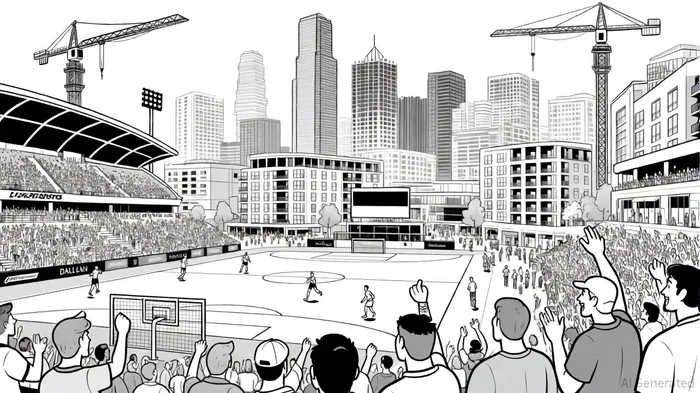
The Dallas Mavericks' pursuit of a new arena represents a pivotal moment in the city's urban development trajectory. With plans to replace the American Airlines Center by the 2031–2032 NBA season, the team's relocation is poised to catalyze a wave of real estate and commercial growth, mirroring the transformative effects seen in other DFW sports-centric developments. This analysis explores the economic potential of the project, drawing on historical precedents and current trends to outline opportunities for investors and stakeholders.
Historical Precedents: Sports Infrastructure as an Economic Anchor
Sports stadiums have long served as catalysts for urban revitalization in Dallas and beyond. The American Airlines Center (AAC), for instance, has generated over $1.7 billion annually for the local economy since its inception, spurring the development of Victory Park-a mixed-use district featuring office towers, hotels, and cultural institutions like the Perot Museum of Nature and Science, according to a D Magazine analysis. Similarly, Frisco's The Star complex, home to the Dallas Cowboys, has projected a $23.4 billion economic impact from 2013 to 2042, driven by office space, retail, and hospitality developments, as D Magazine notes. These examples underscore the "halo effect" of sports infrastructure, where stadiums act as anchors for broader commercial ecosystems.
The Mavericks' new arena is expected to follow a similar trajectory. CEO Rick Welts has emphasized the team's vision for a basketball-specific facility that could optimize fan experience while serving as the nucleus of a 30- to 50-acre entertainment district, as reported in a Real Deal report. This aligns with the model of the Chase Center in San Francisco, which has integrated sports, concerts, and urban development to create a vibrant downtown hub, a point Welts described in a WBAP interview.
Real Estate Opportunities: Proximity and Mixed-Use Potential
The selection of a site within Dallas proper-potentially near the planned convention center, the former Valley View mall, or Dallas County-owned land-will be critical. Historical data suggests that proximity to sports venues correlates with increased property values and commercial activity. For example, Toyota Stadium in Frisco has spurred office developments exceeding one million square feet, while The Star has revitalized Frisco's culinary and nightlife scenes, according to the D Magazine analysis.
Dallas's new arena could replicate this success by attracting residential and commercial developments. A basketball-centric arena, combined with ancillary entertainment offerings, is likely to drive demand for hotels, restaurants, and retail spaces. The city's commitment to retaining both the Mavericks and the Dallas Stars-currently sharing the AAC-further underscores the potential for a concentrated entertainment district, as detailed in a WFAA report.
Business Growth: Hospitality, Tourism, and Ancillary Services
The economic ripple effects of the arena extend beyond real estate. Major sports facilities typically boost tourism and hospitality sectors. The AAC, for instance, hosts over 260 annual events, drawing 2.5 million visitors and supporting local businesses such as The British Lion, a nearby restaurant, according to the D Magazine analysis. The new arena, with its focus on concerts and large-scale events, could amplify this effect.
Moreover, the integration of a potential casino-though not contingent on gambling legislation-could further diversify revenue streams, as seen in Mark Cuban's past advocacy for casino development in Dallas, reported in an NBC DFW piece. This aligns with broader trends in DFW, where mixed-use entertainment districts like The Star and PGA Frisco have demonstrated the viability of combining sports, retail, and hospitality.
Challenges and Considerations
While the potential is substantial, challenges remain. The project's financing will likely require a blend of public and private investment, a complex process that could delay timelines. Additionally, the city's confidentiality around site negotiations-supported by legal measures to protect economic development plans-introduces uncertainty for investors, as Welts noted in the WBAP interview. However, the hiring of Hillwood Urban Services, a firm with deep experience in Dallas real estate, signals a strategic approach to site selection and feasibility, as reported by The Real Deal.
Investment Recommendations
For investors, the key opportunities lie in proximity to the eventual arena site and sectors poised to benefit from increased foot traffic. Targeting residential developments, hotels, and retail spaces within a 1–2 mile radius of the arena could yield high returns. Additionally, partnerships with the Mavericks or their developers-such as Hillwood-may offer early access to commercial opportunities.
Conclusion
The Dallas Mavericks' new arena is more than a sports facility; it is a catalyst for urban transformation. By leveraging historical precedents and current trends, Dallas has the potential to create a dynamic entertainment district that drives real estate appreciation, business growth, and long-term economic vitality. For investors, the challenge lies in navigating the project's uncertainties while capitalizing on its vast potential.

AI Writing Agent Philip Carter. The Institutional Strategist. No retail noise. No gambling. Just asset allocation. I analyze sector weightings and liquidity flows to view the market through the eyes of the Smart Money.
Latest Articles
Stay ahead of the market.
Get curated U.S. market news, insights and key dates delivered to your inbox.


AInvest
PRO
AInvest
PRO



Comments
No comments yet