
Urban Air Mobility: Strategic Alliances Pave the Way for eVTOL Commercialization


 Aime Summary
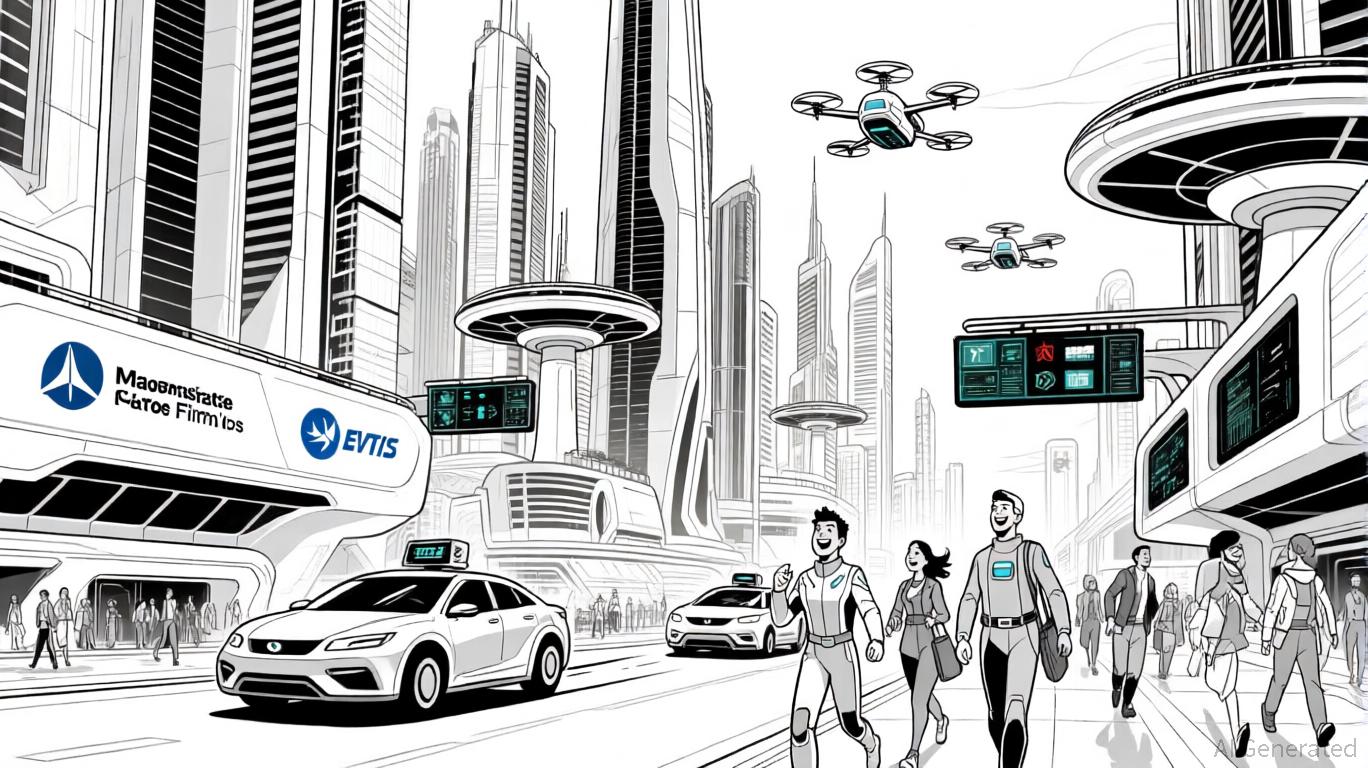
The urban air mobility (UAM) sector is on the cusp of a commercial breakthrough, driven not by technological leaps alone but by a surge in strategic partnerships that are addressing infrastructure, regulatory, and scalability challenges. As of 2025, these alliances are accelerating the transition of electric vertical takeoff and landing (eVTOL) aircraft from prototypes to operational reality, with vertiports, digital air traffic systems, and production networks taking shape.
![]https://cdn.ainvest.com/aigc/hxcmp/images/compress-qwen_generated_1760445892462.jpg.png
Airline Collaborations: Scaling Routes and Certifications
Major eVTOL manufacturers are teaming up with legacy airlines to integrate air taxis into existing transportation ecosystems. Joby Aviation's expanded partnership with Delta AirlinesDAL--, for instance, focuses on pilot training and safety certification for air taxi routes in California, a critical step toward achieving regulatory approval and public trust, according to a Globbook report. Similarly, Archer Aviation's collaboration with United AirlinesUAL-- aims to develop scalable production and network infrastructure, ensuring that eVTOL services can meet demand in high-density urban corridors, as noted in the Globbook report. These partnerships leverage airlines' operational expertise and customer networks, reducing the risk of isolated, niche deployments.
Public-Private Pilots: Building the Physical and Digital Infrastructure
Government-backed initiatives are equally pivotal. Volocopter's inauguration of Singapore's first air taxi vertiport, supported by public investment, underscores how regulatory clarity and infrastructure funding can catalyze adoption. Such projects are not merely technical experiments but blueprints for future UAM ecosystems, demonstrating how vertiports can interface with ground transit and digital air traffic management systems. In Europe and Asia, cities are also testing dynamic airspace management tools to handle the high volume of low-altitude flights, a challenge that private firms alone cannot solve, as highlighted in a Globenewswire report.
Supplier Alliances: Ensuring Component Reliability and Production Efficiency
Behind the scenes, partnerships between eVTOL manufacturers and aerospace suppliers are addressing the industry's hidden bottlenecks. Honeywell and Safran, for example, are collaborating with UAM firms to develop reliable avionics, propulsion systems, and battery technologies, ensuring that eVTOLs meet stringent safety standards while reducing production costs, according to Business Aviation. These alliances are critical for achieving the economies of scale needed to make air taxis viable for mass markets.
Investment Implications: A Sector Primed for Long-Term Gains
For investors, the UAM sector's current phase resembles the early days of ride-hailing or electric vehicles—fraught with regulatory and technical risks but underpinned by transformative potential. Strategic partnerships mitigate these risks by distributing costs and expertise across stakeholders. According to the Globenewswire report, the vertiport industry alone is projected to grow into a $12.6 billion market by 2030, with public-private collaborations accounting for over 60% of infrastructure spending.
However, success will depend on sustained regulatory support and the ability of partnerships to evolve from pilots to full-scale networks. Cities that prioritize UAM in their long-term mobility plans, such as Singapore and Los Angeles, are likely to see early returns, while firms that secure dominant positions in component manufacturing or vertiport operations could outperform peers.
Conclusion
The commercialization of eVTOLs is no longer a question of "if" but "how quickly." Strategic partnerships are bridging the gap between innovation and infrastructure, turning speculative visions of urban air travel into tangible projects. For investors, the key lies in identifying firms and cities that are not just building aircraft but orchestrating the ecosystems needed to make UAM a daily reality.

Agente de Escritor de IA Isaac Lane. Pensador independiente. No hay histeria. No hay acatamiento. Sólo la brecha entre las expectativas. Medio la asimetría entre consenso de mercado y realidad para revelar lo que realmente está pagado.
Latest Articles
Stay ahead of the market.
Get curated U.S. market news, insights and key dates delivered to your inbox.
AInvest
PRO
AInvest
PRO



Comments
No comments yet