
Uranium Remediation and Water Security in Colorado's Chimney Hollow Dam Project: A Convergence of Infrastructure and Sustainability
 Aime Summary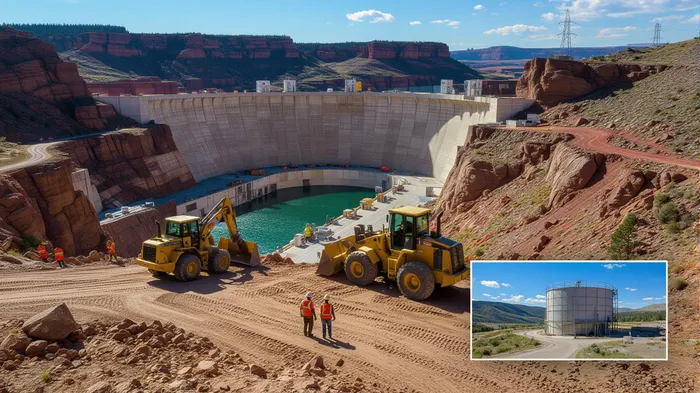
The Chimney Hollow Dam Project in Northern Colorado stands as a microcosm of the United States' evolving infrastructure priorities. As the second-tallest asphalt-core dam in the nation, it is not merely a feat of engineering but a test case for balancing water security, environmental stewardship, and energy transition. The project's recent challenges—specifically, uranium contamination from quarried granitic rock—highlight the complexities of modern infrastructure development. Yet, these challenges also reveal a broader trend: the convergence of infrastructure spending with sustainable resource management, creating fertile ground for investment in uranium remediation and water security.
The Chimney Hollow Dilemma: A Catalyst for Innovation
The discovery of uranium leaching into the reservoir's water supply has forced engineers and policymakers to rethink traditional approaches to water infrastructure. Northern Water, the agency overseeing the project, has proposed dilution strategies and on-site treatment facilities to mitigate risks. While these solutions are costly and time-consuming, they underscore a critical shift: infrastructure projects are no longer evaluated solely on their ability to deliver water but on their capacity to address environmental externalities. This paradigm shift aligns with the Inflation Reduction Act's (IRA) emphasis on clean energy and sustainability, which has spurred federal and state funding for projects that integrate environmental remediation.
The uranium issue also reflects a structural imbalance in the global uranium market. With U.S. uranium production at a historic low (0.6–0.7 million pounds of U₃O₈ in 2024) and global demand rising due to nuclear energy's role in decarbonization, the need for domestic uranium remediation and production is acute. The Chimney Hollow project's reliance on imported uranium-free materials or treatment technologies could become a model for future infrastructure, where environmental compliance is baked into the planning phase.
Uranium Remediation: A Growing Investment Theme
The uranium remediation sector is gaining traction as a strategic asset class, driven by both supply-side constraints and demand-side tailwinds. Uranium EnergyUEC-- Corp (UEC) has emerged as a key player, leveraging its Sweetwater Uranium Complex in Wyoming to produce low-impact uranium via In-Situ Recovery (ISR) methods. UEC's recent acquisition of Rio Tinto's assets and its designation as a “transparency project” under executive orders have accelerated its production timeline, positioning it to meet U.S. demand while adhering to stringent environmental standards.
Investors seeking exposure to uranium remediation can consider equities like UEC, which has surged 114% over the past year, or ETFs such as the Global X Uranium ETF (URA) and Sprott Uranium Miners ETF (URNM). These funds provide diversified access to uranium producers and explorers, including CamecoCCJ-- and NexGen EnergyNXE--. Physical uranium investments, such as the Sprott Physical Uranium Trust (U.U), which holds 66.22 million pounds of U₃O₈, offer direct exposure to price movements.
Water Security: The Infrastructure of the Future
The Chimney Hollow Dam is part of a $667.8 million investment in water infrastructure, supported by a $155 million state-backed loan under House Bill 1435. This funding model—combining public and private capital—reflects a broader trend in U.S. infrastructure spending, where water projects are increasingly prioritized to address scarcity and climate resilience. The dam's role in securing water for 800,000 residents on the Front Range underscores the economic imperative of water infrastructure, particularly as Northern Colorado's population is projected to double in two decades.
Water security ETFs, such as the Invesco Water Resources ETF (PHO) and First Trust Water ETF (FIW), offer exposure to companies involved in water utilities, purification, and smart metering technologies. These funds have outperformed broader equity benchmarks over the past five years, with PHO delivering 12.56% annualized returns. ESG-focused options like the Ecofin Global Water ESG Fund (EBLU) and Global X Clean Water ETF (AQWA) cater to investors prioritizing sustainability, with EBLU's 79.45 ESG score reflecting its alignment with water stewardship goals.
The Synergy of Energy and Water Infrastructure
The Chimney Hollow project also intersects with the energy transition. As data centers and AI infrastructure drive electricity demand, nuclear energy is emerging as a critical baseload power source. The recent partnership between AmazonAMZN-- and Talen EnergyTLN-- to supply 1,920 MW of nuclear power to AWS exemplifies this trend. Uranium's role in this ecosystem is twofold: it powers the reactors that supply clean energy and is itself a commodity whose remediation and production require advanced infrastructure.
Investors should consider a dual strategy: pairing uranium equities with water infrastructure ETFs to capitalize on the interdependence of these sectors. For instance, UEC's uranium production could feed into nuclear plants that power desalination facilities or water treatment plants, creating a closed-loop system of resource management.
Actionable Investment Themes
- Uranium Remediation and Production: Invest in UEC and uranium ETFs like URA and URNM, which benefit from IRA tax credits and rising demand for nuclear energy.
- Water Infrastructure Modernization: Allocate to PHO and FIW to capture growth in water utilities and smart technologies.
- ESG-Integrated Water Funds: Consider EBLU and AQWA for exposure to sustainable water solutions.
- Physical Uranium Holdings: Diversify with Sprott Physical Uranium Trust (U.U) to hedge against price volatility.
The Chimney Hollow Dam Project is a harbinger of a new era in infrastructure, where environmental remediation and water security are inseparable from economic development. As the U.S. continues to invest in its infrastructure, the convergence of uranium remediation and water management will present compelling opportunities for investors who recognize the value of sustainability in the 21st century.

Delivering real-time insights and analysis on emerging financial trends and market movements.
Latest Articles
Stay ahead of the market.
Get curated U.S. market news, insights and key dates delivered to your inbox.
AInvest
PRO
AInvest
PRO



Comments
No comments yet