
UPS's Strategic Shift in Global Logistics and E-commerce: Why the Company's Operational Rebalancing Makes It a Strong Buy Ahead of July 29
 Aime Summary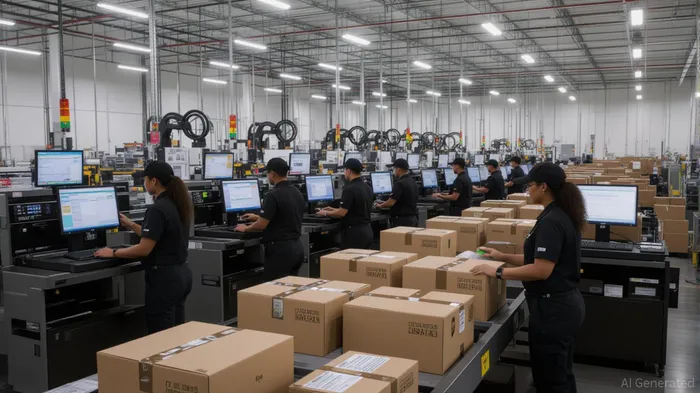
In the ever-evolving landscape of global logistics, United Parcel ServiceUPS-- (UPS) has emerged as a masterclass in strategic reinvention. As the July 29, 2025, Q2 earnings report approaches, the company's recent operational overhauls and market diversification efforts have positioned it as a compelling long-term investment. This article dissects UPS's transformative moves, evaluates the financial implications, and argues why investors should consider this logistics giant ahead of its next earnings catalyst.
Operational Overhaul: Cutting Costs, Boosting Margins
UPS's “Network Reconfiguration and Efficiency Reimagined” initiative has been a cornerstone of its 2025 strategy. By shuttering 73 underperforming facilities and automating 400 others, the company is projected to achieve $3.5 billion in annualized savings by 2026. These cuts are not merely defensive—they are a calculated response to the shifting e-commerce landscape. For instance, the 50% reduction in AmazonAMZN-- shipping volume by 2026, while painful in the short term, is a deliberate pivot away from low-margin contracts. The results are already visible: Q2 2025 operating margins expanded to 8.2%, up from 7.9% in 2024.
The introduction of the “Ground Saver Service” further underscores this shift. Targeted at small and medium-sized businesses (SMBs), this cost-effective solution now accounts for 31.2% of U.S. volume. By catering to a segment less sensitive to price volatility, UPSUPS-- is building a more resilient revenue stream. Meanwhile, the integration of RFID and data analytics in last-mile delivery is slashing fuel costs and reducing delivery times—a critical edge in a sector where speed and efficiency are paramountPARA--.
Market Diversification: Healthcare Logistics as a New Growth Engine
UPS's acquisition of Andlauer Healthcare in 2025 marks a strategic pivot into the high-margin healthcare logistics sector. This move is not just about diversification—it's about capturing a market segment with predictable demand and high service premiums. The company aims to double healthcare revenue to $20 billion by 2026, leveraging its global network to handle time-sensitive pharmaceutical deliveries.
This expansion is a hedge against the cyclical nature of e-commerce and retail. While e-commerce growth has slowed in the U.S. due to trade policy shifts (e.g., the end of the de minimis tax exemption for Chinese parcels), Southeast Asia's e-commerce air cargo demand grew 3.1% in May 2025. UPS's pivot to this region—where capacity expanded 3.5% year-over-year—positions it to benefit from global supply chain diversification trends.
Financial Discipline: Balancing Dividend Payouts and Reinvestment
UPS's capital allocation strategy has been a double-edged sword. While the company maintains a generous dividend yield of 6.6%, its Q1 2025 payout ratio hit a concerning 1.10, signaling overreliance on short-term earnings. However, the 0.6% quarterly dividend increase to $1.64 per share in May 2025 reflects a measured approach to preserving shareholder value. Analysts are split: some argue a dividend cut could free capital for innovation, while others fear a blow to investor confidence.
The key lies in UPS's ability to execute its cost-savings initiatives and healthcare expansion. With $3.5 billion in annualized savings by 2026, the company has room to reinvest in high-growth areas without jeopardizing its dividend. The current forward P/E of 12.48, well below its 5-year average of 15.3, further suggests the stock is undervalued relative to its growth prospects.
Earnings Report: A Catalyst for Re-rating
The July 29 Q2 earnings report will be a pivotal moment. Analysts project EPS of $1.56, up 4.2% from Q1, with revenue expected to hit $21.5 billion. If UPS meets or exceeds these estimates, it could trigger a re-rating of the stock, particularly as the market digests its progress on cost savings and healthcare growth. CEO Carol Tomé and CFO Brian Dykes will need to articulate a clear path for sustaining margin expansion and navigating trade policy uncertainties.
The broader market context also favors UPS. As global trade tensions ease and supply chains stabilize, the company's diversified business model—spanning domestic, international, and healthcare logistics—positions it to outperform peers. The recent outperformance of logistics stocks like FedExFDX-- and DHL in Q1 2025 further validates the sector's growth potential.
Investment Thesis: Strong Buy with Caution
While UPS's dividend yield is attractive, investors must weigh this against the company's strategic reinvestment needs. The “Moderate Buy” analyst rating and $114.36 mean price target (9.5% upside) reflect cautious optimism. However, the potential for a dividend cut—a move that could free up capital for innovation—should not be dismissed as a negative. In fact, such a cut could signal a long-term commitment to margin expansion and shareholder value.
For risk-tolerant investors, UPS's strategic shifts and upcoming earnings report present a compelling opportunity. The company's ability to execute on its cost-cutting and diversification plans will determine its success in the evolving logistics landscape. With a forward P/E below industry averages and a clear path to margin improvement, UPS is well-positioned to deliver alpha, especially if its Q2 results exceed expectations.
Conclusion: Timing the Market Rebalancing
UPS's strategic rebalancing—driven by cost optimization, healthcare expansion, and Southeast Asia's e-commerce growth—has created a unique inflection point. While the company faces challenges, including trade uncertainties and dividend sustainability, its operational execution and disciplined capital allocation make it a strong buy ahead of July 29. Investors who act now could capitalize on a potential earnings-driven re-rating, particularly if the company reaffirms its margin-expansion trajectory.
In a sector where agility and innovation define success, UPS's transformation is not just a defensive play—it's a blueprint for outperforming in a post-pandemic world.

Delivering real-time insights and analysis on emerging financial trends and market movements.
Latest Articles
Stay ahead of the market.
Get curated U.S. market news, insights and key dates delivered to your inbox.
AInvest
PRO
AInvest
PRO



Comments
No comments yet