
UPS's Strategic Rebalancing: A Blueprint for Post-Pandemic Supply Chain Dominance
 Aime Summary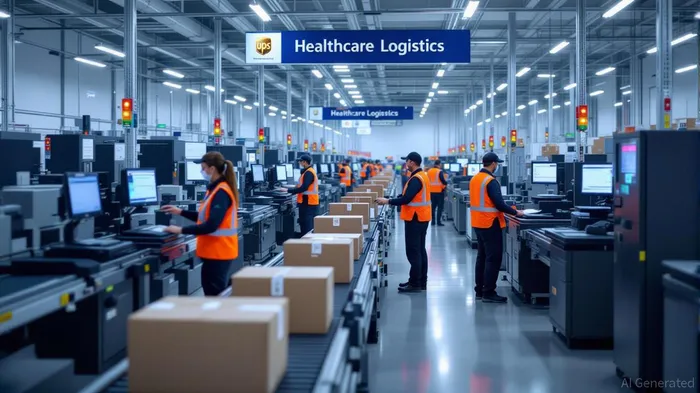
The post-pandemic era has forced global supply chains to confront a new reality: fragility. For companies like UPSUPS--, the challenge is not merely surviving but redefining their role in an increasingly fragmented and innovation-driven world. The package delivery giant's recent strategic pivot—from cost-cutting to high-margin diversification—offers a compelling case study in operational rebalancing and long-term positioning. As the July 29 Q2 earnings report looms, investors must assess whether UPS's moves signal a sustainable transformation or a temporary recalibration.
Operational Rebalancing: The Art of Precision Pruning
UPS's "Network Reconfiguration and Efficiency Reimagined" initiative is a masterclass in disciplined cost optimization. By closing 73 underperforming facilities and automating 400 others, the company has slashed $3.5 billion in annualized costs by 2026. This is not just a defensive move; it is a strategic unshackling from low-margin contracts, particularly with AmazonAMZN--, which is expected to see a 50% decline in shipping volume by 2026. The operating margin expansion—from 7.9% in 2024 to 8.2% in Q2 2025—demonstrates the power of precision pruning.
Yet, cost-cutting alone is insufficient. UPS has reinvested savings into high-growth areas, such as healthcare logistics. The 2025 acquisition of the Andlauer Healthcare Group—a European leader in pharmaceutical delivery—positions UPS to capitalize on the $20 billion global healthcare logistics market. This sector's resilience against economic cycles, combined with UPS's global network, creates a moat that transcends the volatility of e-commerce.
Geographic and Sectoral Diversification: Beyond the E-Commerce Bubble
While U.S. e-commerce growth has plateaued—exacerbated by the end of the de minimis tax exemption for Chinese parcels—UPS is pivoting to Southeast Asia, where e-commerce air cargo demand grew 3.1% in May 2025. This shift aligns with global supply chain diversification trends, as companies seek to reduce overreliance on China. By expanding its footprint in Vietnam, Indonesia, and Thailand, UPS is not just chasing growth; it is future-proofing against geopolitical shocks.
Simultaneously, the launch of the "Ground Saver Service" has allowed UPS to capture 31.2% of U.S. volume by catering to small and medium-sized businesses (SMBs). These clients, less sensitive to price volatility, provide a stable revenue base as macroeconomic uncertainty persists.
Technological Innovation: The New Fuel for Efficiency
UPS's integration of RFID and data analytics in last-mile delivery is reducing fuel costs and improving delivery times—a critical edge in a sector where speed and precision are non-negotiable. The company's investment in AI-driven route optimization and real-time inventory tracking is not just incremental improvement; it is a fundamental reimagining of supply chain economics.
Financial Discipline and Shareholder Value: A Delicate Balancing Act
UPS's dividend yield of 6.6% remains a draw for income-focused investors, but the Q1 2025 payout ratio of 1.10 raises concerns about overreliance on short-term earnings. The company's 0.6% quarterly dividend increase to $1.64 per share in May 2025 suggests a cautious approach, but analysts debate whether a temporary cut could free capital for innovation. For now, UPS's disciplined capital allocation—reinvesting in automation, healthcare, and Southeast Asia—provides a buffer against near-term volatility.
The July 29 Earnings Report: A Make-or-Break Moment
The upcoming Q2 earnings report will be a litmus test. Analysts project EPS of $1.56 (a 4.2% rise from Q1) and revenue of $21.5 billion. If UPS exceeds these estimates, it could trigger a re-rating of its stock, particularly as the market digests its progress on margin expansion and healthcare growth. CEO Carol Tomé and CFO Brian Dykes must clearly articulate a path to sustain this momentum amid trade policy uncertainties and inflationary pressures.
Investment Implications: A Strong Buy with Caveats
UPS's strategic rebalancing—cost optimization, healthcare expansion, and Southeast Asia's e-commerce growth—positions it as a rare inflection point in the logistics sector. While risks persist (dividend sustainability, trade wars), the company's operational execution and innovation make it a strong buy ahead of July 29. Investors who act now could capitalize on a potential earnings-driven re-rating, especially if the company reaffirms its margin-expansion trajectory.
In a post-pandemic world where agility defines success, UPS's transformation is not just a defensive play—it's a blueprint for outperforming. For those seeking a blend of stability and growth, UPS's stock offers a compelling case: a company that has mastered the art of reinvention.

Delivering real-time insights and analysis on emerging financial trends and market movements.
Latest Articles
Stay ahead of the market.
Get curated U.S. market news, insights and key dates delivered to your inbox.
AInvest
PRO
AInvest
PRO



Comments
No comments yet