
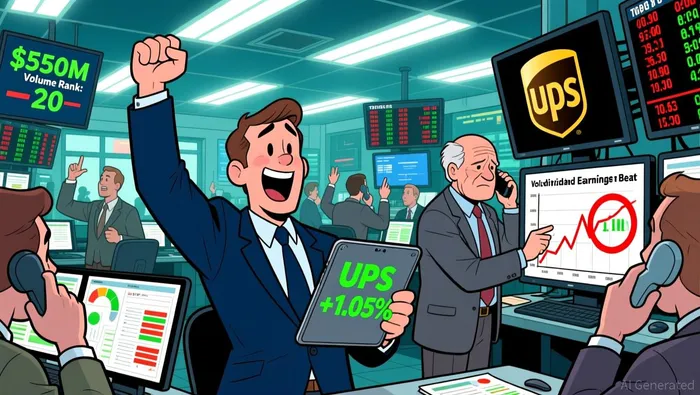
UPS Shares Rally 1.05% as $550M Volume Ranks 201st on November 25 Amid Earnings Beat and Unstable Dividend Payout Ratio
 Aime Summary
Market Snapshot
On November 25, 2025, , outperforming the broader market. , ranking 201st in trading activity for the day. Despite the positive momentum, , indicating mixed investor sentiment. , , reflecting its position as a mid-to-large-cap transportation stock with moderate volatility.
Key Drivers
Earnings and Revenue Performance
UPS’s recent quarterly earnings report, released on October 28, 2025, , . While this demonstrated strong short-term profitability, , raising concerns about long-term growth. , . Analysts attributed the revenue dip to macroeconomic headwinds and pricing pressures in its U.S. Domestic Package segment, which accounts for the bulk of its operations.
Dividend Policy and Payout Sustainability
, . However, . This high ratio, calculated by dividing dividends by net income, indicated that the company is distributing more in dividends than it earns, potentially straining financial flexibility. Institutional investors, including and Mufg Securities Americas, adjusted their holdings in the quarter, with some trimming stakes while others increased exposure. The dividend’s allure may have attracted income-focused investors, but the payout ratio’s unsustainability could deter long-term holders.
Analyst Sentiment and Price Target Volatility
Analyst coverage of UPSUPS-- reflected a divided outlook. , . Conversely, Morgan Stanley and JPMorgan cut their targets, . This divergence highlighted uncertainty about UPS’s ability to navigate sector-specific risks, such as rising fuel costs and labor expenses. Deutsche Bank and Barclays also downgraded their positions, citing valuation concerns and macroeconomic risks. The mixed analyst sentiment created a tug-of-war in investor confidence, with bullish calls focusing on dividend yields and bearish ones emphasizing financial overextension.
Institutional Investor Activity and Strategic Shifts
Institutional ownership data revealed shifting priorities among major investors. Rhumbline Advisers reduced its stake by 1.0% in Q2, while AlphaCore Capital and significantly increased their holdings. These movements signaled a mix of caution and optimism, with some investors betting on UPS’s dividend resilience and others hedging against potential volatility. The firm’s debt-to-equity ratio of 1.50 also drew scrutiny, as analysts debated its capacity to service debt while maintaining dividend payouts. The recent Q4 2025 guidance, , added a layer of uncertainty, as the company’s ability to meet these expectations will depend on its cost management and operational efficiency.
Market Position and Sector Dynamics
UPS’s role as a global logistics leader remains pivotal, but its stock performance is increasingly influenced by sector-specific challenges. The logistics industry faces headwinds from inflation-driven cost inflation and evolving consumer expectations for faster delivery times. While UPS’s U.S. Domestic Package segment benefits from e-commerce growth, its International Package division struggles with geopolitical risks and currency fluctuations. , . However, the combination of high leverage and aggressive dividend payouts may limit its ability to reinvest in growth opportunities, such as last-mile delivery innovations or international expansion.
Conclusion
The interplay of earnings strength, dividend policy, analyst divergence, and institutional activity has created a complex narrative for UPS. While its short-term earnings beat and high yield attract income-focused investors, long-term concerns about revenue growth, payout sustainability, and sector risks persist. The company’s ability to balance dividend commitments with strategic investments will be critical in determining its trajectory. Investors are advised to monitor upcoming earnings reports, analyst revisions, and institutional trading patterns for further clues about UPS’s near-term direction.

Stay ahead of the market.
Get curated U.S. market news, insights and key dates delivered to your inbox.
AInvest
PRO
AInvest
PRO



Comments
No comments yet