
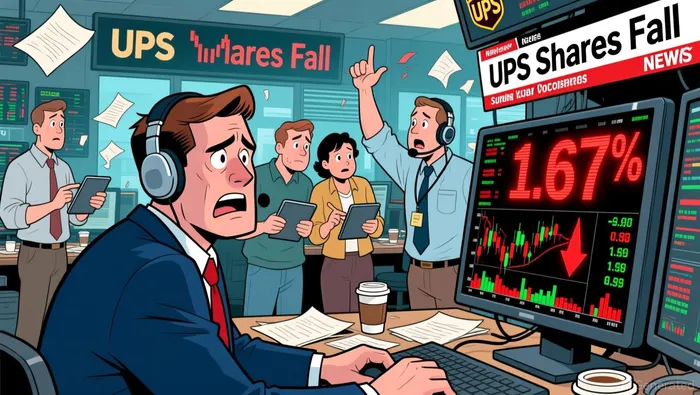
UPS Shares Fall 1.67% as 31.17% Volume Surge Ranks 169th
 Aime Summary
Market Snapshot
United Parcel Service (UPS) closed 2025-11-20 with a 1.67% decline, extending its underperformance despite strong quarterly earnings. The stock’s trading volume surged 31.17% to $680 million, ranking it 169th in the market. While UPSUPS-- exceeded estimates with $1.74 earnings per share (EPS) and $21.42 billion in revenue (down 3.7% year-over-year), the price drop suggests mixed investor sentiment. The stock opened at $92.95, and its 50-day and 200-day moving averages stood at $88.28 and $92.84, respectively, indicating a slight pullback from its recent averages.
Key Drivers Behind UPS's Recent Performance
Earnings Outperformance and Revenue Challenges
UPS reported Q3 2025 earnings of $1.74 per share, surpassing the $1.31 consensus by $0.43. This outperformance was driven by a 40.07% return on equity and a 6.15% net margin. However, revenue fell 3.7% year-over-year to $21.42 billion, reflecting ongoing macroeconomic headwinds in global logistics. Analysts note that while the EPS beat signals operational efficiency, the revenue decline highlights persistent challenges in the U.S. and international markets, particularly in lower-margin segments.
Dividend Sustainability Concerns
The company’s recent dividend announcement—$1.64 per share, annualized at $6.56 (7.1% yield)—has drawn attention due to its high payout ratio of 101.39%. This implies the dividend is not fully covered by earnings, raising sustainability concerns for income-focused investors. While the yield is attractive in a high-interest-rate environment, the payout ratio’s proximity to 100% suggests reliance on leverage or operational efficiency to maintain the dividend. This could pressure the stock if earnings volatility or capital expenditures disrupt cash flow.
Institutional Buying and Ownership Structure
Institutional confidence in UPS has remained robust, with Vanguard Group Inc. increasing its stake by 1.2% in Q2 to 66.9 million shares (7.90% ownership). Other large investors, including State Street Corp., Charles Schwab, and Goldman Sachs, also boosted holdings, reflecting institutional conviction in the company’s long-term value. However, institutional ownership now accounts for 60.26% of the float, which could amplify price volatility in response to portfolio rebalancing or market-wide shifts.
Analyst Sentiment and Valuation Metrics
Wall Street analysts remain divided, with a consensus “Hold” rating and an average price target of $110.00. The stock’s price-to-earnings ratio of 14.37 and PEG ratio of 2.29 suggest it is trading at a premium to its earnings growth, which may deter value investors. Notable downgrades include Barclays and Morgan Stanley, who reduced price targets due to macroeconomic uncertainty, while Stifel Nicolaus and Vertical Research maintained “Buy” and “Hold” ratings, citing long-term logistics demand. The mixed sentiment reflects uncertainty about UPS’s ability to sustain earnings growth amid inflation and supply chain normalization.
Strategic Developments and Market Position
UPS’s partnership with BETA Technologies Inc. to develop autonomous aircraft for military and logistics applications adds a speculative growth angle. This collaboration aligns with UPS’s broader strategy to modernize its delivery infrastructure, particularly in defense and commercial cargo markets. While the initiative is in early testing phases, it could diversify UPS’s revenue streams and enhance its competitive edge in the logistics sector. However, execution risks and regulatory hurdles remain significant barriers to near-term profitability.
Insider Activity and Governance
Director Christiana Smith Shi’s recent purchase of 500 shares at $88.17 apiece ($44,085 total) signals cautious optimism from leadership. However, insider ownership remains minimal at 0.13%, limiting the impact of individual transactions on broader market sentiment. The absence of major insider sales contrasts with Rep. Scott DesJarlais’s recent sell-off of UPS shares, though the latter’s political ties and investment rationale are not disclosed in the data.
This analysis synthesizes UPS’s recent performance with institutional and analyst dynamics, highlighting both near-term risks (dividend sustainability, revenue challenges) and long-term opportunities (strategic innovation). The stock’s trajectory will likely hinge on its ability to balance operational efficiency with capital allocation discipline in a volatile macroeconomic landscape.

Encuentren esos activos que tengan un volumen de transacciones explosivo.
Latest Articles
Stay ahead of the market.
Get curated U.S. market news, insights and key dates delivered to your inbox.
AInvest
PRO
AInvest
PRO



Comments
No comments yet