
Upbound Group’s $0.39 Cash Dividend: Market Impact and Recovery Outlook for Dec. 17 Ex-Dividend Date
 Aime Summary
Introduction
Upbound Group (ticker: UPBD) has maintained a consistent dividend policy, offering investors a reliable income stream with its latest quarterly cash dividend of $0.39 per share. This ex-dividend date, set for December 17, 2025, marks another opportunity for shareholders to evaluate the company’s dividend yield in the context of its financial health and broader market conditions. With a trailing twelve-month (TTM) earnings per share (EPS) of $6.76 (four quarters of $1.69), Upbound GroupUPBD-- appears to maintain a sustainable payout relative to industry benchmarks, though its cash flow and expense structure suggest a measured approach to capital distribution.
Market conditions leading up to the ex-dividend date remain stable, with low volatility and moderate investor optimism reflected in the broader equity indices. Upbound Group’s stock has historically shown a short-term price adjustment on ex-dividend dates, followed by a moderate recovery trend, as evidenced by historical backtest data.
Dividend Overview and Context
A cash dividend of $0.39 per share is a material payout for Upbound Group, particularly given the company’s financial performance over the most recent quarter. The ex-dividend date of December 17, 2025, means that investors must be registered as shareholders by the close of business on December 16 to receive the dividend. On the ex-dividend date, the stock price typically adjusts downward by roughly the amount of the dividend, as the company’s value is restated post-dividend.
This adjustment can present short-term trading opportunities for investors who understand the mechanics and historical tendencies of the stock. The key to interpreting this event lies in Upbound Group’s earnings, expenses, and its ability to maintain a consistent payout while managing its operating costs.
Backtest Analysis
The backtest results for Upbound Group’s dividend events provide valuable insights for investors. Conducted over multiple dividend cycles using historical price data, the analysis assumes a simple strategy: holding the stock through the ex-dividend date and observing the price behavior in the subsequent weeks.
Key findings from the backtest include:
- Average Recovery Time: The stock typically recovers from the ex-dividend price dip in an average of 2.86 days.
- Recovery Probability: There is a 58% probability that the stock will recover its pre-dividend price within 15 days.
- Short-Term Volatility: The backtest highlights that while a dip is common, it is generally not indicative of long-term weakness.
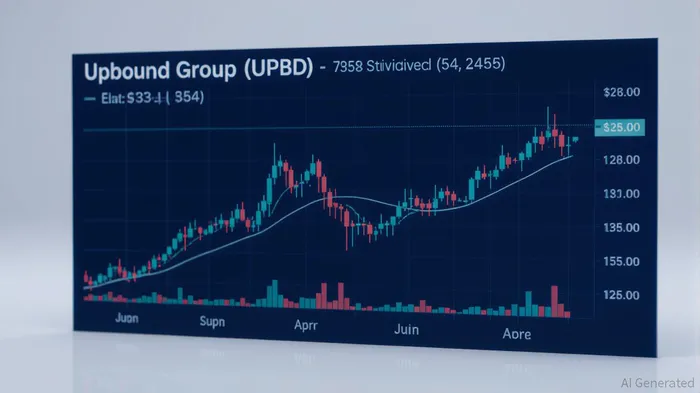
These results suggest that while the ex-dividend date may trigger a minor short-term price correction, the stock often rebounds quickly. Investors should remain mindful of this pattern when planning their trades or managing their portfolios.
Driver Analysis and Implications
Upbound Group’s latest financial report indicates strong operating performance, with total revenue of $3.24 billion and operating income of $129.77 million. However, total operating expenses of $1.44 billion, including $733.77 million in marketing, selling, and general administrative costs, highlight the company’s significant cost base.
The net income of $92.496 million, or $1.69 per share on a basic EPS basis, supports the recent cash dividend but also underscores the need for disciplined cost management. The company’s net interest expense of $82.71 million reflects ongoing debt obligations, which could impact future payout sustainability if interest rates rise.
Macro-level factors such as interest rate trends and economic inflation are also relevant. In a low-rate environment, dividend yields remain attractive, but a shift toward higher rates could pressure high-dividend stocks. Investors should monitor macroeconomic signals for potential shifts in Upbound Group’s cost of capital and future dividend capacity.
Investment Strategies and Recommendations
For investors interested in dividend capture or portfolio income:
- Short-Term Traders: Consider entering positions before the ex-dividend date and exiting shortly after to capture the dividend and potential price rebound. The backtest suggests a high likelihood of a quick recovery, making this strategy viable for active traders.
- Long-Term Holders: Investors should view Upbound Group’s dividend as a sign of financial stability and a commitment to shareholder returns. As long as the company maintains its earnings momentum and manages costs effectively, the dividend is likely to remain sustainable.
It is important for investors to assess their personal risk tolerance and time horizon when deciding on the appropriate strategy for this ex-dividend event.
Conclusion & Outlook
The ex-dividend date of December 17, 2025, represents a key point in the investment cycle for Upbound Group. With a $0.39 cash dividend and a historically resilient post-dividend price trend, the company presents both opportunity and caution for investors. The strong earnings and manageable cost structure support the sustainability of the payout, while macroeconomic factors remain watchpoints.
Upcoming events to monitor include Upbound Group’s next earnings report and any future dividend announcements. Investors should stay informed as the company’s performance in the coming quarters may influence both its financial strategy and market perception.

Stay ahead of the market.
Get curated U.S. market news, insights and key dates delivered to your inbox.
AInvest
PRO
AInvest
PRO



Comments
No comments yet