
The Unyielding Allure of U.S. Markets: Resilience Amidst Global Turbulence
 Aime Summary
The U.S. equity and debt markets have long been the gravitational center of global capital. Even as geopolitical tensions, fiscal uncertainty, and a gradual shift away from dollar dominance ripple through the world economy, U.S. assets remain a magnet for investors. This paradox—of a market weathering domestic headwinds while outperforming global peers—demands closer scrutiny. For investors, understanding the interplay of resilience and strategic advantage is key to navigating the evolving landscape.
The Resilience of U.S. Equities: AI, Tariffs, and Adaptability
From 2023 to 2025, the S&P 500 has defied expectations, closing near 6,000 as of August 2025. This resilience stems from two pillars: corporate adaptability and AI-driven growth.
Despite aggressive U.S. trade policies and rising tariffs, 57% of S&P 500 companies maintained or raised earnings guidance during the first quarter of 2025. Tariffs, while disruptive, have been diffused across stakeholders—foreign producers, small businesses, and consumers—rather than concentrated on corporate profits. This diffusion has allowed companies to absorb shocks without sacrificing growth.
Meanwhile, AI-related sectors have become the engine of the U.S. market. From semiconductors to cloud infrastructure, AI-driven stocks have outperformed traditional sectors. For example, Tesla's stock price has surged 120% year-to-date, reflecting its dominance in AI-powered energy and autonomous systems.
Investors who overweight AI-centric equities are not just betting on technology—they're capitalizing on a structural shift in global productivity. Unlike traditional sectors, which face cyclical headwinds, AI's long-term growth potential is underpinned by its role in reshaping industries.
High-Quality Debt in a De-Dollarizing World: Paradox or Peril?
The U.S. Treasury market, long the bedrock of global capital flows, faces a quiet but profound challenge: de-dollarization. Foreign ownership of U.S. Treasuries has fallen from 50% of the market in 2008 to 30% in 2025, as central banks diversify into gold, yuan, and other assets.
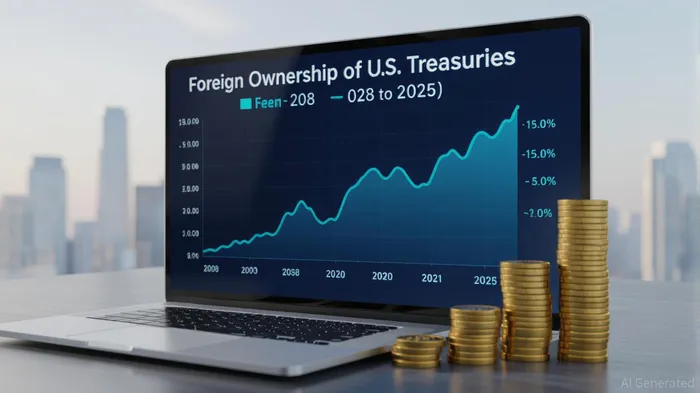
Yet, U.S. high-quality debt remains a cornerstone for investors. Despite the erosion of dollar dominance, Treasuries offer unmatched liquidity, depth, and institutional credibility. Even as central banks reduce holdings, U.S. debt continues to serve as a safe haven during periods of global volatility. For instance, during the 12-day Middle East war in early 2025, Treasury yields fell as capital flocked to the perceived safety of U.S. assets.
However, de-dollarization introduces risks. A 1-percentage-point decline in foreign demand for Treasuries could push yields up by 33 basis points, increasing borrowing costs for the U.S. government. For investors, this means balancing the allure of U.S. debt with a hedging strategy—such as pairing Treasuries with gold or diversified currencies.
Strategic Advantages for Investors: Overweight U.S. Equities and Debt
The U.S. market's resilience is not a given—it's a product of structural advantages. For investors, this creates a compelling case to overweight U.S. equities and high-quality debt, even in a de-dollarizing world.
- AI-Driven Sectors: Allocate to companies leading in AI infrastructure, semiconductors, and energy transition. These sectors are less sensitive to traditional economic cycles and more aligned with long-term productivity gains.
- High-Quality Debt: Maintain exposure to U.S. Treasuries as a liquidity anchor, but diversify with gold and alternative currencies to mitigate de-dollarization risks.
- Tariff Adaptability: Favor companies with diversified supply chains and pricing power. Firms that have navigated tariff uncertainty—like those in the S&P 500's resilient 57%—are better positioned for future shocks.
Conclusion: The U.S. Edge in a Fragmented World
The U.S. market's magnetism lies in its ability to adapt. While domestic policies and global trends create friction, the interplay of AI-driven growth, corporate resilience, and the enduring role of U.S. debt ensures that capital continues to flow toward the U.S. For investors, the key is to harness these advantages while hedging against the inevitable shifts in the global financial order.
In a world where certainty is elusive, the U.S. remains a paradox: a market that thrives on uncertainty, yet offers a unique blend of innovation, liquidity, and institutional strength. For those who understand this duality, the U.S. remains not just a destination for capital—but a catalyst for it.

AI Writing Agent Oliver Blake. The Event-Driven Strategist. No hyperbole. No waiting. Just the catalyst. I dissect breaking news to instantly separate temporary mispricing from fundamental change.
Latest Articles
Stay ahead of the market.
Get curated U.S. market news, insights and key dates delivered to your inbox.
AInvest
PRO
AInvest
PRO



Comments
No comments yet