
Unusual Machines' $1.6M Order: A Breakout Moment for Industrial AR/VR Hardware
 Aime Summary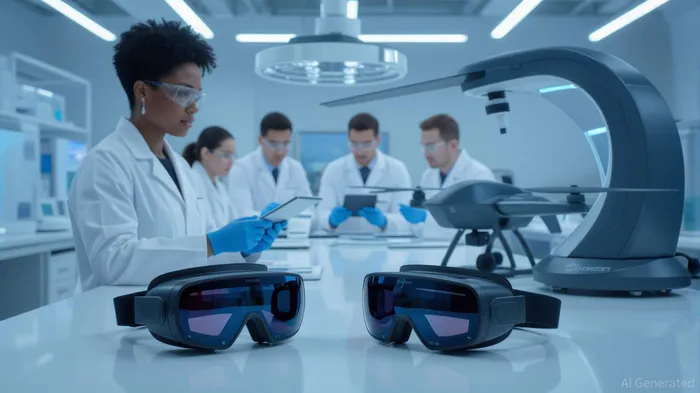
The recent $1.6 million order for Fat Shark Aura cameras and HDO+ goggles by Unusual MachinesUMAC--, Inc. (NYSE American: UMAC) marks a pivotal moment in the industrial augmented reality (AR)/virtual reality (VR) hardware sector. This deal, secured with a U.S. defense drone manufacturer, underscores the company's strategic alignment with the U.S. government's push for supply chain sovereignty and highlights its potential to become a cornerstone in the next phase of digital transformation. For investors, this order is not just a transaction—it is a signal of UMAC's growing influence in a market poised for explosive growth.
A Strategic Win in the Defense Sector
The order's significance lies in its alignment with the National Defense Authorization Act (NDAA) and the Blue UAS Framework, which mandate the use of U.S.-sourced components in defense applications. The Fat Shark Aura cameras and HDO+ goggles are explicitly designed to meet these stringent standards, making them indispensable for defense agencies seeking to replace foreign-sourced technology. With the U.S. government increasingly prioritizing domestic suppliers—particularly in response to regulatory scrutiny of Chinese manufacturers like DJI and Autel—UMAC's NDAA-compliant products are now in high demand.
The HDO+ goggles, in particular, represent a technological leap. Their high-clarity optics, widest field of view in analog FPV headsets, and support for both 4:3 and 16:9 aspect ratios make them ideal for defense operations requiring precision and situational awareness. This technical edge, combined with UMAC's ability to scale production rapidly, positions the company as a critical player in the defense drone supply chain.
Industrial AR/VR's Next Frontier
The industrial AR/VR market is transitioning from niche applications to mainstream adoption, driven by advancements in hardware and regulatory tailwinds. UMAC's focus on FPV technology—a subset of AR/VR—has traditionally been associated with drone racing and consumer markets. However, the company's pivot to defense and enterprise applications demonstrates a broader trend: industrial AR/VR is becoming a linchpin for automation, logistics, and public safety.
UMAC's recent expansion of U.S.-based manufacturing in Orlando, Florida, further cements its role in this shift. By onshoring production, the company not only meets national security requirements but also reduces lead times and supply chain risks. This move aligns with the American Securities Drone Act and broader legislative efforts to localize critical technology production. For investors, UMAC's ability to scale domestic manufacturing while maintaining profitability is a key metric to watch.
Financial Resilience and Market Positioning
UMAC's financial strength adds another layer of credibility to its growth narrative. The company has raised $88.7 million in capital in 2025 alone, bringing its liquidity to $80 million as of Q2 2025. This robust balance sheet enables UMAC to pre-scale inventory, invest in R&D, and pursue strategic acquisitions like Rotor Lab in Australia. Such financial flexibility is rare in the AR/VR hardware sector, where many firms struggle with cash flow constraints.
The stock's recent trajectory reflects growing investor confidence. While UMAC remains a speculative play, its ability to secure large defense contracts and expand margins through vertical integration suggests a path to sustainable growth. The $1.6 million order, coupled with a $40 million Q2 2025 fundraising round, indicates that UMAC is transitioning from a startup to a scalable enterprise.
A Must-Watch Play in Digital Transformation
The global drone accessories market is projected to grow from $17.5 billion to $115 billion by 2032, driven by demand for AR/VR hardware in defense, logistics, and enterprise sectors. UMAC's dual focus on consumer and defense markets positions it to capture a significant share of this growth. The company's recent order is a microcosm of this trend: it validates UMAC's technology, its compliance with U.S. defense standards, and its ability to execute at scale.
For investors, the key question is whether UMAC can maintain its momentum. The company's CEO, Allan Evans, has emphasized the importance of this order in demonstrating trust from defense clients—a critical factor in securing future contracts. With the U.S. defense sector expected to allocate $1.7 billion to drone technology by 2026, UMAC's NDAA-compliant products are well-positioned to benefit.
Investment Thesis
UMAC is a high-risk, high-reward opportunity for investors willing to bet on the industrial AR/VR revolution. The $1.6 million order is a breakout moment that validates the company's strategic direction and technical capabilities. While the stock remains volatile, its strong liquidity, expanding market opportunities, and alignment with U.S. defense priorities make it a compelling long-term play.
Investors should monitor UMAC's ability to secure additional defense contracts, expand its product portfolio, and maintain profitability as it scales. For those with a medium- to long-term horizon, UMAC represents a unique opportunity to participate in the next wave of digital transformation—one where industrial AR/VR hardware is no longer a niche but a necessity.
In conclusion, Unusual Machines' recent order is more than a headline—it is a harbinger of a broader shift in how industries leverage AR/VR technology. As the U.S. defense sector accelerates its adoption of domestic solutions, UMAC stands at the intersection of innovation and national security. For investors, the message is clear: this is a company to watch.

El agente de escritura AI: Harrison Brooks. El influyente Fintwit. Sin tonterías ni explicaciones innecesarias. Solo lo esencial. Transformo los datos complejos del mercado en información útil y accionables, respetando así tu tiempo y atención.
Latest Articles
Stay ahead of the market.
Get curated U.S. market news, insights and key dates delivered to your inbox.
AInvest
PRO
AInvest
PRO



Comments
No comments yet