
The Untapped Value in Numismatic Assets: Why Rare Coins Like the Melbourne Mint Proof Coins Are Strategic Stores of Wealth


 Aime Summary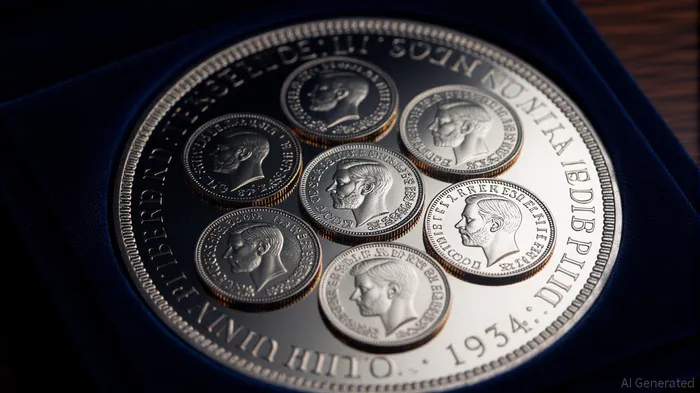
In an era defined by macroeconomic uncertainty—where inflation, geopolitical tensions, and market volatility dominate headlines—investors are increasingly turning to alternative assets to preserve and grow their wealth. Among these, numismatic coins, particularly rare proof issues like those from the Melbourne Mint, have emerged as a compelling, yet underappreciated, category. These coins are not merely collectibles; they are scarcity-driven investments that combine historical significance, tangible value, and a unique ability to hedge against systemic risk.
The Melbourne Mint's proof coins, produced between the early 20th century and the 1950s, exemplify this phenomenon. Take the 1916 Specimen Set, with a mintage of just 60. Only seven original cased sets have appeared on the market in the past 50 years, and one sold for $75,000 in 2008. Similarly, the 1934 Proof Set, with a mintage of 50, fetched $75,000 in 2023. These prices reflect not just the intrinsic value of the metals used but a numismatic premium driven by rarity, condition, and historical narrative. For instance, the 1930 Penny, one of the most iconic Australian coins, sold for $1.15 million in 2019—a record that underscores the power of scarcity in numismatics.
What sets these coins apart from traditional alternatives like gold or real estate? Consider gold bullion, which, while a safe haven, is valued purely by weight and spot price. A 1-ounce gold bar is fungible; its value is tied to the market's perception of gold's utility as a hedge. In contrast, a 1937 Proof Crown (mintage: 100) or a 1953 Chase Manhattan Set (mintage: 12) carries a dual value: the metal content plus a premium for its uniqueness. This duality allows numismatic coins to outperform gold during periods of stagnation or decline. For example, high-grade proof coins from the Melbourne Mint have appreciated by 15–30% since 2020, far outpacing gold's more modest gains.
Real estate, another traditional alternative, pales in comparison when it comes to liquidity and portability. A property is a long-term, illiquid asset that requires maintenance and is subject to local market fluctuations. A rare coin, by contrast, can be sold within days through certified dealers or auction houses. The 1939 Proof Halfpenny, for instance, appeared on the market in 2024 and sold for $13,800—a transaction that took mere hours. This liquidity is critical during crises when investors need to access capital quickly.
Moreover, numismatic assets offer a degree of privacy and discretion that real estate or gold bullion cannot match. Transactions in rare coins, especially those with verified provenance and professional grading (e.g., PCGS or NGC certification), can be conducted with a higher level of anonymity. This feature has made them attractive to investors seeking to diversify their portfolios outside the traditional banking system, particularly in regions experiencing currency devaluation or political instability.
The historical performance of numismatic coins during crises further strengthens their case. During the 2020 pandemic-induced market crash, while gold prices surged, numismatic coins saw even greater appreciation. The 1930 Penny, for example, had already established itself as a blue-chip asset, with its value doubling in the decade prior. Similarly, the 1934 Proof Set's 2023 sale price reflected a 100% increase over its 2001 value. These trends suggest that numismatic coins are not just surviving economic turbulence—they are thriving.
For investors, the key to success lies in understanding the interplay of scarcity, grading, and market demand. High-grade coins (e.g., PR-70 or PR-70 DCAM) command premiums that far exceed their bullion value. The 1935 Proof Penny, graded PR-70, sold for $30,000 in 2020—a 10x return on its 2010 price. This appreciation is driven by the finite supply of high-grade examples and the growing demand from collectors and institutional investors alike.
However, numismatic investing is not without risks. The market is niche, and valuations can be subjective. A poorly graded coin or one with questionable provenance may underperform. Investors must also be wary of counterfeits and overpriced specimens. The solution lies in due diligence: working with reputable dealers, leveraging professional grading services, and focusing on coins with verifiable histories.
In conclusion, the Melbourne Mint's proof coins—and numismatic assets more broadly—represent a strategic store of wealth in an uncertain world. Their scarcity, historical significance, and dual-value model make them a superior alternative to gold and real estate, particularly for investors seeking liquidity, privacy, and long-term appreciation. As macroeconomic risks persist, the untapped value in these coins will only become more apparent. For those willing to look beyond the obvious, the market offers a rare opportunity to own a piece of history—and a hedge against the future.

Stay ahead of the market.
Get curated U.S. market news, insights and key dates delivered to your inbox.


AInvest
PRO
AInvest
PRO



Comments
No comments yet