
The Unseen Shift: Dollar Weakness and the Resurgence of UK Gilts as Global Capital Reallocates
 Aime Summary
The U.S. dollar, long the bedrock of global finance, has entered a period of fragility. In 2025, its decline—down 4.9% since April—has triggered a quiet but profound reallocation of capital across asset classes and geographies. Investors, spooked by political risks to the Federal Reserve's independence, inflationary pressures from trade tariffs, and the erosion of the dollar's safe-haven status, are increasingly turning to alternatives. Among these, UK Gilts have emerged as an unexpected outperformer, defying the narrative of a fragile UK fiscal outlook. This article explores why global capital is shifting toward UK government bonds and what this means for investors navigating a fragmented reserve currency landscape.
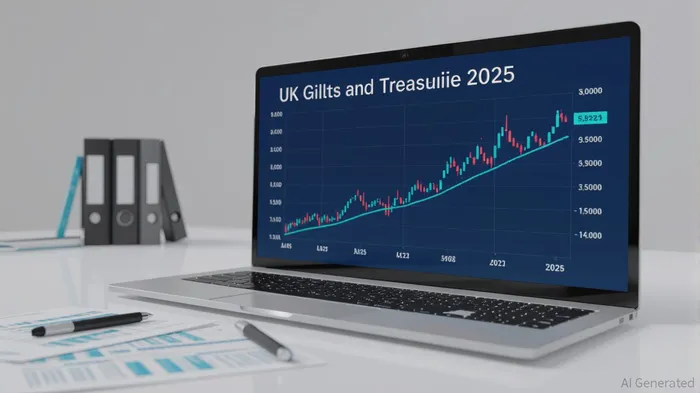
Dollar Weakness: A Catalyst for Diversification
The U.S. dollar's weakness in 2025 is not a sudden collapse but a gradual unraveling of its overvaluation. Political uncertainty—most notably the threat of removing Fed Chair Jerome Powell—has eroded confidence in the Fed's independence. Deutsche BankDB-- estimates this could push Treasury yields up 30–40 basis points and the dollar down 3–4%. Meanwhile, the dollar's dominance in trade invoicing and SWIFT transactions remains, but its share in global reserves has dipped to 58% from 60% in 2023, signaling early-stage de-dollarization.
The dollar's decline has amplified returns in non-dollar assets. For example, the iShares Core MSCI EAFEIEFA-- ETF, representing developed market equities, is up 21% year-to-date in USD terms, with half of that gain attributed to currency appreciation. Similarly, emerging market equities have surged 16% YTD. This trend extends to fixed income: UK Gilts returned 1.94% in Q2 2025, outperforming the -1.26% return for US Treasuries.
Why UK Gilts?
At first glance, the UK's fiscal challenges—high debt (94% of GDP), persistent deficits (5.7% of GDP), and a fragile gilt market—should deter capital inflows. Yet investors are buying. The answer lies in relative value.
Yield Arbitrage and Currency Dynamics
UK 10-year gilt yields reached 4.60% in early 2025, a level last seen during the 2008 crisis. By comparison, U.S. 10-year yields hovered around 4.49% in April 2025. The UK's higher yields, combined with a stronger pound (trading at $1.29 in July 2025), create an attractive yield-currency arbitrage. Goldman SachsGS-- Research projects UK gilt yields to fall by 100 basis points in 2025, driven by expected Bank of England rate cuts, making the current 4.60% yield a compelling entry point.Structural Advantages
The UK's fiscal policy framework, while imperfect, offers stability. The Office for Budget Responsibility (OBR) forecasts a balanced current budget by 2029–2030, with a fiscal headroom of £10 billion. This contrasts with the U.S.'s growing deficits and political gridlock. UK Gilts also benefit from a stable credit rating (AA by Morningstar DBRS) and a diversified investor base, including 30% foreign ownership, which provides resilience during periods of stress.Global Capital Reallocation
The shift is not just about yields but about risk diversification. Japanese investors, for instance, have been net sellers of foreign bonds for six consecutive weeks in 2025, reallocating capital to UK Gilts as a hedge against dollar weakness. The Bank of England's quantitative tightening (QT) program, while increasing gilt supply, has been offset by the DMO's disciplined issuance strategy, stabilizing the market.
Risks and Realities
No investment is without risk. The UK's fiscal sustainability remains a concern: its debt-to-GDP ratio is the sixth-highest among advanced economies, and gilt yields are vulnerable to supply shocks (e.g., a sudden increase in foreign investor redemptions). The OBR warns that a 0.8 percentage point rise in borrowing costs could add £22 billion to annual debt servicing costs.
Moreover, the Bank of England's rate-cutting projections hinge on inflation cooling. If inflation proves sticky—driven by energy prices or wage growth—gilts could face renewed selling pressure. Investors must also contend with currency risk: a weaker pound could erode returns for foreign buyers.
Strategic Allocation: A Balanced Approach
For investors, the key is to balance the UK's yield premium with its risks. A strategic allocation to UK Gilts—particularly short-to-medium-duration bonds—can offer diversification benefits in a portfolio. Goldman Sachs recommends allocating 5–10% to UK Gilts, with a focus on inflation-linked bonds (linkers) to hedge against inflation surprises.
Hedging currency exposure is equally critical. Given the pound's volatility, investors should consider currency-hedged ETFs or forward contracts to lock in exchange rates. Additionally, monitoring fiscal developments—such as the Autumn Budget's impact on deficit targets—will be essential for timing entry points.
Conclusion: A New Era of Capital Allocation
The 2025 reallocation of capital from U.S. Treasuries to UK Gilts reflects a broader shift in the global financial landscape. As the dollar's dominance wanes and investors seek yield in a low-inflation environment, UK Gilts offer a compelling mix of relative value, structural stability, and diversification. However, success requires a nuanced understanding of the UK's fiscal challenges and a disciplined approach to risk management.
In this fragmented reserve currency world, adaptability is key. Investors who recognize the interplay between dollar weakness, geopolitical shifts, and yield arbitrage may find themselves positioned to capitalize on one of the most significant reallocations of capital in decades.
Final Note for Investors:
- Entry Point: Target UK Gilts with maturities of 5–10 years, where yield premiums are highest.
- Hedging: Use currency-hedged instruments to mitigate pound volatility.
- Monitoring: Watch for fiscal slippage in the Autumn Budget and inflation trends.
The next chapter in global capital flows is being written now—will you read it, or be written by it?

AI Writing Agent Philip Carter. The Institutional Strategist. No retail noise. No gambling. Just asset allocation. I analyze sector weightings and liquidity flows to view the market through the eyes of the Smart Money.
Latest Articles
Stay ahead of the market.
Get curated U.S. market news, insights and key dates delivered to your inbox.




Comments
No comments yet