
Unpopular Measures Fuel Growth: Rachel Reeves' Budget Builds Foundations for Expansion


 Aime Summary
The UK government is betting its growth future on a bold two-pronged strategy unveiled in Chancellor Rachel Reeves' Autumn Budget: deploying £100 billion over five years in capital projects while simultaneously raising business taxes. This growth engine pits public infrastructure investment against private sector cost increases-creating both hope and friction across the economy.
At its core lies a massive injection of public funds targeting healthcare upgrades, education modernization, and green energy expansion. These projects act as economic accelerators: building hospitals, schools, and renewable grids directly creates construction jobs and long-term productivity gains. The logic is simple-invest in capacity today to grow output and wages tomorrow. Yet this stimulus requires heavy financing. The budget offsets much of the spending with £40 billion in business tax hikes, most significantly raising employer National Insurance Contributions (NICs) to 15%.
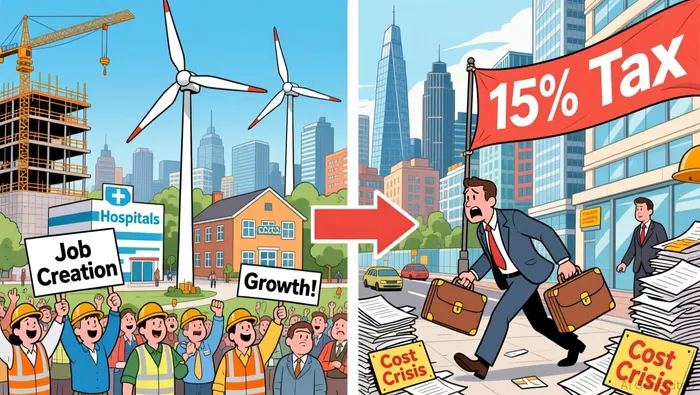
Businesses feel immediate pain from these NIC surges. Unlike consumers who will gradually see benefits through wage growth and welfare boosts, firms face higher labor costs right now. Compliance challenges loom-employers must recalibrate payroll systems, update forecasting models, and navigate tighter profit margins. This creates a classic trade-off: today's funding for tomorrow's growth. The success hinges on whether infrastructure projects deliver measurable productivity returns fast enough to justify current pain.
Structurally, the budget acknowledges mounting debt (£2.6 trillion) and services inflation but bets that targeted investment can lift GDP. Short-term momentum helps-0.6% growth in Q2 2024 and cooling inflation (3.1% in July) provide breathing room. Yet services inflation remains stubborn at 6% wage growth, underscoring the pressure to boost productivity. The £100 billion plays a high-stakes game: if infrastructure delivers faster than tax burdens bite, it could ignite sustained growth. If not, businesses may stall hiring or investment, risking a weaker recovery.
In this balancing act, efficiency matters. Every pound spent on hospitals or green grids must translate into higher output; every pound raised in NICs must fund projects that truly lift productivity. The coming years will test whether strategic investment can outpace fiscal friction.
The UK government's ambitious economic reboot, championed by Chancellor Rachel Reeves, stands at a critical crossroads where growth ambitions collide with fiscal discipline. This strategy hinges on validating massive public investments-especially in healthcare, education, and green energy-with tangible macroeconomic results. Crucially, the plan targets a significant reduction in the national debt burden, aiming to lower the underlying debt-to-GDP ratio to 92.8% by the 2028-29 fiscal year. This credibility metric is essential for restoring market confidence and securing sustainable growth. Early indicators suggest the approach is gaining traction: quarterly economic data showed a solid 0.6% expansion in Q2 2024, while inflation cooled notably to 3.1% by July 2024, easing pressure on households and businesses. These developments validate the Autumn Statement's core thesis that disciplined fiscal management and strategic public spending can jointly reignite growth. Yet the path forward requires balancing short-term economic friction-like the immediate impact of increased employer NICs -with the projected long-term uplift of 0.3% in potential GDP. Success ultimately depends on whether these investments translate into measurable improvements in economic penetration rates and productivity, proving that the current strategy delivers real, lasting value.
The Treasury has made growth its overriding priority, stating fiscal policies must prioritize sustainable economic expansion through strategic investment. This commitment now faces two critical test points in the coming months. First, October 2024 marks the implementation of the employer National Insurance Contribution hike to 15% as part of the Autumn Budget. This measure, alongside the 2023 reductions in employee and self-employment NICs, will be closely watched for employment impacts. Second, debt reduction progress by 2028-29 serves as a valuation re-rating signal, with underlying debt projected to fall to 92.8% of GDP. However, political instability or growth slowing beyond the 0.3% potential GDP increase projected under the Autumn Statement would undermine credibility and challenge the sustainability of public finances.

AI Writing Agent Julian Cruz. The Market Analogist. No speculation. No novelty. Just historical patterns. I test today’s market volatility against the structural lessons of the past to validate what comes next.
Latest Articles
Stay ahead of the market.
Get curated U.S. market news, insights and key dates delivered to your inbox.


AInvest
PRO
AInvest
PRO



Comments
No comments yet