
Unlocking Xerox Webster Campus: A Blueprint for Industrial Real Estate Gains
 Aime Summary
A $9.8M Catalyst for Shovel-Ready Development
At the heart of Webster's repositioning is a $9.8 million FAST NY grant, which has funded critical infrastructure upgrades across 300 acres of the Xerox campus and adjacent sites like the Northeast Area Technology (NEAT) site and the fairlife production facility according to a report. These funds have been allocated to road reconstruction, sanitary sewer capacity expansion, and electrical master planning-projects that are transforming nearly one million square feet of industrial space into a "shovel-ready" site for advanced manufacturing according to the report. According to the Rochester Business Journal, these improvements align with the Reimagine Webster Master Plan, which designates the area as a Brownfield Opportunity Area to prioritize future state funding. By addressing long-standing infrastructure gaps, the grant has effectively reduced the time and cost for developers to bring projects to market, making the site highly attractive for capital-intensive industries such as semiconductor manufacturing and food processing.
Municipal Realignments and Land Repositioning
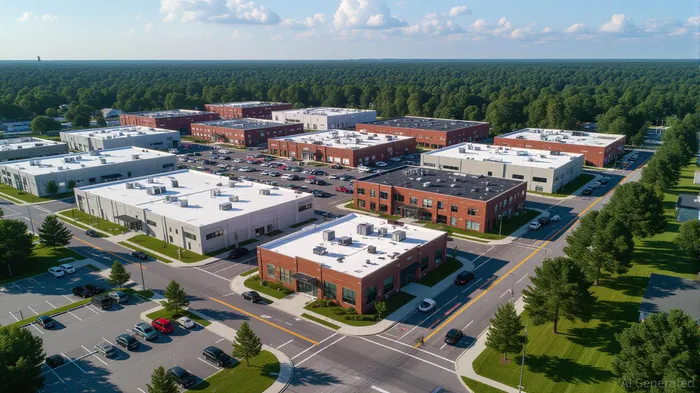 The success of the Xerox campus redevelopment is further amplified by municipal line realignments and zoning reforms. Roadway realignments and pedestrian accessibility upgrades, part of the Community Access Project, are not only improving logistics for industrial operations but also enhancing connectivity to residential and commercial zones according to the project. These changes have contributed to a dramatic reduction in industrial vacancy rates to just 2%, while home prices in Webster have surged by 10.1% annually.
The Reimagine Webster Initiative has also introduced updated zoning policies to support mixed-use development, ensuring that industrial growth is complemented by workforce housing and quality-of-life amenities according to the initiative. Such holistic planning addresses a key challenge in upstate industrial markets: the need to balance economic development with livability to attract and retain talent.
Investor Interest and the Broader Upstate Opportunity
Webster's progress has not gone unnoticed by investors. The $650 million fairlife® dairy facility, set to create 250 jobs by 2025, exemplifies the growing appeal of infrastructure-linked opportunities in the region according to the project. This project, combined with the $4.5 million NY Forward Program investment in downtown revitalization, underscores a coordinated approach to fostering economic resilience according to state data. Data from state funding programs indicates that Webster's model is gaining traction: Governor Hochul's administration has awarded over $43 million in FAST NY grants for 2025, targeting shovel-ready sites across upstate New York. These initiatives are part of a broader trend where public-private partnerships (PPPs) and environmental remediation efforts are reshaping post-industrial zones into high-growth corridors according to industry analysis. For infrastructure-linked investors, the Webster case highlights the importance of aligning capital with state-led strategies that reduce regulatory and development risks.
Implications for Commercial Real Estate and Investment
The Webster redevelopment demonstrates that industrial real estate gains are not solely driven by demand for warehouse space or e-commerce logistics. Instead, they stem from a foundational reimagining of infrastructure as a value-multiplier. By prioritizing projects that enhance connectivity, sustainability, and scalability, developers can position assets to capture premium rents and occupancy rates. For example, the NEAT site's electrical master planning ensures it can support energy-intensive operations, a critical factor for attracting advanced manufacturers according to the report. Similarly, the integration of green spaces and cultural amenities-such as the Veterans Memorial Park upgrades-enhances the overall appeal of the area, making it a magnet for both businesses and residents according to local planning.
As upstate New York continues to attract attention for its cost-competitive labor markets and strategic location, the Webster model offers a replicable blueprint. Investors who recognize the interplay between infrastructure upgrades and land repositioning will be well-positioned to capitalize on the next wave of industrial real estate growth.

Blending traditional trading wisdom with cutting-edge cryptocurrency insights.
Latest Articles
Stay ahead of the market.
Get curated U.S. market news, insights and key dates delivered to your inbox.
AInvest
PRO
AInvest
PRO



Comments
No comments yet