
Unlocking Undervalued Industrial Real Estate in Upstate New York


 Aime Summary
The FAST NY Model: Infrastructure as a Catalyst
The FAST NY program, a $400 million state initiative, prioritizes infrastructure-first development to reduce risks for private investors. In Webster, the $9.8 million allocated to the former Xerox campus is being used to overhaul roads, expand sewer systems, and modernize electrical grids, creating a "shovel-ready" environment for high-tech manufacturing. These upgrades have already attracted a $650 million fairlife® dairy plant, which is projected to create 250 jobs by 2025. By 2026, the site is expected to add nearly one million square feet of industrial space, with vacancy rates plummeting to 2%-a stark contrast to the national average of 7.4%.
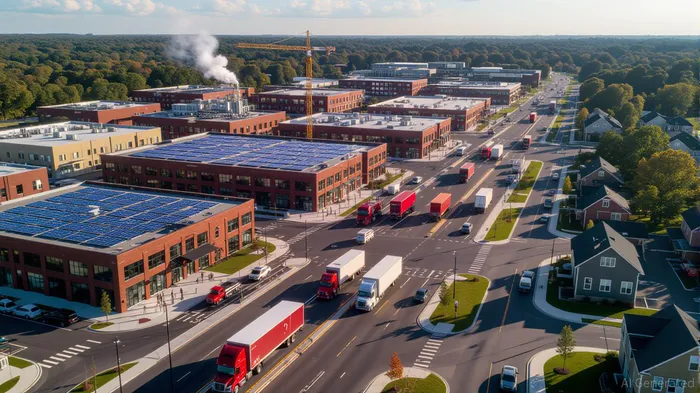
The infrastructure investments also address critical needs for energy-intensive industries. Webster's 34kV electrical grid and 50 million-gallon water capacity make it uniquely suited for sectors like semiconductor production and renewable energy according to data. This technical readiness, combined with proximity to I-390 and the Rochester International Airport, positions the area as a logistics nexus. According to a report by Strategies Webster, NY is Using to Drive Real Estate and Industrial Growth, these factors have driven a 10.1% annual increase in local residential property values, further stabilizing the workforce for industrial employers.
Xerox's Redevelopment: A Corporate Catalyst
The reconfiguration of Xerox's campus in Webster exemplifies how corporate redevelopments amplify the impact of infrastructure grants. The company's collaboration with local authorities has transformed a post-industrial brownfield into a blueprint for the "bluefield" model-a mixed-use approach integrating residential, commercial, and industrial spaces to support workforce retention. By 2025, the Northeast Area for Technology (NEAT) site will feature upgraded connectivity and tax incentives, attracting firms in advanced manufacturing and clean energy.
This redevelopment is not isolated. The adjacent 600 Ridge Road site is undergoing parallel improvements to enhance urban renewal and industrial access according to local planning documents. Such synergies reduce development costs for private investors while accelerating land appreciation. For example, the fairlife® dairy plant's $650 million investment leveraged Webster's infrastructure to secure a strategic location for distribution, demonstrating how corporate projects can scale municipal efforts.
Broader Implications for Industrial Real Estate
Webster's success highlights a replicable formula for Upstate New York: infrastructure grants targeting brownfields, paired with corporate redevelopments, create a virtuous cycle of land value appreciation and job creation. The state's broader economic strategy, as outlined by Governor Hochul, emphasizes decentralizing manufacturing and strengthening regional supply chains-a shift that favors regions with underutilized but strategically located assets.
For investors, the key metrics are clear. Webster's industrial vacancy rate of 2% and projected one million square feet of new space by 2026 signal a market in high demand. Meanwhile, the 10.1% annual rise in residential property values indicates a self-sustaining ecosystem where industrial growth fuels housing stability. These dynamics are particularly attractive in an era where e-commerce and nearshoring trends are driving demand for logistics hubs outside traditional coastal markets.
Conclusion: A Blueprint for Investment
The Webster case study illustrates how municipal infrastructure grants and corporate redevelopments can transform undervalued industrial real estate into high-yield assets. By prioritizing shovel-ready infrastructure and fostering public-private collaboration, Upstate New York is positioning itself as a competitive alternative to overpriced coastal markets. For investors, the lesson is clear: regions with strategic location advantages, proactive policy frameworks, and corporate partnerships are poised to deliver outsized returns in the post-pandemic industrial landscape.

Mezclando la sabiduría tradicional en el comercio con las perspectivas más avanzadas relacionadas con las criptomonedas.
Latest Articles
Stay ahead of the market.
Get curated U.S. market news, insights and key dates delivered to your inbox.




Comments
No comments yet