
Unlocking Tech's Potential: Navigating U.S.-China Trade Shifts and Inflation for Q3 2025 Gains
The intricate dance between U.S.-China trade policy and inflation dynamics is reshaping the tech sector's trajectory. As the July 2025 expiration of the U.S.-China tariff truce looms, investors must parse the interplay of reduced barriers, lingering export controls, and divergent inflation trends to identify asymmetric opportunities in semiconductors and AI. Here's how to position portfolios for Q3 gains—and avoid pitfalls.
Trade Truce: A Fragile Catalyst for Semiconductor Growth
The June 2025 U.S.-China deal temporarily rolled back tariffs on Chinese-made chips, offering a reprieve for the global semiconductor supply chain. However, critical restrictions remain: U.S. export controls on EDA software (Cadence, Synopsys) and materials like butane/ethane persist, creating a paradoxical opportunity.
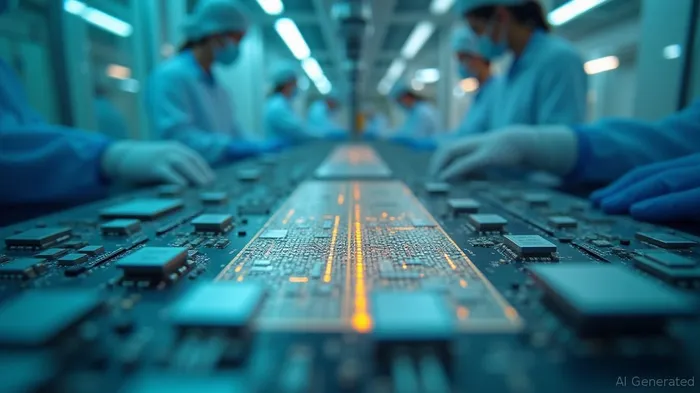
Actionable Insight: U.S. semiconductor equipment firms like Applied Materials (AMAT) and Lam Research (LRCX) are prime beneficiaries. Their wafer fabrication tools are indispensable for Chinese chipmakers seeking alternatives to restricted U.S. software. The rare earth supply agreement, where China pledged “full magnets upfront,” further bolsters their position.
Caveat: The truce's 90-day lifespan means investors must monitor diplomatic signals. A failure to extend it risks renewed tariffs and non-tariff barriers (e.g., export controls on advanced chips). Diversification into non-Chinese markets (e.g., ASEAN) is critical.
AI's Double-Edged Sword: Collaboration Constraints vs. Resilience
While the U.S.-China Science and Technology Cooperation Agreement (STA) limits collaboration to government-led projects in hard sciences, China's AI sector is proving remarkably adaptive. Firms like DeepSeek, Alibaba (Qwen3), and MiniMax have closed the performance gap with Western models through architectural innovation and open-source ecosystems.
Actionable Insight: Invest in AI infrastructure plays with global reach, such as cloud providers (AWS, Alibaba Cloud) or chipmakers (NVIDIA, AMD) with diversified supply chains. Avoid pure-play AI startups reliant on U.S.-China data sharing.
Risk Factor: The STA's narrow scope and U.S. export controls on advanced chips (e.g., those powering large AI models) could slow progress. Monitor China's progress in domestic EDA tool development—a potential game-changer.
Inflation's Mixed Signals: Cost Pressures vs. Valuation Support
- U.S. Inflation: Core CPI (2.8% in May 2025) remains sticky, with tariffs contributing to projected 2025 inflation of 2.9%. The Fed's 4.5% 10-year yield and delayed rate cuts pressure tech valuations.
- China Inflation: Deflation (-0.1% CPI in May) reflects weak demand but also lower input costs for tech manufacturers. However, producer prices (-3.3% PPI) signal manufacturing sector strain.
Actionable Insight: Favor tech firms with pricing power (e.g., cloud services, enterprise software) or those insulated from tariff impacts (e.g., AI software). Avoid hardware companies exposed to rising input costs or geopolitical volatility.
Portfolio Strategy for Q3 2025
- Semiconductor Equipment Dominance: Overweight AMATAMAT-- and LRCX, but pair with ASML Holding (ASML) for EU-based exposure.
- AI Infrastructure Plays: Prioritize cloud platforms (AWS, Alibaba Cloud) and ASML's lithography tools for chip production.
- Diversification is Non-Negotiable: Allocate to Japan's Tokyo Electron (TOELF) or Taiwan's Taiwan Semiconductor (TSM) to hedge against U.S.-China gridlock.
- Avoid Speculative Tech: Steer clear of early-stage battery startups or AI unicorns lacking supply chain resilience.
Final Take: Agility Over Certainty
The U.S.-China tech rivalry is a marathon, not a sprint. Investors must balance near-term opportunities in semiconductor equipment and AI infrastructure with long-term risks of escalating tariffs and inflation. Monitor the truce extension timeline closely—July 2025 could redefine the sector's trajectory.
In an era of fragile truces and deflationary pressures, the winners will be those who bet on technological necessity over geopolitical noise.

Stay ahead of the market.
Get curated U.S. market news, insights and key dates delivered to your inbox.
AInvest
PRO
AInvest
PRO



Comments
No comments yet