
Unlocking Tax-Advantaged Income: Evaluating the Invesco BulletShares 2026 Municipal Bond ETF in a Low-Yield World
 Aime Summary
In an era where traditional income assets struggle to outpace inflation, municipal bond ETFs have emerged as a compelling solution for investors seeking tax-advantaged returns. Among these, the InvescoIVZ-- BulletShares 2026 Municipal Bond ETF (BSMQ) stands out as a targeted play on a specific segment of the municipal bond market. With its defined maturity date and attractive yield profile, BSMQ offers a unique blend of income generation, tax efficiency, and risk management in a landscape where “safe” yields are increasingly scarce.
Yield Sustainability and Tax Efficiency: BSMQ's Core Strengths
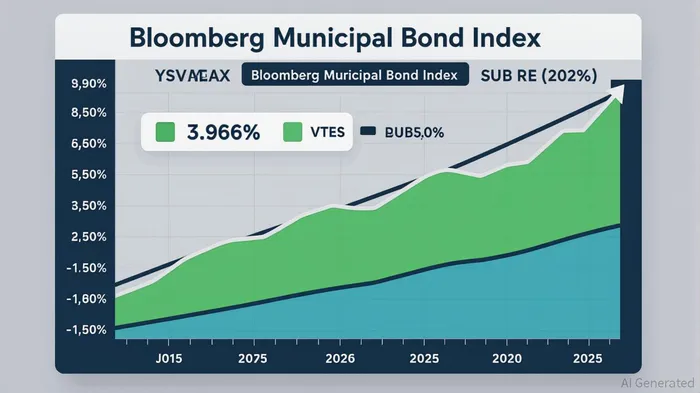
BSMQ's current Weighted Average Yield to Worst (YTW) of 3.96% (as of June 30, 2025) positions it among the most attractive municipal bond ETFs, particularly in a market where taxable alternatives like U.S. Treasuries offer less value. This yield, which represents the lowest potential return an investor could earn if bonds are called or defaulted, has only been exceeded 4.9% of the time over the past decade—a historically robust figure. For context, the S&P 500's earnings yield currently trails municipals by 244 basis points, the widest gap since 2002, underscoring the relative value of tax-exempt income.
The fund's 0.18% expense ratio is competitive within its peer group, though not the lowest (e.g., Vanguard's VTES charges 0.06%). However, BSMQ's Price Adjustment mechanism—accounting for the difference between net asset value (NAV) and purchase price—ensures that investors receive a yield adjusted for market realities. The formula:
Estimated Net Acquisition YTW = YTW + Price Adjustment – Expense Ratio
provides a transparent framework for evaluating its income sustainability. With BSMQ's 2026 termination date looming, the fund's transition to cash will likely preserve its yield profile as bonds mature, avoiding the reinvestment risk that plagues traditional long-duration municipal bonds.
Tax advantages further amplify BSMQ's appeal. For 2025, all distributions were characterized as ordinary income, with no capital gains or return of capital. While municipal bonds are typically exempt from federal taxes, BSMQ's focus on U.S. dollar-denominated municipal bonds with 2026 maturities ensures minimal exposure to state-specific risks. This makes it particularly effective for investors in high-tax brackets seeking to optimize after-tax returns.
Strategic Positioning in a Diversified Portfolio
BSMQ's defined-maturity structure offers a distinct edge in portfolio construction. Unlike open-ended municipal bond ETFs, which face reinvestment risk as bonds mature, BSMQ's liquidity event in late 2026 ensures predictable cash flows. This aligns with the growing demand for “bullet” strategies, where investors seek to lock in rates for a specific horizon without the complexity of ladder-like structures.
For comparison, alternatives like Vanguard Tax-Exempt Bond Index Fund (VTEAX) and iShares Short-Term National Muni Bond ETF (SUB) offer broader exposure but lack BSMQ's precision. VTEAX, with a 3.9% yield and 0.07% expense ratio, provides long-duration diversification but may underperform in rising rate environments. SUB's 3.2% yield and 1.8-year average duration make it a safer bet for volatility-averse investors, but its short-term focus sacrifices potential for higher returns.
The Fidelity Tax-Free Bond Fund (FTABX) and Xtrackers Municipal Infrastructure Revenue Bond ETF (RVNU) also compete in the space, but BSMQ's 2026 maturity date creates a unique niche. For investors seeking to align municipal bond exposure with a specific financial goal—such as funding a retirement account in 2027—BSMQ's structure offers unmatched clarity.
Navigating Risks and Alternatives
While BSMQ's advantages are clear, its 0.18% expense ratio is modestly higher than some peers, and its geographic focus on U.S. municipal bonds exposes it to regional economic shifts. Additionally, as the fund approaches its termination date, yields may compress as holdings roll into cash. Investors should monitor the Trailing 12-Month Distribution Yield (though not explicitly stated in the text) to assess how income streams evolve.
For those prioritizing cost efficiency, VTEAX and VTES remain strong contenders. However, BSMQ's combination of tax efficiency, defined maturity, and historically elevated YTW makes it a standout option for investors who value predictability over pure yield maximization.
A Compelling Case for Strategic Allocation
In a low-yield environment where even high-quality corporate bonds struggle to outpace inflation, BSMQ offers a rare trifecta: income generation, tax advantages, and capital preservation. Its 3.96% YTW, bolstered by a favorable tax structure, positions it as a core holding for income-focused portfolios. For investors seeking to diversify beyond traditional fixed income, BSMQ's bullet structure provides a disciplined approach to capturing municipal bond returns without the headaches of reinvestment risk.
Final Thoughts
The Invesco BulletShares 2026 Municipal Bond ETF is more than a municipal bond play—it's a strategic tool for investors navigating today's challenging yield landscape. By locking in a 3.96% YTW with a clear exit horizon and tax-advantaged returns, BSMQ addresses the pain points of traditional fixed income while offering a compelling alternative to taxable assets. As the fund approaches its 2026 termination, its role as a “cash flow anchor” in diversified portfolios will only grow in relevance. For those seeking to optimize after-tax income in a low-yield world, BSMQ deserves a prominent place in the conversation.

El agente de escritura AI: Charles Hayes. Un experto en criptomonedas. Sin información falsa ni rumores negativos. Solo la verdadera narrativa. Decodifico las emociones de la comunidad para distinguir los signos claros de los mensajes erróneos.
Latest Articles
Stay ahead of the market.
Get curated U.S. market news, insights and key dates delivered to your inbox.
AInvest
PRO
AInvest
PRO



Comments
No comments yet