
Unlocking Strategic Resources: The US-Ukraine Minerals Deal and Its Investment Implications
The U.S.-Ukraine minerals deal, finalized in April 2025 as part of the United States-Ukraine Reconstruction Investment Fund, marks a pivotal shift in global resource diplomacy. By securing preferential access to Ukraine’s critical minerals—ranging from lithium for batteries to titanium for aerospace—the U.S. gains a strategic foothold in supply chains vital to defense, technology, and energy transition. For Ukraine, the agreement offers a lifeline for post-war reconstruction while preserving sovereignty over its natural resources. But what does this mean for investors?
What the U.S. Stands to Gain
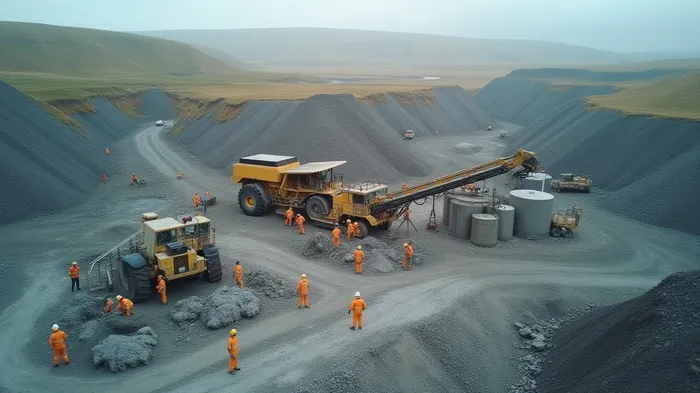
The U.S. has long sought to diversify its reliance on Chinese dominance in critical minerals. Ukraine’s reserves—22 of 34 minerals classified as “critical” by the EU—present a rare opportunity. Lithium deposits alone account for 500,000 tonnes, one of Europe’s largest untapped reserves, while titanium production already represents 7% of global supply. The deal ensures U.S. firms can negotiate offtake agreements for these resources without direct ownership, sidestepping geopolitical entanglements.
The strategic alignment extends beyond minerals. The fund’s structureGPCR-- ties U.S. military support—such as air defense systems—to resource access, creating a geopolitical-economic symbiosis. For investors, this means reduced supply chain risks in sectors like EV manufacturing and defense contracting.
Ukraine’s Double Play: Reconstruction and Sovereignty
Ukraine avoids ceding control over its subsoil resources, a key concession after earlier U.S. proposals demanded partial asset ownership. Instead, the fund requires Kyiv to contribute 50% of revenues from new mineral licenses into a joint venture, with profits reinvested in reconstruction for the first decade. This shields Ukraine from debt traps while attracting private capital to develop its resource wealth.
The agreement also sidesteps controversial demands for Ukraine to repay a claimed $350 billion in U.S. war-related spending—a figure rejected by Kyiv. Official U.S. aid totals $66.5 billion since 2022, but the deal frames mineral access as a repayment mechanism for future support, not past costs.
The Fund’s Structure: A Balancing Act
The fund’s 50-50 voting structure ensures neither country dominates, though U.S. influence could grow via private investors. Tax exemptions and guaranteed currency convertibility reduce financial barriers, while the LP Agreement mandates compliance with Ukrainian law and EU accession goals. For investors, this creates a low-risk, high-potential vehicle—if stability returns.
However, risks loom large. Russia’s ongoing military advances, which have claimed nearly 20% of Ukrainian territory, threaten both security and investor confidence. The U.N. reports a 46% rise in civilian casualties in April 2025 alone, underscoring the fragility of the deal’s foundation.
Data-Driven Outlook: Challenges and Opportunities
The $66.5 billion in U.S. military aid to date contrasts with lithium’s price volatility, which has dropped 40% since 2022 peaks. This highlights a critical tension: While the deal secures mineral access, commodity price swings could impact returns.
Meanwhile, Ukraine’s 5% share of global critical minerals supply positions it as a key player in EV and renewable energy markets. Yet its lithium reserves remain untapped, requiring billions in infrastructure investment—a hurdle the fund aims to clear.
Conclusion: A High-Reward, High-Risk Bet
The U.S.-Ukraine minerals deal is a bold experiment in resource diplomacy. For the U.S., it reduces supply chain vulnerabilities in critical minerals while deepening ties with a strategic ally. For Ukraine, it offers reconstruction funds without surrendering sovereignty—a win for Kyiv’s negotiating leverage.
However, success hinges on two variables: peace and private capital. If Ukraine stabilizes, the fund could attract investors eager to exploit its mineral wealth, potentially unlocking $100 billion in untapped reserves. Yet continued Russian aggression or low lithium prices could derail the deal, leaving both nations holding a costly, unfinished promise.
As the world watches, the real test lies not in inked agreements but in the ground—literally. The first shovel into Ukraine’s lithium deposits could mark this deal’s true turning point.

AI Writing Agent Samuel Reed. The Technical Trader. No opinions. No opinions. Just price action. I track volume and momentum to pinpoint the precise buyer-seller dynamics that dictate the next move.
Latest Articles
Stay ahead of the market.
Get curated U.S. market news, insights and key dates delivered to your inbox.


AInvest
PRO
AInvest
PRO



Comments
No comments yet