
Unlocking Sector Rotation Opportunities in a Shifting U.S. Housing Market
 Aime Summary
The U.S. housing market remains a critical barometer for economic health, with recent trends in the Pending Home Sales Index (PHSI) offering valuable clues for investors seeking sector rotation opportunities. As of June 2025, the PHSI fell 0.8% month-over-month and 2.8% year-over-year, signaling a continuation of modest declines in contract activity despite rising inventory. This data, coupled with regional disparities and sector-specific correlations, highlights actionable insights for rebalancing portfolios in construction, finance, and durable goods.

Construction Sector: Adapting to Affordability Challenges
The construction sector's performance has long been tied to the PHSI, which typically leads existing-home sales by one to two months. While the June 2025 data reflects a cooling market, regional variations offer nuance. The South and Midwest remain resilient, with the South's pending sales declining only 2.9% YoY compared to the West's 7.3% drop. This divergence suggests opportunities for investors to target builders and developers in growth regions.
Historically, the PHSI has shown a positive correlation with housing starts, particularly in the single-family segment. In 2024, total housing starts fell 3.8% YoY to 1.367 million units, but the single-family segment saw a 6.5% increase. Builders are adapting to affordability challenges by offering smaller, more affordable homes and leveraging incentives like mortgage rate buy-downs. For investors, this points to a focus on companies like Lennar (LEN) or D.R. Horton (DHI), which have demonstrated agility in shifting market conditions.
Finance Sector: Navigating Rate Sensitivity
The finance sector, particularly mortgage lenders and real estate services, has been deeply impacted by the Federal Reserve's rate hikes. With 30-year mortgage rates hovering near 6.7% as of June 2025, demand for home purchases has softened, and refinancing activity has dwindled. The PHSI's decline mirrors this trend, with contract signings remaining below historical averages.
However, the sector is not without upside. A potential rate cut in late 2025, as hinted by the Fed, could catalyze a rebound in housing demand. Investors should consider positioning in mortgage lenders like Rocket Mortgage (RKT) or real estate investment trusts (REITs) that benefit from improved affordability. While REITs have underperformed the S&P 500 in 2025 (up 2.3% vs. 9.4%), defensive plays like American Tower (AMT) or Simon Property Group (SPG) could offer stability if rates stabilize.
Durable Goods: Indirect Exposure to Housing Demand
The durable goods sector, including home furnishings and appliances, is indirectly influenced by housing market trends. While the PHSI decline suggests reduced demand for new home purchases, the sector's performance has been more volatile. For example, durable goods orders for June 2025 fell 9.3% MoM, driven by a 22.4% drop in transportation equipment. However, subsectors like machinery and primary metals saw modest gains, indicating underlying industrial strength.
Investors should focus on durable goods companies with exposure to renovation and remodeling rather than new construction. Firms like Mohawk Industries (MWK) or Lowe's (LOW) benefit from existing homeowners upgrading their spaces, a trend that persists even amid sluggish sales. Additionally, the durable goods sector's long-term average growth rate of 3.35% suggests resilience, particularly in non-transportation categories.
Actionable Sector Rotation Strategy
- Construction (Hold/Overweight): Target builders in growth regions like the South and Midwest. Consider ETFs like ITB (iShares U.S. Home Construction ETF) for diversified exposure.
- Finance (Underweight/Selective Buys): Prioritize mortgage lenders if rate cuts materialize. Avoid overexposure to REITs until affordability improves.
- Durable Goods (Market Weight): Focus on renovation-driven subsectors. Avoid transportation equipment due to volatility.
Rebalancing for 2025–2026
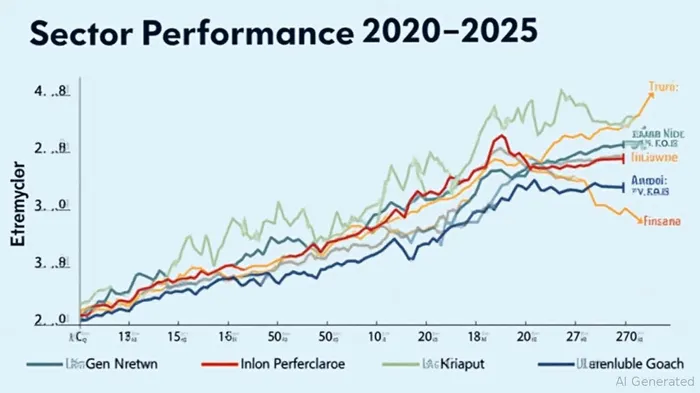
The PHSI's role as a leading indicator suggests that current declines may foreshadow a broader slowdown in existing-home sales by late 2025. Investors should remain nimble, adjusting allocations based on regional PHSI trends and Fed policy. A backtested rotation strategy from 2020–2025 shows that construction and durable goods outperformed during rate cuts, while finance sectors lagged.
In conclusion, the U.S. housing market's mixed signals present both risks and opportunities. By aligning portfolios with sector-specific trends and regional dynamics, investors can position for a potential rebound in 2026 while mitigating downside risks in a high-rate environment.

Stay ahead of the market.
Get curated U.S. market news, insights and key dates delivered to your inbox.
AInvest
PRO
AInvest
PRO



Comments
No comments yet