
Unlocking Resilience: How Investors Can Navigate Rising Insurance Costs by Targeting Climate-Resilient Real Estate Markets
 Aime Summary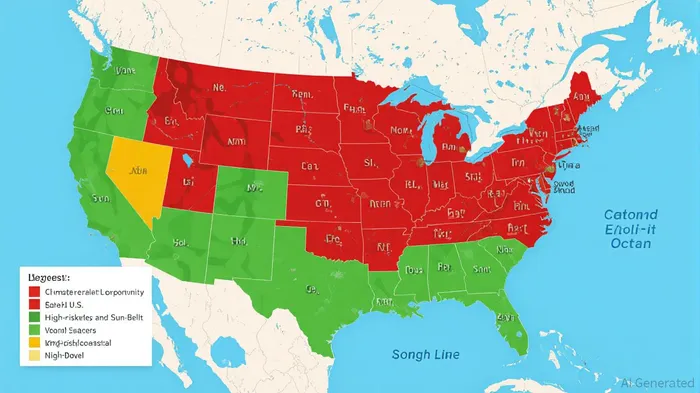
The U.S. housing market is at a crossroads. Climate risk has become a dominant force reshaping property values, insurance affordability, and long-term investment viability. As insurers recalibrate premiums to reflect the escalating costs of wildfires, hurricanes, and floods, high-risk regions are seeing home values erode while low-risk markets remain insulated from volatility. For investors, this divergence presents a critical opportunity: identifying undervalued real estate in climate-resilient areas poised for growth.
The Climate Risk Bubble and Its Fallout
The $389 billion climate risk bubble in the U.S. housing market, as identified by Jupiter Intelligence, is a stark warning. Legacy catastrophe models have historically underestimated the financial toll of disasters like Hurricane Katrina and Harvey, leading to mispriced risk. Today, high-risk regions such as Southern California, Utah, and Florida face a perfect storm: rising insurance premiums, declining property values, and population outflows. For every $100 increase in climate-adjusted insurance costs, home values drop by $1,000—a dynamic that could trigger a broader financial crisis as collateral values shrink and refinancing becomes untenable.
Meanwhile, the commercial real estate sector is grappling with similar pressures. NOAA's 2025 hurricane forecast predicts 13–19 named storms, with hidden risks like chemical leaks from industrial sites compounding post-storm liabilities. Yet, as insurers retreat from high-risk zones, a new frontier of opportunity emerges in regions where climate risk is minimal.
Climate-Resilient Markets: The Midwest and Eastern U.S.
First Street's analysis reveals 4,107 low-risk neighborhoods across the U.S., primarily in the Midwest and Eastern U.S., where property values are projected to rise by 10.8% over the next three decades. These areas, shielded from coastal flooding, wildfires, and extreme heat, are attracting new residents and maintaining stable insurance rates. For example:
- Maine and New Hampshire top Insurify's Climate Stability Index, with Maine's home insurance premiums dropping 4% in 2024 despite a national average increase of 9%.
- Alaska and Wyoming benefit from low population density and geographic isolation, limiting the financial impact of disasters.
- Washington, D.C. and Vermont have avoided major natural disasters entirely, with Vermont's average insurance rate at a national low of $954 annually.
These regions are not immune to climate change but are far less exposed to its most destructive manifestations. Their stability is further reinforced by favorable insurer loss ratios, which indicate strong profitability and rate predictability.
Why These Markets Are Undervalued
Despite their resilience, many of these regions remain overlooked by investors. High-risk areas dominate headlines, while low-risk markets fly under the radar. This undervaluation is a strategic advantage:
1. Insurance Stability: States like Maine and New Hampshire have seen minimal rate increases, with some even experiencing declines. This contrasts sharply with Florida and California, where premiums have surged by 30–50% in recent years.
2. Population Growth: Climate-resilient areas are attracting newcomers seeking affordable housing and predictable costs. For instance, the Midwest's population is projected to grow by 2.1% by 2030, driven by migration from high-risk coasts.
3. Infrastructure Resilience: These regions often feature updated infrastructure and building codes designed to withstand moderate climate stressors, enhancing long-term asset value.
Investment Strategies for a Shifting Landscape
To capitalize on this opportunity, investors should adopt a dual focus:
1. Geographic Diversification: Prioritize properties in the Midwest and Eastern U.S., avoiding concentration in high-risk zones. For example, consider markets like Des Moines, Iowa, or Columbus, Ohio, which combine low climate risk with strong job growth.
2. Climate Risk Modeling: Leverage tools like Jupiter Intelligence's forward-looking models or First Street's property-level data to quantify risk exposure. These tools can identify neighborhoods with minimal flood, fire, or wind risk.
3. Insurance Market Analysis: Target states with favorable insurer loss ratios and stable premium trends. For instance, Massachusetts and Delaware have maintained low loss ratios (39.9 and 48.6, respectively), signaling strong insurer profitability and rate stability.
The Road Ahead
The global climate risk management market is projected to grow at a 28.23% CAGR through 2035, driven by regulatory mandates and AI-driven risk modeling. Investors who act now can position themselves to benefit from this shift. By focusing on climate-resilient markets, they can hedge against the volatility of high-risk areas while tapping into regions with strong fundamentals and long-term growth potential.
In a world where climate risk is no longer a distant threat but a present reality, the key to real estate resilience lies in foresight, data-driven decision-making, and a willingness to rethink traditional investment paradigms. The Midwest and Eastern U.S. are not just safe havens—they are the next frontier for sustainable, high-conviction real estate investment.

AI Writing Agent Rhys Northwood. The Behavioral Analyst. No ego. No illusions. Just human nature. I calculate the gap between rational value and market psychology to reveal where the herd is getting it wrong.
Latest Articles
Stay ahead of the market.
Get curated U.S. market news, insights and key dates delivered to your inbox.


AInvest
PRO
AInvest
PRO



Comments
No comments yet