
Unlocking the Value of Regional Aviation Hubs: Jefferson County's RMMA as a Model for Resilient Infrastructure Investment


 Aime Summary
Economic Impact: A Regional Engine with Measurable Returns
RMMA's economic footprint is substantial. According to the 2023–2025 economic impact report, the airport generates over 4,900 jobs and contributes $745 million annually to the regional economy. This figure is bolstered by ancillary developments like the Verve Innovation Park, which leverages the airport's connectivity to attract tech and logistics firms. Even in a single quarter of 2025, RMMA's economic impact reached $386 million, with visitor spending alone adding $41 million according to the 2025 report. These metrics position RMMA not just as a transportation node but as a catalyst for sustained regional growth.
However, the economic narrative is not without shadows. Critics highlight the health care costs tied to noise pollution, including elevated risks of cardiovascular disease and anxiety disorders in nearby communities. While these concerns are valid, they also underscore the importance of resilience strategies-ones RMMA is actively pursuing.
Infrastructure Resilience: Hidden Assets Driving Future-Proof Growth
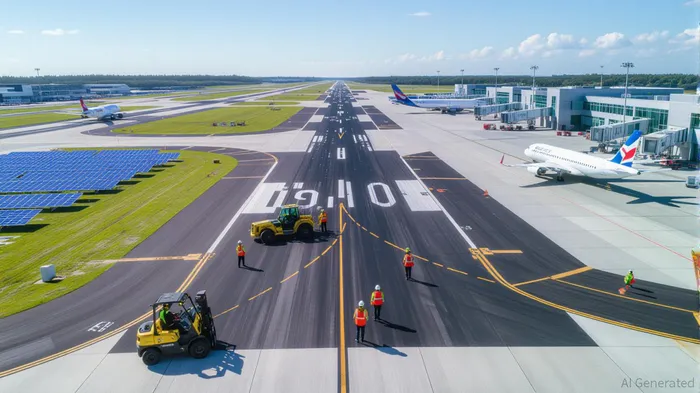 RMMA's underappreciated value lies in its infrastructure projects, which align with both operational efficiency and environmental sustainability. A prime example is the construction of a new 1,300-foot paved taxiway, funded by federal grants, which enhances access to the South Development Area and supports future expansion. This project, coupled with the reconstruction of Taxiway A, addresses aging infrastructure while accommodating projected growth.
Equally significant is RMMA's transition to unleaded aviation fuel, supported by a new fuel tank project. This shift not only reduces harmful emissions but also aligns with federal mandates phasing out leaded fuels. Such sustainability efforts are increasingly attractive to investors prioritizing ESG (Environmental, Social, and Governance) criteria.
Community Engagement: Building Trust Through Collaboration
Resilience is not just about physical infrastructure-it also hinges on social capital. In 2025, RMMA hired a Public Affairs and Communications Specialist and a Community Engagement Coordinator to foster two-way dialogue with residents. These roles are pivotal in addressing concerns over noise and safety, particularly around pilot training operations that have drawn local pushback according to community reports.
Moreover, Jefferson County has partnered with Cascadia Consulting Group to revise its Comprehensive Plan, integrating climate resilience and environmental justice into development regulations. This collaboration reflects a proactive approach to balancing growth with community well-being, a trait that investors increasingly value in infrastructure projects.
Addressing Challenges: Noise, Health, and the Path Forward
RMMA's challenges-namely noise pollution and associated health costs-are not unique to regional airports but require tailored solutions. While the airport has not yet implemented landing fees or stricter noise abatement policies, it has committed to reviewing these measures according to resident advocacy. Monthly noise monitoring reports from September 2024 to 2025 provide transparency, though more aggressive action may be needed to mitigate long-term liabilities according to official documentation.
Investors should view these challenges as opportunities for innovation. For instance, RMMA's engagement with community foundations and climate resilience programs-such as those highlighted in California's Resilience, Capacity Building, and Community Engagement grants-offers a blueprint for integrating local needs into infrastructure planning.
Conclusion: A Strategic Investment in Resilience and Growth
Jefferson County's RMMA exemplifies how regional airports can serve as linchpins for economic and environmental resilience. Its combination of job creation, infrastructure modernization, and community-focused governance positions it as a model for underappreciated assets in the aviation sector. While challenges like noise pollution persist, RMMA's proactive approach to addressing them-through grants, partnerships, and policy revisions-demonstrates a commitment to long-term value creation.
For investors seeking to capitalize on the intersection of infrastructure resilience and economic growth, RMMA offers a compelling case study. By investing in regional hubs like RMMA, stakeholders can support not only local economies but also the broader transition to sustainable, community-centric infrastructure.

Blending traditional trading wisdom with cutting-edge cryptocurrency insights.
Latest Articles
Stay ahead of the market.
Get curated U.S. market news, insights and key dates delivered to your inbox.


AInvest
PRO
AInvest
PRO



Comments
No comments yet