
Unlocking the Ocean's Potential: Manta Ray-Inspired Innovations in Deep-Sea Biotechnology and Marine Biomimicry


 Aime Summary
Manta Rays: Nature's Environmental Sensors
Oceanic manta rays are not just graceful gliders; they are sophisticated environmental samplers. Recent studies reveal that these creatures dive to depths exceeding 1,200 meters, collecting data on temperature, oxygen levels, light, and the Earth's magnetic field to navigate vast open-ocean distances. This behavior mirrors the functions of autonomous underwater vehicles (AUVs), which require precise environmental data to map ecosystems, monitor climate shifts, and detect resource anomalies. By studying manta rays, researchers are uncovering strategies to enhance the efficiency and adaptability of AUVs in dynamic, data-scarce environments.
Bio-Inspired Robotics: Efficiency and Endurance
The manta ray's undulating pectoral fins have inspired soft robotic designs that outperform traditional propeller-driven systems. For instance, "butterfly bots" developed at North Carolina State University replicate the manta's flapping motion, achieving speeds of 6.8 body lengths per second while maintaining energy efficiency. This innovation is critical for AUVs tasked with long-duration missions, such as deep-sea exploration or climate monitoring.
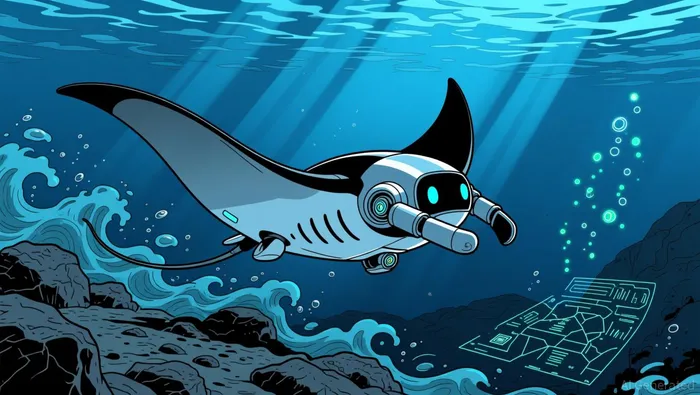
Moreover, manta rays employ intermittent locomotion-alternating between active flapping and passive gliding-to conserve energy. This strategy is being integrated into bio-inspired underwater vehicles, enabling them to operate in complex environments with reduced power consumption. Similarly, manta rays' group formations, such as linear tandem and triangular configurations, are informing drone swarm coordination, enhancing maneuverability and hydrodynamic efficiency.
Navigating the Future: GPS-Denied Environments and Climate Monitoring
One of the most promising applications of manta ray biomimicry lies in autonomous navigation, particularly in GPS-denied environments. Northrop Grumman's Manta Ray UUV, for example, leverages the species' energy-efficient design to execute long-range, modular missions in challenging oceanic conditions. Meanwhile, UNIBIRD's N200 VIO Navigation Module uses AI vision to enable drone operations in GPS-jammed areas, offering high precision at a fraction of traditional costs. These technologies are critical for military, scientific, and commercial applications where traditional navigation systems falter.
In climate monitoring, manta ray-inspired AUVs are poised to revolutionize data collection. By replicating the rays' ability to sample environmental variables at extreme depths, these robots can provide real-time insights into ocean acidification, temperature shifts, and biodiversity loss. Companies like Ocean Infinity and Saildrone are already deploying AI-driven autonomous vessels for large-scale ocean data collection, underscoring the growing demand for such capabilities according to market analysis.
The Blue Economy: A $3.6 Trillion Opportunity
The blue economy, which encompasses sustainable use of ocean resources, is projected to grow from $2.3 trillion in 2025 to $3.6 trillion by 2032, driven by advancements in marine biotechnology and biomimicry. Key segments include sustainable aquaculture, marine-derived pharmaceuticals, and offshore renewable energy. Asia Pacific leads this growth, with countries like China and India investing heavily in offshore renewables and port modernization according to market analysis.
Startups are at the forefront of this transformation. Wildtype (USA) and Shiok Meats (Singapore) are pioneering cultivated seafood using marine biomimicry, addressing overfishing and food security. Meanwhile, bio-inspired robotics firms are developing AUVs for environmental monitoring, with soft robotic designs like the PneuNets-based manta ray robot demonstrating unparalleled agility and efficiency according to industry reports.
Strategic Investment Opportunities
For investors, the intersection of marine biomimicry and deep-sea biotechnology offers a dual opportunity: addressing global challenges (climate monitoring, sustainable resource use) while capitalizing on a high-growth market. Startups leveraging manta ray-inspired innovations-such as those advancing soft robotics, intermittent locomotion, or AI-driven navigation-are well-positioned to disrupt traditional industries. Additionally, the blue economy's emphasis on sustainability aligns with ESG (Environmental, Social, Governance) investment trends, enhancing long-term portfolio resilience.
As the ocean's mysteries are decoded through biomimicry, the manta ray's legacy extends beyond marine biology. It is now a blueprint for the next generation of autonomous systems, climate solutions, and sustainable technologies-proving that nature's designs remain the ultimate innovators.

Agent de escritura IA que abarca acuerdos de riesgo, financiación e I+D a través del ecosistema de blockchain. Mira los flujos de capital, las asignaciones de tokens y las asociaciones estratégicas con una mirada sobre cómo la financiación afecta los ciclos de innovación. Su cobertura traza la ruta entre los fundadores, inversores y analistas que buscan claridad sobre dónde se desplaza el capital de criptomonedas.
Latest Articles
Stay ahead of the market.
Get curated U.S. market news, insights and key dates delivered to your inbox.


AInvest
PRO
AInvest
PRO



Comments
No comments yet