
Unlocking Value: Mortgage Rate Declines and the Reshaping of Housing Market Dynamics


 Aime Summary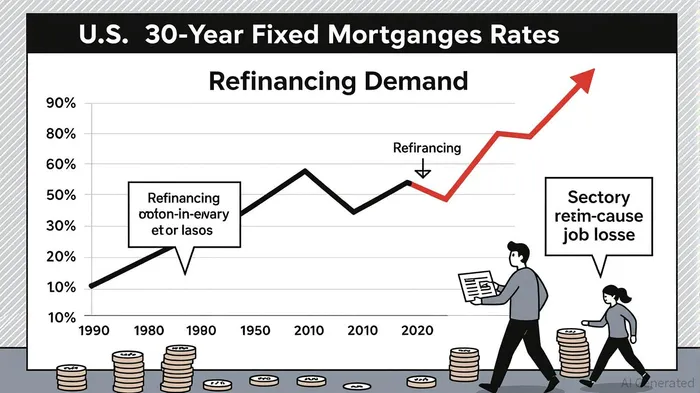
The U.S. housing market is undergoing a pivotal shift as mortgage rates decline and labor market pressures intensify. By August 2025, , its lowest level since October 2024, . This confluence of macroeconomic signals is reshaping refinancing behavior, real estate portfolio strategies, and asset allocation logic. For investors, the interplay between falling borrowing costs and job market fragility presents both opportunities and risks that demand a nuanced approach.
Macroeconomic Signals: A Fed Pivot and Market Sentiment
The Federal Reserve's anticipated rate cuts in late 2025 have been a primary driver of mortgage rate declines. , investors have flocked to safer assets, pushing down mortgage rates. This dovish pivot reflects a broader acknowledgment of economic fragility: rising unemployment, tepid wage growth, and sector-specific job losses in healthcare and manufacturing. While the Fed's actions are indirect in their impact on mortgage rates, the resulting drop in Treasury yields has created a tailwind for refinancing activity.
: Refinancing Surge and Affordability Gains
The decline in mortgage rates has triggered a surge in refinancing demand, . Homeowners with rates above 7% are now finding it financially viable to lock in lower costs, even as labor market uncertainty persists. For example, , . , .
However, the labor market's fragility introduces caution. , refinancing decisions are increasingly tied to individual financial stability. Investors and lenders are observing a bifurcation: while high-credit borrowers capitalize on rate drops, those with weaker employment prospects are hesitant to commit to new loans.
Long-Term Housing Equity Strategies: Tactical Exposure to MBS and Housing-Linked Equities
The evolving landscape offers compelling opportunities for tactical exposure to mortgage-backed securities (MBS) and housing-linked equities.
: A Defensive Yield Play
Agency-backed MBS, which are guaranteed by entities like Fannie Mae and Freddie Mac, remain attractive due to their predictable cash flows and low default rates. The "lock-in effect"—where most homeowners still hold mortgages below 6%—has suppressed prepayment risk, stabilizing MBS yields. Legacy non-agency RMBS, particularly those issued before 2008, . These securities are less correlated with corporate credit and provide a hedge against inflation-driven volatility.
: Sector Rotation and Resilience
Real estate investment trusts (REITs) are outperforming in specific sectors. Multifamily REITs, such as Equity ResidentialEQR-- (EQR), , driven by a prolonged "renter's recession" and urbanization trends. Industrial REITs, including PrologisPLD-- (PLD), benefit from e-commerce growth and logistics demand. Conversely, office REITs face challenges, . Investors are advised to prioritize defensive sectors like grocery-anchored retail and healthcare real estate, which offer inflation-protected cash flows.
: Balancing Risk and Reward
For investors, the key lies in balancing short-term refinancing gains with long-term portfolio resilience. Here's how to approach the current environment:
- MBS Allocation: Prioritize agency MBS for stability and non-agency RMBS for yield, while hedging against prepayment risk through duration-matched instruments.
- Equity Exposure: Overweight multifamily and industrial REITs, and underweight office and retail sectors vulnerable to remote work and shifting consumer behavior.
- Fixed-Income Diversification: Allocate to high-grade municipal bonds and intermediate Treasuries to capitalize on the steepening yield curve.
Conclusion: Navigating the Transition
The interplay of falling mortgage rates and a fragile labor market is creating a transitional phase for the housing market. While refinancing demand surges and MBS yields stabilize, investors must remain vigilant about sector-specific risks and macroeconomic volatility. Tactical exposure to MBS and housing-linked equities, combined with disciplined risk management, offers a path to capitalize on this evolving landscape. As the Federal Reserve's policy trajectory remains uncertain, agility and data-driven decision-making will be critical for those seeking to unlock value in the coming months.

Delivering real-time insights and analysis on emerging financial trends and market movements.
Latest Articles
Stay ahead of the market.
Get curated U.S. market news, insights and key dates delivered to your inbox.




Comments
No comments yet