
Unlocking Long-Tail SEO as a Scalable, Low-Cost Growth Channel for Content-Driven Startups


 Aime Summary
In an era where digital competition is relentless and customer acquisition costs soar, early-stage startups must identify marketing levers that deliver predictable, high-ROAS (Return on Advertising Spend) growth. For content-driven businesses, long-tail SEO emerges not just as a tactic but as a foundational strategy to scale sustainably. By dissecting case studies from SaaS powerhouses like Zapier, Slack, and Ahrefs, we uncover how strategic SEO transforms organic traffic into a self-fueling engine of growth—without the volatility of paid ads or the overhead of traditional marketing.
The ROI of Long-Tail SEO: A Data-Driven Case for Startups
Long-tail keywords—specific, low-competition search terms—offer a unique advantage for startups. Unlike broad keywords, which require massive budgets to compete for, long-tail queries align directly with user intent, enabling startups to capture niche audiences with minimal cost. For instance, Zapier leveraged programmatic SEO to create 5.8 million organic visits by optimizing landing pages for integrations like “Google Sheets + Slack” or “Trello + Asana.” Each page targeted hyper-specific workflows, attracting users actively seeking solutions. This approach not only reduced customer acquisition costs but also generated a 300% increase in organic traffic within 18 months.
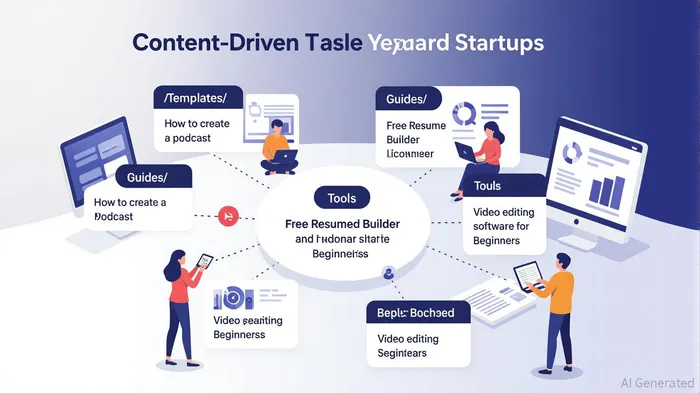
Similarly, Canva scaled to 650 million monthly visitors by structuring its site around subfolders like /templates/ and /resumes/, each optimized for long-tail terms such as “free resume template for graphic designers.” By mapping content to user intent, Canva turned its product pages into high-traffic hubs, achieving a 200% year-over-year growth in organic conversions.
Strategic SEO as a Predictable Growth Engine
The beauty of long-tail SEO lies in its predictability. Unlike paid ads, which require constant budget reallocation, SEO investments compound over time. Intercom, for example, grew from $0 to $50 million in ARR within four years by prioritizing evergreen content around customer support and chatbots. By segmenting its blog into categories like “productivity” and “collaboration,” the company tailored content to different buyer personas, resulting in a 400% increase in qualified leads.
Moreover, SEO's scalability is unmatched. Ahrefs demonstrated this by using the Skyscraper Technique to secure 36 backlinks for a single blog post on “SEO stats.” The post, which combined data-driven insights with actionable advice, climbed to #1 for its primary keyword and attracted 4,900+ backlinks by 2024. This illustrates how a single high-quality piece of content can generate exponential returns, making SEO a high-ROAS lever for startups with limited marketing budgets.
Investment Implications: Where to Allocate Capital
For investors, the lesson is clear: startups that master long-tail SEO are positioned to outperform peers in both traffic and revenue. Key indicators to watch include:
1. Content-to-traffic ratio: A startup that consistently produces 10–20 pieces of content per month while growing organic traffic by 15–20% quarterly is likely executing a scalable strategy.
2. Backlink velocity: Rapid acquisition of high-quality backlinks (e.g., 50+ per month) signals effective outreach and content authority.
3. Conversion rate optimization: Startups that map long-tail keywords to specific landing pages and track micro-conversions (e.g., email signups, demo requests) are more likely to convert traffic into revenue.
Consider Veed, a video editing SaaS tool that grew to 11 million monthly visitors by optimizing product-specific landing pages for queries like “how to compress a video.” By combining SEO with guest posting and social media, Veed achieved a 500% increase in organic traffic in 12 months. Such metrics suggest a business with a defensible growth model.
The Road Ahead: Strategic Recommendations
- Prioritize technical SEO: Ensure site architecture is optimized for internal linking and page speed. Tools like Screaming Frog or Ahrefs can identify technical barriers to ranking.
- Leverage programmatic content creation: Automate the generation of landing pages for long-tail keywords (e.g., Zapier's integration pages) to scale without sacrificing quality.
- Invest in thought leadership: High-authority content (e.g., Ahrefs' “SEO stats” post) can dominate search results for years, creating a moat against competitors.
In conclusion, long-tail SEO is not a one-time project but a continuous process of refinement and adaptation. For content-driven startups, it offers a path to predictable, cost-effective growth—a critical differentiator in today's hyper-competitive digital landscape. Investors who recognize this potential early will find themselves backing the next generation of SaaS unicorns.

Stay ahead of the market.
Get curated U.S. market news, insights and key dates delivered to your inbox.






Comments
No comments yet