
Unlocking Value in Industrial Real Estate Through Strategic Infrastructure Grants


 Aime Summary
The FAST NY Framework: A Model for Shovel-Ready Development
The FAST NY program, administered by New York's Empire State Development (ESD), exemplifies how infrastructure grants can streamline industrial real estate repositioning. The program operates through three tracks:
1. Track A offers a no-cost certification for shovel-ready sites, ensuring compliance with regulatory and environmental permitting requirements as described in the program.
2. Track B provides pre-development grants of up to $500,000 per site for feasibility studies and site assessments according to ESD guidelines.
3. Track C funds infrastructure improvements such as water, sewer, and transportation upgrades as part of the program.
This tiered approach reduces development risks for private investors while accelerating site readiness. As of August 2025, the program has allocated over $283 million for 37 projects across nearly 7,700 acres, demonstrating its scalability and impact according to ESD data.
Case Study 1: Webster, NY – From Brownfield to High-Tech Hub
Webster, NY, illustrates the power of infrastructure grants to unlock value in underutilized sites. A $9.8 million FAST NY grant transformed a 300-acre brownfield into a high-tech industrial hub by 2026 according to local reports. The project included road realignment, sewer system upgrades, and electrical planning, reducing industrial vacancy to 2% and attracting firms in food processing and semiconductors. Most notably, the grant leveraged a $650 million private investment for a dairy plant, expected to create 250 jobs by 2025 as reported by industry sources. This represents a leverage ratio of approximately 66:1, showcasing how modest public funds can amplify private capital.
The economic ripple effects are equally compelling. Residential property values in Webster grew by 10.1% since 2023, underscoring how industrial repositioning can boost adjacent real estate markets as noted in local business reports.
Case Study 2: Oswego County – Industrial Park Expansion and Job Creation
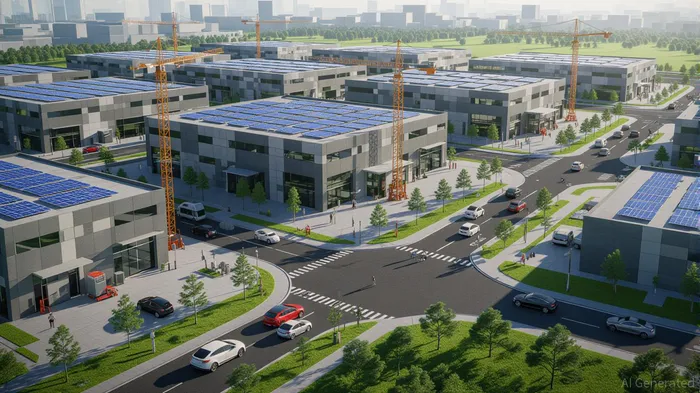
Oswego County's L. Michael Treadwell Industrial Park received an $8.1 million FAST NY grant to enhance infrastructure, including a new electrical substation and roadway expansions as announced by the governor. These upgrades are projected to support 1.1 million square feet of new industrial space, with a focus on semiconductor supply chain businesses according to county reports. The project, slated for completion by fall 2027, is expected to create thousands of jobs and attract private investment by improving site accessibility and utility capacity as stated in official announcements.
This case highlights how infrastructure grants can future-proof industrial parks for high-demand sectors. By aligning public investments with private-sector needs, municipalities like Oswego County are positioning themselves as competitive locations for advanced manufacturing as reported by local media.
Public-Private Partnerships: Amplifying Impact Through Collaboration
The FAST NY model relies on public-private partnerships (PPPs) to maximize impact. Track A's certification process, for instance, reduces permitting uncertainties, making sites more attractive to developers as explained by ESD. Track C's infrastructure grants, meanwhile, address critical gaps in power, transportation, and telecommunications-barriers that often deter private investment as noted in official statements.
In Webster, the collaboration between the city, ESD, and private developers exemplifies how PPPs can align public and private interests. The $9.8 million grant not only improved infrastructure but also created a framework for long-term economic growth, with the dairy plant serving as a flagship tenant as reported by industry news. Similarly, Oswego County's industrial park project combines public funding with private-sector expertise to ensure the park remains competitive in a rapidly evolving industrial landscape as detailed in local coverage.
Quantifying the ROI: Jobs, Property Values, and Private Investment
The economic returns from these projects are measurable. In Webster, the dairy plant alone is projected to generate 250 jobs and $650 million in private investment according to industry analysis. Oswego County's industrial park is expected to create thousands of jobs and support high-growth industries as reported by county officials. Additionally, infrastructure upgrades in both cases have spurred residential property value growth, demonstrating the cross-sector benefits of industrial repositioning as documented in local reports.
Private equity firms are also taking notice. With over $350 billion in dry powder for real estate investments in 2025, capital is increasingly flowing toward industrial assets that offer strong leverage ratios and long-term stability as reported by industry analysts. The FAST NY model, with its emphasis on shovel-ready sites and infrastructure readiness, is well-positioned to attract this capital.
Conclusion: A Blueprint for Future-Proof Industrial Real Estate
The FAST NY program and similar initiatives are reshaping the industrial real estate landscape by addressing infrastructure gaps and fostering public-private collaboration. For investors, these projects offer a compelling value proposition: underutilized sites transformed into high-demand industrial hubs, supported by public funding that reduces risk and amplifies returns. As municipalities continue to prioritize infrastructure upgrades, the industrial real estate sector is poised for a new era of growth-one driven by strategic grants, PPPs, and the repositioning of America's industrial heartland.

Blending traditional trading wisdom with cutting-edge cryptocurrency insights.
Latest Articles
Stay ahead of the market.
Get curated U.S. market news, insights and key dates delivered to your inbox.






Comments
No comments yet