
Unlocking Value in High-Yield Savings: Why Retail Investors Must Shift Capital Now
The Federal Reserve's aggressive rate-hiking cycle from 2022 to 2023 has created a stark divide between stagnant conventional savings accounts and high-yield alternatives. For retail investors, this divergence represents a rare opportunity to boost risk-adjusted returns without taking on additional risk. Here's why the shift to high-yield savings products is critical—and how to execute it.
The Yield Gap: A Decade of Divergence
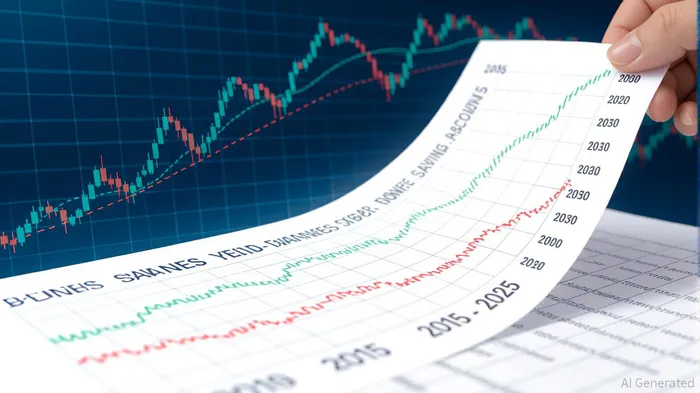
Conventional savings accounts, offered by large banks like JPMorganJPM-- or Bank of AmericaBAC--, have long been synonymous with near-zero returns. Since 2015, their average annual yield has never exceeded 0.47%—peaking in 2024 before declining to 0.41% in 2025. Meanwhile, high-yield accounts from digital banks like Bask, Varo, and Fitness Bank surged to 5.00% APY by late 2023, a 12-fold advantage over traditional offerings.
The catalyst? Structural differences. High-yield providers operate with lower overhead costs and prioritize competitive rates to attract deposits. Conventional banks, burdened by physical branches and legacy systems, cannot match these returns.
Risk-Adjusted Returns: No Trade-Off Needed
Both high-yield savings accounts and conventional savings products are FDIC-insured, meaning they carry identical credit risk. The sole difference lies in yield.
- 2015–2021: High-yield accounts offered 5–10x the returns of conventional accounts (e.g., 0.99% vs. 0.06% in 2015).
- 2022–2024: The gapGAP-- widened further, with high-yield rates hitting 5% while conventional accounts languished at 0.45%.
- 2025: Even with three Fed rate cuts in late 2024, high-yield accounts still deliver 12x the yield of conventional options (5.00% vs. 0.41%).
This is a no-brainer for liquidity-focused investors. Consider this:
- $100,000 in a conventional account (0.41% APY) earns $410/year.
- The same in a high-yield account (5.00% APY) generates $5,000/year—12x the return with no added risk.
Actionable Steps: Reallocate Capital Strategically
- Move Cash to High-Yield Savings Accounts Immediately
Start by transferring emergency funds or short-term liquidity needs to institutions offering 4.5%–5.0% APY. Key players include: - Varo Bank: 5.00% APY (as of July 2025)
- Bask Bank: 4.75% APY (no minimum balance)
Fitness Bank: 4.90% APY (with debit card rewards)
Ladder CDs for Predictable Returns
Short-term CDs (e.g., 6–12 months) currently offer 4.25%–4.75% APY, outperforming long-term CDs and conventional accounts. Use a CD ladder to lock in rates while maintaining liquidity.Avoid “Sticky” Conventional Banks
Institutions like Chase or Wells FargoWFC-- still offer laughably low rates (0.01%–0.08% APY). Their value proposition—convenience—is far outweighed by the yield penalty.
Risks and Considerations
- Rate Cycles: If the Fed cuts rates further, high-yield accounts will eventually follow. But with inflation still above 3%, the Fed won't slash rates aggressively anytime soon.
- Liquidity: High-yield accounts offer the same access as conventional ones, with no lock-up periods. CDs require a time commitment but are FDIC-insured up to $250,000.
Conclusion: Capitalize on the Fed's Gift
The Fed's rate-hiking era has gifted retail investors a once-in-a-decade chance to boost cash returns without risk. By reallocating funds to high-yield savings and strategic CDs, you can secure 5%+ returns while preserving liquidity.
The math is simple: Do not keep money in conventional savings accounts. The yield gap is too wide to ignore.
Act now—before rates drop further.
Stay informed: Track APY changes with .

Stay ahead of the market.
Get curated U.S. market news, insights and key dates delivered to your inbox.
AInvest
PRO
AInvest
PRO



Comments
No comments yet