
Unlocking Hidden Value: Grassroots Sports Clubs and the Music Festival Revenue Play
In an era where traditional revenue streams are under pressure, grassroots sports clubs are discovering a novel path to financial resilience: repurposing underutilized real estate for music festivals. This strategy not only taps into the booming live entertainment market but also unlocks latent value in undervalued sports facilities. Let's explore how this shift could redefine the investment landscape—and where to place your bets.
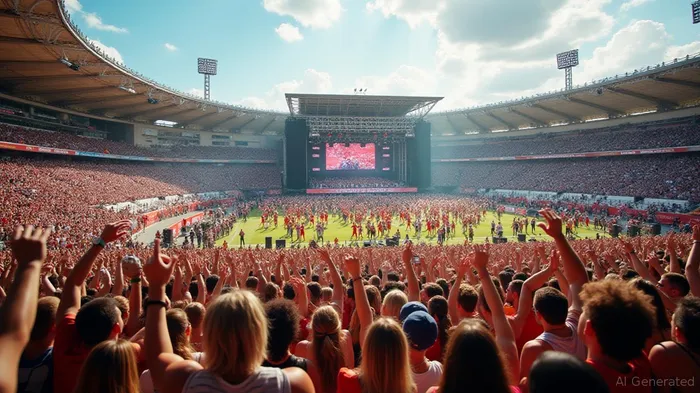
The Undervalued Real Estate Opportunity
Sports clubs often own prime real estate—stadiums, arenas, and open fields—that sits idle outside of game days. These spaces are prime candidates for transformation into event venues. Consider the Deccan Festival in Hyderabad, which generated $6.7 million in direct revenue through ticket sales and vendor activity. The event also drove $2 million in indirect revenue from hotels, which saw 90% occupancy. This underscores how festivals can turn dormant assets into cash flow engines.
For investors, the key is identifying clubs with underutilized properties in regions with strong entertainment demand. Such assets are often undervalued because their potential isn't fully recognized. A stadium in a growing city, for instance, could command higher valuations once its dual-use potential is proven.
Event-Driven Income Streams: A Gold Mine
Music festivals offer multiple revenue streams:
1. Ticket Sales: Direct income from attendees, amplified by premium pricing for high-profile acts.
2. Sponsorships: Brands eager to align with cultural events (e.g., beverage companies partnering with music festivals).
3. Merchandise & Vendors: Food trucks, artisan stalls, and branded goods sold on-site.
4. Government & Tourism Funds: Festivals attract tourists, boosting local economies and potentially securing grants.
The Venu Holding Corporation (NYSE: VENU) is already capitalizing on this model. The company's $10.125 million investment in amphitheaters in McKinney, Texas, and Tulsa, Oklahoma, aims to tap into this demand.
This visual would show a rising stock price, reflecting investor confidence in its diversification strategy.
Case Study: Venu Holding's Strategic Play
Venu's convertible preferred stock offering at $15 per share (with a 4% dividend) signals confidence in its growth trajectory. If its stock climbs above $20—a realistic target given its amphitheater pipeline—the conversion terms could yield significant returns for investors. The company's focus on repurposing sports facilities aligns with the $1.08 trillion sports facilities market, projected to grow at 23.4% annually through 2034.
Challenges and Mitigation Strategies
While the potential is clear, risks exist:
- High Operational Costs: Venue upgrades and permits can strain budgets.
- Regulatory Hurdles: Tax policies (e.g., DraftKings' $0.50 Illinois fee) may squeeze margins.
- Competition: Established festivals and venues could siphon audiences.
Solution: Prioritize clubs with strong local partnerships (e.g., sponsorships, tourism boards) and invest in technology-driven experiences (e.g., AR/VR integrations) to differentiate events.
Investment Opportunities: Where to Look Now
- Undervalued Sports Clubs: Target those in regions with rising tourism or entertainment demand. Use metrics like property occupancy rates and local GDP growth to identify candidates.
- Venue Operators Like VENU: Their stock (VENU) is a direct play on the trend. Monitor its progress in Tulsa/McKinney for near-term catalysts.
- Live Event Partners: Companies like Live Nation (NYSE: LYV), which signed diplomat Richard Grenell to boost negotiations, could benefit from expanded partnerships with sports venues.
A comparison would reveal which company is better positioned for growth.
The Bottom Line
Grassroots sports clubs are no longer just about games—they're evolving into cultural hubs. By repurposing real estate and embracing music festivals, they're creating event-driven income streams that could redefine their value. For investors, this is a multi-faceted opportunity: a bet on real estate appreciation, live entertainment growth, and operational innovation.
Action Items:
- Buy VENU if its amphitheaters meet initial attendance targets.
- Consider LYV for its scale and event expertise.
- Look for ETFs tracking sports facilities or live entertainment stocks (e.g., $LIVN).
The next wave of growth isn't just about stadiums—it's about stadiums that also rock.

Stay ahead of the market.
Get curated U.S. market news, insights and key dates delivered to your inbox.
AInvest
PRO
AInvest
PRO



Comments
No comments yet