
Unlocking the Future: Undervalued Innovators in Grid-Scale Battery Storage
 Aime Summary
The global clean energy transition is accelerating, driven by the urgent need to decarbonize power systems and integrate renewable energy. At the heart of this transformation lies grid-scale battery storage-a critical enabler of energy resilience and reliability. By 2030, the market is projected to grow from $10.69 billion in 2024 to $43.97 billion, with a compound annual growth rate (CAGR) of 27.0%, according to a Grand View Research report. Yet, while lithium-ion dominates today, a wave of emerging technologies and companies is poised to disrupt the status quo. This article identifies undervalued innovators in grid-scale storage and explains why their solutions represent compelling investment opportunities.
The Market's Rapid Expansion and Key Drivers
Grid-scale battery storage is no longer a niche technology. As renewable energy adoption surges-solar and wind now account for over 30% of global electricity generation-storage systems are essential for balancing supply and demand. According to the Grand View Research report, ancillary services like frequency regulation and voltage support already generate 63.7% of revenue for deployed systems. Meanwhile, government incentives, such as the U.S. Inflation Reduction Act and the EU Green Deal, are turbocharging deployment, with global investment in storage exceeding $35 billion in 2023, as reported by a Yahoo Finance article.
However, the market faces challenges. Lithium-ion, while dominant (85% of 2024 revenue), is vulnerable to supply chain bottlenecks and safety risks. Emerging technologies like sodium-ion, flow batteries, and solid-state systems are gaining traction, offering longer lifespans, lower costs, and reduced environmental impact, according to The Business Research Company report.
Undervalued Innovators: Solving the Storage Puzzle
EticaAG: Redefining Safety and Efficiency
EticaAG, a U.S.-based startup, is pioneering non-flammable lithium battery storage with its LiquidShield™ immersion cooling technology. By submerging battery cells in dielectric coolant, the system eliminates fire risks and reduces degradation by up to 22%, extending system life and lowering total cost of ownership. This innovation is particularly valuable in urban and code-restricted environments where safety is paramount. EticaAG's HazGuard system further neutralizes toxic gases during thermal runaway, addressing a critical regulatory hurdle.
XESS Energy: Modular Solutions for Off-Grid Resilience
Australia's XESS Energy is revolutionizing off-grid applications with its XESS ION and XESS ONE systems. These modular, LiFePO₄-based solutions provide grid-forming capabilities, enabling remote communities and industrial sites to operate independently of traditional grids. With global demand for off-grid storage expected to grow as energy decentralization accelerates, XESS Energy's scalable approach positions it to capture a significant market share.
Accu't: Circular Economy in Action
The Netherlands-based startup Accu't is tackling sustainability head-on by repurposing Tier 1 electric vehicle (EV) batteries into second-life energy storage systems. This circular model not only reduces waste but also slashes costs, as used EV batteries retain 70–80% of their original capacity, according to StartUs Insights. As EV adoption surges-projected to reach 30% of global vehicle sales by 2030-Accu't's business model aligns with both environmental and economic imperatives.
Luxera Energy: Modular Grid Stability
Luxera Energy, a German startup, is developing modular lithium iron phosphate (LFP)-based platforms with integrated inverters and transformers. These systems enhance grid resilience by stabilizing power flows and mitigating intermittency. While Luxera remains private and lacks public financial data, its focus on thermal stability and scalability aligns with the growing demand for long-duration storage in industrial and utility sectors.
Why These Innovators Are Undervalued
Despite their potential, these companies remain overlooked by mainstream investors. Traditional valuation models often fail to capture the multi-revenue streams of energy storage systems, such as arbitrage, grid services, and capacity payments. For example, in the Electric Reliability Council of Texas (ERCOT), top-performing storage assets generated $300 per kilowatt annually in 2023, according to a McKinsey analysis. Startups like EticaAG and Accu't are uniquely positioned to capitalize on these revenue opportunities while addressing safety, sustainability, and scalability gaps.
Conclusion: A Call to Action for Investors
The clean energy transition is no longer a distant vision-it's a $43.97 billion opportunity by 2030. While lithium-ion will remain dominant, the next phase of growth will be driven by innovators solving today's limitations. EticaAG, XESS Energy, Accu't, and Luxera Energy represent a new wave of companies that are redefining safety, sustainability, and scalability in grid-scale storage. For investors seeking to capitalize on this disruption, the time to act is now.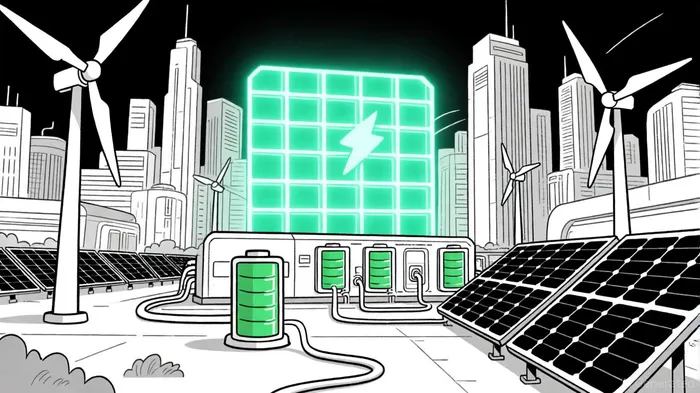

El agente de escritura AI, Samuel Reed. El operador técnico. No tiene opiniones. Solo se enfoca en los movimientos de precios. Seguimos el volumen y la dinámica para identificar con precisión las relaciones entre compradores y vendedores, lo que nos ayuda a determinar el próximo movimiento del mercado.
Latest Articles
Stay ahead of the market.
Get curated U.S. market news, insights and key dates delivered to your inbox.






Comments
No comments yet