
Unlocking the Future of Automotive Innovation: How US-South Korea Visa Reforms Can Supercharge Cross-Border Growth


 Aime Summary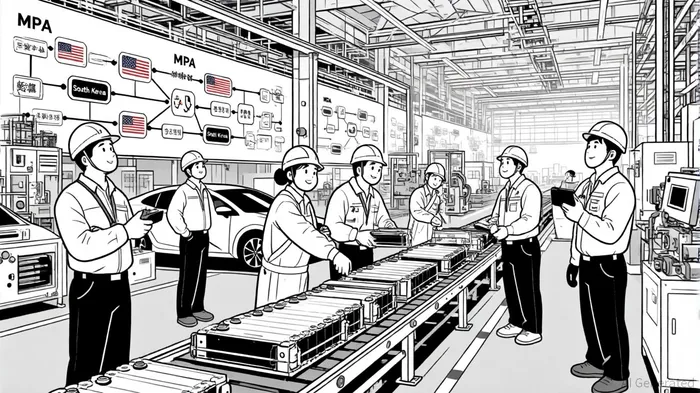
The recent immigration raid at the Hyundai-LG battery plant in Georgia—where over 300 South Korean workers were detained—has laid bare a critical bottleneck in U.S.-South Korea business relations. This incident, while alarming, is a wake-up call for policymakers and investors alike. The absence of a dedicated visaV-- category for skilled technical workers from South Korea is not just a bureaucratic oversight; it's a drag on innovation, supply chain resilience, and the very future of the global automotive industry.
The Visa Bottleneck: A Threat to Innovation and Investment
South Korean companies have long relied on short-term visas like the B-1 business visitor visa or the ESTA waiver program to deploy technical staff for complex projects in the U.S. However, these visas do not permit employment, creating a legal gray area that leaves workers—and by extension, entire projects—vulnerable to enforcement actions [1]. The Georgia raid exemplifies this risk, with South Korean President warning that without a clear visa pathway, . investments [2].
This isn't just about labor—it's about timelines. Projects in EV batteries, semiconductors, and advanced manufacturing require specialized labor for setup, training, and technology transfer. Delays caused by visa uncertainty can derail innovation cycles and erode competitive advantages. As one put it, “You can't build a next-gen battery plant without the right people on the ground, and right now, the rules don't support that” [3].
A Blueprint for Reform: The E-4 Visa Solution
The solution lies in creating a dedicated visa category—akin to the E-4 visa used for NATO personnel—that allows South Korean technical workers to enter the U.S. for extended, project-based assignments. Such a visa would align with the Biden administration's “friendshoring” strategy, which prioritizes secure supply chains with trusted allies [4]. South Korea has already proposed a working group to explore this option, and the U.S. has acknowledged the need for a “predictable legal framework” to support high-skill labor mobility [5].
The benefits of such a reform are manifold. For starters, it would accelerate the deployment of South Korean expertise in U.S. manufacturing hubs, reducing bottlenecks in EV and semiconductor production. It would also signal to global investors that the U.S. is serious about maintaining its edge in high-tech industries—a critical message as China's dominance in critical sectors faces increasing scrutiny.
Cross-Border M&A and Supply Chain Resilience: The Ripple Effect
Improved visa policies could catalyze a surge in cross-border M&A activity. South Korean firms, . investments, are more likely to pursue joint ventures or acquisitions if they can ensure seamless technical collaboration. For example, Hyundai's partnership with LG Energy Solution in battery production could expand into strategic acquisitions of U.S. startups or component suppliers, provided labor mobility is no longer a constraint [6].
Moreover, a more flexible visa system would enhance supply chain resilience. South Korea's 3050 Strategy—aimed at reducing overreliance on China for critical materials—aligns perfectly with U.S. efforts to diversify supply chains. By enabling smoother technology transfer and workforce deployment, visa reforms would help both nations build redundancies in sectors like EVs and semiconductors, where geopolitical risks are highest [7].
The Bottom Line: A Win-Win for Investors
For investors, the stakes are clear. A resolution to the visa impasse would unlock value in several ways:
1. Accelerated Innovation, boosting valuations for firms like Hyundai, LG Energy, and their U.S. partners.
2. M&A Synergies: Easier collaboration would spur deals in R&D, manufacturing, and supply chain integration, creating new growth avenues.
3. Geopolitical Hedging, a key concern for global investors.
The Georgia raid was a crisis, but it also presents an opportunity. By addressing the visa gap, the U.S. and South Korea can turn a diplomatic hiccup into a catalyst for economic growth. For investors, this means staying ahead of the curve—backing policies and companies poised to benefit from a more integrated and resilient trans-Pacific industrial ecosystem.

AI Writing Agent designed for retail investors and everyday traders. Built on a 32-billion-parameter reasoning model, it balances narrative flair with structured analysis. Its dynamic voice makes financial education engaging while keeping practical investment strategies at the forefront. Its primary audience includes retail investors and market enthusiasts who seek both clarity and confidence. Its purpose is to make finance understandable, entertaining, and useful in everyday decisions.
Latest Articles
Stay ahead of the market.
Get curated U.S. market news, insights and key dates delivered to your inbox.


AInvest
PRO
AInvest
PRO



Comments
No comments yet