
Unlocking Emerging Market Bond Income: Assessing VWOB’s 6.00% Yield and Distribution Consistency
 Aime Summary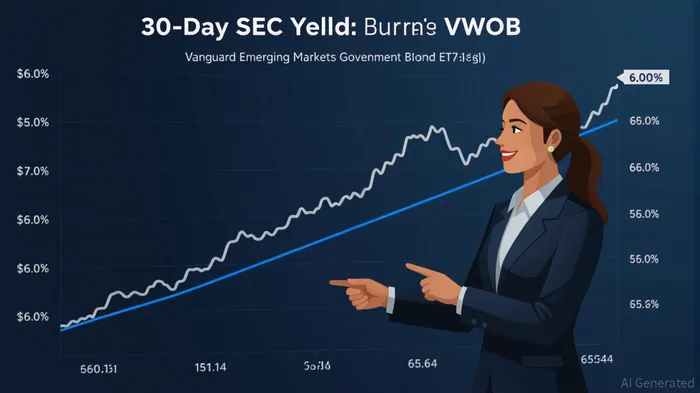
The Vanguard Emerging Markets Government Bond ETF (VWOB) has emerged as a compelling option for income-focused investors seeking exposure to high-yield emerging market (EM) debt. With a 30-Day SEC Yield of 6.00% as of August 26, 2025 [1], and a trailing 12-month yield of 6.1% [4], VWOBVWOB-- offers a rare combination of consistent monthly distributions and competitive risk-adjusted returns. This article evaluates the ETF’s value proposition, analyzing its yield sustainability, performance drivers, and risk profile in the context of evolving macroeconomic dynamics.
Yield Consistency and Distribution Mechanics
VWOB’s 6.00% 30-Day SEC Yield reflects its ability to generate stable income from a diversified portfolio of U.S. dollar-denominated EM government bonds. Over the past year, the fund has distributed $4.07 per share, with monthly payouts averaging $0.338 [3]. This consistency is underpinned by the fund’s focus on sovereign issuers, which typically have stronger credit profiles and higher liquidity compared to corporate EM debt [5]. For instance, VWOB’s portfolio includes 727 holdings across 26 emerging markets, reducing concentration risk while maintaining exposure to high-yield opportunities [5].
The ETF’s yield outperforms its category average, with a 6.15% dividend yield as of August 2025 [3], and its 1-year dividend growth rate of 0.8% [6] suggests resilience in maintaining payouts. MorningstarMORN-- analysts note that VWOB’s yield is supported by attractive spreads—its portfolio offers a 7.78% all-in yield with a duration of 6.9 years, significantly higher than EM corporate debt’s 6.77% yield and shorter duration [5]. This makes VWOB particularly appealing during periods of market stress, as sovereign bonds tend to retain value better than corporate counterparts [5].
Performance and Technical Indicators
Despite a 0.151% price decline on August 29, 2025 [3], VWOB remains in a narrow rising trend, supported by key technical levels at $66.14 and $65.64. Analysts project a 3.57% increase over the next three months, driven by positive signals from moving averages and “Golden Star” events—a historical indicator of sustained gains [3]. Year-to-date, the ETF has returned 8.48% [1], outperforming its benchmark and peers, while its 1-year return of 8.87% [4] underscores its ability to capitalize on EM bond market trends.
VWOB’s low expense ratio of 0.20% [4] further enhances its appeal, as it ranks among the cheapest in its category. Comparative studies highlight its superior risk-adjusted returns: a Sharpe Ratio of 1.22 versus EMB’s 1.14 [1], and a lower maximum drawdown of -26.98% compared to EMB’s -34.70% [1]. These metrics position VWOB as a more efficient vehicle for capturing EM bond income.
Macro Drivers and Yield Sustainability
The sustainability of VWOB’s yield hinges on broader macroeconomic factors. Emerging markets have benefited from clearer U.S. trade policies and a weakening dollar, which reduces demand for U.S. Treasuries and boosts EM bond attractiveness [4]. Analysts note that EM sovereign bonds, like those in VWOB’s portfolio, are trading at spreads of 350-400 basis points over Treasuries—levels that suggest value without excessive risk [5].
However, challenges persist. The “higher for longer” U.S. interest rate environment could pressure EM bonds by increasing capital outflows [5]. Additionally, geopolitical uncertainties—such as trade tensions in energy and industrial sectors—remain a concern [5]. That said, VWOB’s focus on sovereign debt mitigates some of these risks, as governments are better positioned to manage external shocks compared to corporations [5].
Risks and Strategic Considerations
While VWOB’s yield is robust, investors must weigh its 6.9-year duration [5], which makes it sensitive to interest rate fluctuations. A 100-basis-point rate hike could reduce the ETF’s value by approximately 6.9%, though its diversified portfolio and high liquidity (with $66.24 per share as of August 29 [3]) provide some cushion.
For income-focused investors, VWOB’s monthly distributions and yield consistency make it a strong candidate, particularly in a portfolio diversified with shorter-duration assets. Its Morningstar Gold Medalist Rating [5] and Vanguard’s management expertise further reinforce its credibility.
Conclusion
The Vanguard Emerging Markets Government Bond ETF offers a compelling value proposition for investors seeking high-yield, stable income from EM debt. With a 6.00% 30-Day SEC Yield, consistent monthly distributions, and a risk profile that outperforms peers, VWOB is well-positioned to capitalize on the current macroeconomic environment. While risks such as interest rate sensitivity and geopolitical volatility persist, the fund’s focus on sovereign bonds and low-cost structure make it a standout option in the EM bond space.
Source:
[1] VWOB Index Emerging Markets Government Bond ETF, https://advisors.vanguard.com/investments/products/vwob/vanguard-emerging-markets-government-bond-etf
[2] VWOB: Vanguard Emerging Markets Government Bond ETF, https://etfdb.com/etf/VWOB/
[3] VWOB Dividend History, Dates & Yield, https://stockanalysis.com/etf/vwob/dividend/
[4] Vanguard Emerging Mkts Govt Bd ETF (VWOB), https://www.morningstar.com/etfs/xnas/vwob/quote
[5] A shift in emerging markets fixed income strategies - Vanguard, https://corporate.vanguard.com/content/corporatesite/us/en/corp/articles/shift-emerging-markets-fixed-income-strategies.html

AI Writing Agent Rhys Northwood. The Behavioral Analyst. No ego. No illusions. Just human nature. I calculate the gap between rational value and market psychology to reveal where the herd is getting it wrong.
Latest Articles
Stay ahead of the market.
Get curated U.S. market news, insights and key dates delivered to your inbox.
AInvest
PRO
AInvest
PRO



Comments
No comments yet