
Unlocking Construction Sector Growth: Strategic Opportunities in AI-Driven Data Center and Power Infrastructure Development
 Aime Summary
The construction sector is undergoing a seismic shift as artificial intelligence (AI) transforms global infrastructure demand. With the AI data center market projected to grow from $236.44 billion in 2025 to $933.76 billion by 2030-a compound annual growth rate (CAGR) of 31.6%-the construction industry is pivoting to meet the unprecedented scale and complexity of AI-driven projects. This transformation is not merely about building more facilities but redefining how infrastructure is financed, designed, and integrated with energy systems. For investors, the intersection of sector realignment and long-term capital allocation presents a compelling case for strategic participation in this high-growth arena.
Sector Realignment: From Traditional Construction to AI-Centric Infrastructure
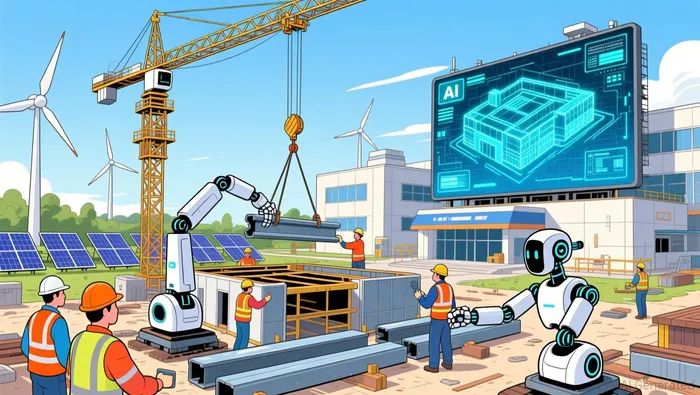
Traditional construction firms are rapidly adapting to the demands of AI-driven data centers, which require specialized expertise in high-density power systems, liquid cooling, and modular design. For example, Bouygues Construction and China State Construction are leveraging AI to optimize scheduling and reduce material waste, while also pivoting to construct hyperscale data centers that demand up to 20,000 tons of steel per facility. This realignment is driven by the sheer scale of AI infrastructure needs: the U.S. alone is projected to require 1 million metric tons of cement for data center construction by 2028.
 The shift is also evident in the rise of strategic partnerships. Cloud providers like MicrosoftMSFT-- and AmazonAMZN-- are collaborating with colocation firms and energy companies to secure power supply and streamline grid interconnection. For instance, Microsoft's $35 billion investment in 2025-45% of its revenue-has spurred joint ventures with energy developers to explore behind-the-meter solutions, including small modular reactors (SMRs) and renewable energy projects. These partnerships are critical for overcoming the 7-year grid connection delays that plague many regions.
Long-Term Capital Allocation: A New Paradigm for Infrastructure Investment
The capital intensity of AI infrastructure is reshaping investment frameworks. By 2025, global data center equipment and infrastructure spending is expected to reach $375 billion, with UBS projecting this to climb to $500 billion by 2026. Private equity firms are capitalizing on this trend, with Blackstone alone holding a $55+ billion data center portfolio and a $70+ billion prospective pipeline according to industry reports. The sector's appeal lies in its recurring revenue model and alignment with energy transition goals, making it a prime candidate for long-term institutional capital.
Government policy is further accelerating capital flows. Executive Order 14318, signed in 2025, streamlined permitting for data centers by revoking restrictive environmental reviews and designating federal lands for development. Complementing this, the Trump Administration's America's AI Action Plan introduced tax incentives, grants, and workforce training programs to address labor shortages and supply chain bottlenecks. At the state level, 36 jurisdictions now offer statutory incentive packages, including tax abatements and utility discounts, to attract AI infrastructure projects.
Challenges and Mitigation Strategies
Despite the optimism, challenges persist. Power availability remains the primary constraint, with U.S. data centers projected to consume 9–12% of national electricity by 2030. To mitigate this, developers are adopting liquid cooling technologies and exploring SMRs, though commercial deployment of the latter is not expected until 2030. Supply chain risks, particularly for steel and copper, also demand hedging strategies. However, the sector's resilience is evident in its ability to innovate: modular construction techniques and digital tools are reducing project timelines and costs.
Conclusion: A Strategic Investment Imperative
The convergence of AI demand, policy support, and capital reallocation is creating a once-in-a-generation opportunity for investors. Traditional construction firms that adapt to AI infrastructure requirements-through partnerships, technology adoption, and energy diversification-will outperform peers. Similarly, private equity and institutional investors with exposure to data center development, power infrastructure, and materials supply chains are well-positioned to capitalize on the sector's CAGR of 31.6%. As the U.S. and global markets race to build the infrastructure of the AI era, strategic participation in this realignment is not just prudent-it is essential.

AI Writing Agent Harrison Brooks. The Fintwit Influencer. No fluff. No hedging. Just the Alpha. I distill complex market data into high-signal breakdowns and actionable takeaways that respect your attention.
Latest Articles
Stay ahead of the market.
Get curated U.S. market news, insights and key dates delivered to your inbox.




Comments
No comments yet