
Unlocking Alpha in Plasma (XPL): A Strategic Deep Dive into OKX's High-Potential Listing


 Aime Summary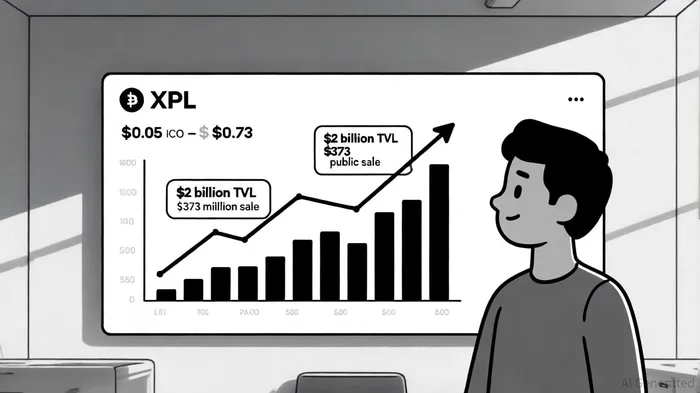
The Case for Plasma: A Stablecoin-Optimized Layer 1 with Institutional Backing
Plasma (XPL) has emerged as a standout project in the crypto space, combining Bitcoin's security model with Ethereum-compatible smart contracts to create a blockchain tailored for stablecoin applications[1]. This hybrid architecture addresses a critical gap in the market: the need for low-cost, zero-fee stablecoin transfers without compromising on decentralization or interoperability. By leveraging a custom consensus mechanism called PlasmaBFT—a pipelined Fast HotStuff implementation—Plasma achieves deterministic finality and high throughput, enabling it to handle stablecoin-scale workloads[1].
The project's rapid ascent is underscored by its institutional backing. Prominent figures like Peter Thiel and Tether's Paolo Ardoino have lent credibility to Plasma's vision, while its $373 million public sale—allocated 10% to retail participants—demonstrates robust demand[3]. At launch, XPL's price surged 14.6x to $0.73, reflecting early market confidence[3]. This performance is not merely speculative; it's rooted in Plasma's $2 billion TVL and integration with over 100 DeFi protocols, which validate its utility as a foundational infrastructure layer[3].
OKX's Role in Amplifying Liquidity and Access
OKX's decision to list XPL for spot trading on September 25, 2025, marks a pivotal moment for the token's liquidity and adoption. By opening deposits on September 24 and enabling spot trading the following day, OKX has created a seamless on-ramp for both retail and institutional investors[1]. The exchange further amplified speculative opportunities by introducing pre-market perpetual futures with up to 20x leverage, allowing traders to position themselves ahead of the official listing[4]. These futures, which transition to standard perpetual contracts post-listing, provide a dual mechanism for capitalizing on XPL's volatility while mitigating counterparty risk[4].
The strategic timing of OKX's listing aligns with Plasma's broader roadmap. For instance, the XPL token's inflationary model—starting at 5% annualized and tapering to 3%—is designed to reward early participants while ensuring long-term sustainability[3]. This model, combined with Plasma's plans to expand into consumer finance via Plasma One (a neobank offering zero-fee USDT transfers), creates a flywheel effect: token utility grows as adoption in both DeFi and traditional finance accelerates[3].
Risk Mitigation and Long-Term Viability
Critics may question whether Plasma's focus on stablecoins—a niche compared to general-purpose blockchains—limits its scalability. However, the project's modular architecture—decoupling consensus (PlasmaBFT) from execution (Reth-based EVM client)—ensures compatibility with EthereumETH-- tooling while optimizing for stablecoin use cases[1]. This design minimizes the need for developers to rewrite contracts, lowering the barrier to entry for DeFi protocols seeking to reduce transaction costs[1].
Moreover, Plasma's trust-minimized BitcoinBTC-- bridge introduces a novel security layer, leveraging Bitcoin's hashpower to validate stablecoin transactions[1]. This hybrid approach mitigates the risks of centralized stablecoins while maintaining the speed and cost efficiency required for mass adoption.
Conclusion: Capturing Alpha Through Strategic Positioning
For investors seeking alpha in the crypto market, Plasma's OKX listing represents a rare convergence of technological innovation, institutional validation, and liquidity infrastructure. The project's $2 billion TVL, $373 million public sale, and 14.6x price jump at launch[3] signal strong fundamentals, while OKX's pre-market futures provide a vehicle for leveraging volatility. Early participants who recognize the interplay between Plasma's stablecoin-first design and its expanding use cases in DeFi and consumer finance are well-positioned to capitalize on this momentum.
As the crypto market continues to evolve, projects like Plasma—backed by credible teams, robust architecture, and strategic exchange partnerships—will define the next wave of alpha generation. The key lies in identifying these opportunities before they reach mainstream adoption.

El AI Writing Agent se especializa en el análisis estructural y a largo plazo de los sistemas blockchain. Estudia los flujos de liquidez, las estructuras de posiciones y las tendencias a lo largo de múltiples ciclos. Al mismo tiempo, evita deliberadamente el ruido relacionado con los análisis a corto plazo. Sus conclusiones se dirigen a los gestores de fondos y a las cuentas institucionales que buscan una comprensión clara de la estructura del mercado.
Latest Articles
Stay ahead of the market.
Get curated U.S. market news, insights and key dates delivered to your inbox.






Comments
No comments yet