
Unlocking AI's Potential: IBM's Insights for CMOs
ByAinvest
Monday, Aug 11, 2025 12:53 pm ET2min read
IBM--
The market is segmented by type, with Variational Autoencoders (VAEs) dominating in 2024, accounting for a 30% revenue share. VAEs are favored for their ability to simulate various logistics scenarios and process structured data, making them suitable for large logistics firms. Generative Adversarial Networks (GANs) are projected to grow at the fastest CAGR due to their ability to generate synthetic data and model complex multi-variable logistics systems.
Cloud-based deployment currently dominates the market, accounting for 68% of revenue share in 2024. However, on-premise solutions are expected to register the fastest CAGR during 2024–2032, driven by the need for data security and local data governance laws.
Road transportation currently dominates the market, accounting for 34% of revenue share in 2024. However, shipping and ports are expected to grow at the fastest CAGR from 2024 to 2032, driven by the digitization initiative in maritime logistics.
North America currently dominates the market, accounting for 44% of revenue share in 2024. However, Asia-Pacific is expected to record the fastest CAGR from 2024 to 2032, driven by the booming e-commerce industry and increasing investments in smart cities and digital logistics corridors.
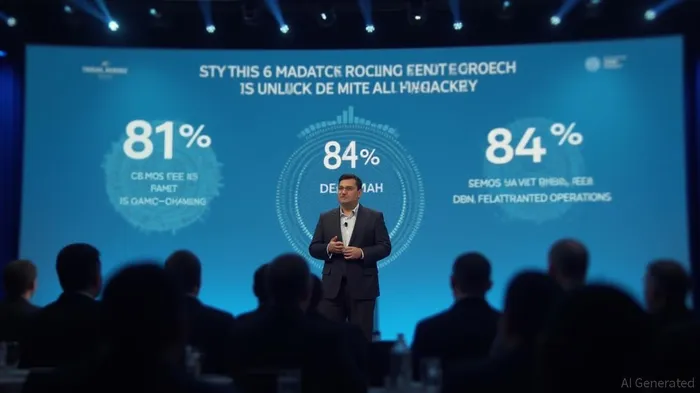
IBM's Institute for Business Value study highlights the challenges faced by CMOs in implementing AI, with 84% facing rigid, fragmented operations hindering its full potential. IBM addresses these challenges through its "client zero" approach, testing AI tools on its own operations before offering them to clients. This approach emphasizes the need for data as a foundation for AI implementation, with the visible technology representing only 20% of the transformation, while the deeper systems, processes, and data drive the remaining 80%.
References
[1] Generative AI in Logistics Market Report, SNS Insider, https://finance.yahoo.com/news/generative-ai-logistics-market-hit-133000480.html
IBM's Institute for Business Value study found that 81% of CMOs see AI as a game-changer, but 84% face rigid, fragmented operations hindering its full potential. IBM addresses these challenges through its "client zero" approach, testing AI tools on its own operations before offering them to clients. Adashek emphasizes the need to first get a company's data in order to unlock AI's full potential, comparing it to an iceberg where the visible technology represents only 20% of the transformation, while the deeper systems, processes, and data drive the remaining 80%.
The generative AI in logistics market is experiencing significant growth, driven by the increasing need for autonomous decision-making and predictive logistics optimization. According to the SNS Insider report [1], the market size was valued at USD 816.15 million in 2023 and is projected to reach USD 13621.30 million by 2032, expanding at a CAGR of 36.93% from 2024 to 2032. The U.S. market, in particular, is expected to grow at a CAGR of 36.76% during the same period, driven by strong adoption of AI-powered automation, robust e-commerce infrastructure, and high investment in smart logistics.The market is segmented by type, with Variational Autoencoders (VAEs) dominating in 2024, accounting for a 30% revenue share. VAEs are favored for their ability to simulate various logistics scenarios and process structured data, making them suitable for large logistics firms. Generative Adversarial Networks (GANs) are projected to grow at the fastest CAGR due to their ability to generate synthetic data and model complex multi-variable logistics systems.
Cloud-based deployment currently dominates the market, accounting for 68% of revenue share in 2024. However, on-premise solutions are expected to register the fastest CAGR during 2024–2032, driven by the need for data security and local data governance laws.
Road transportation currently dominates the market, accounting for 34% of revenue share in 2024. However, shipping and ports are expected to grow at the fastest CAGR from 2024 to 2032, driven by the digitization initiative in maritime logistics.
North America currently dominates the market, accounting for 44% of revenue share in 2024. However, Asia-Pacific is expected to record the fastest CAGR from 2024 to 2032, driven by the booming e-commerce industry and increasing investments in smart cities and digital logistics corridors.
IBM's Institute for Business Value study highlights the challenges faced by CMOs in implementing AI, with 84% facing rigid, fragmented operations hindering its full potential. IBM addresses these challenges through its "client zero" approach, testing AI tools on its own operations before offering them to clients. This approach emphasizes the need for data as a foundation for AI implementation, with the visible technology representing only 20% of the transformation, while the deeper systems, processes, and data drive the remaining 80%.
References
[1] Generative AI in Logistics Market Report, SNS Insider, https://finance.yahoo.com/news/generative-ai-logistics-market-hit-133000480.html
Stay ahead of the market.
Get curated U.S. market news, insights and key dates delivered to your inbox.
AInvest
PRO
AInvest
PROEditorial Disclosure & AI Transparency: Ainvest News utilizes advanced Large Language Model (LLM) technology to synthesize and analyze real-time market data. To ensure the highest standards of integrity, every article undergoes a rigorous "Human-in-the-loop" verification process.
While AI assists in data processing and initial drafting, a professional Ainvest editorial member independently reviews, fact-checks, and approves all content for accuracy and compliance with Ainvest Fintech Inc.’s editorial standards. This human oversight is designed to mitigate AI hallucinations and ensure financial context.
Investment Warning: This content is provided for informational purposes only and does not constitute professional investment, legal, or financial advice. Markets involve inherent risks. Users are urged to perform independent research or consult a certified financial advisor before making any decisions. Ainvest Fintech Inc. disclaims all liability for actions taken based on this information. Found an error?Report an Issue




Comments
No comments yet