
Universal Corporation's Strategic Sustainability Push: A Catalyst for Long-Term Value Creation
 Aime Summary
In an era where environmental, social, and governance (ESG) considerations are reshaping corporate strategy and investor priorities, Universal Corporation has emerged as a standout example of how proactive sustainability initiatives can align with regulatory trends and investor demand. As global regulations tighten and stakeholder expectations evolve, the company's 2025 sustainability strategy-marked by ambitious emissions reductions, supply chain transparency, and governance reforms-positions it as a leader in the transition to a sustainable economy. This analysis explores how Universal's ESG efforts intersect with regulatory developments and investor sentiment, offering insights into its potential for long-term value creation.
Regulatory Alignment: Navigating a Shifting Compliance Landscape
The past year has seen a dramatic escalation in mandatory ESG disclosures, driven by stringent frameworks such as the EU Corporate Sustainability Reporting Directive (CSRD) and the EU Deforestation-Free Products Regulation. These regulations demand not only transparency but also accountability, requiring companies to report on Scope 3 emissions, supply chain impacts, and governance practices. Universal Corporation has responded with a strategic overhaul of its sustainability reporting, aligning with the CSRD's double materiality assessment and enhancing traceability across its supply chains.
For instance, the company's 2025 Sustainability Report highlights a sixfold increase in renewable electricity consumption and a 7.7% reduction in combined Scope 1 and 2 greenhouse gas emissions. Such metrics not only meet the EU's evolving standards but also preempt the International Sustainability Standards Board's (ISSB) 2025 mandates, which require detailed climate-related financial risk disclosures and scenario-based analyses. By integrating these requirements into its operations, Universal demonstrates a forward-looking approach that mitigates regulatory risks while building resilience against future compliance costs.
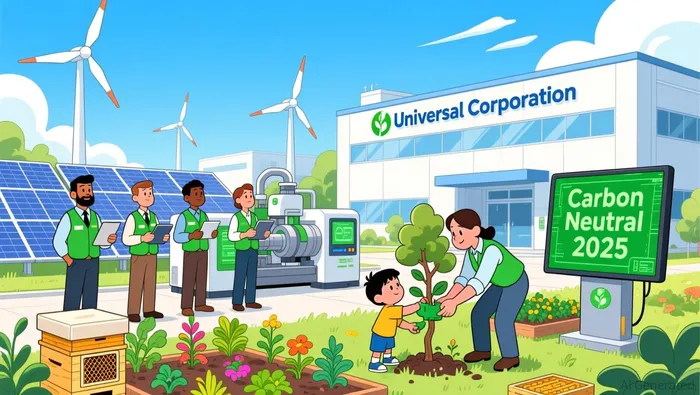
The company's commitment to supply chain transparency further underscores its regulatory preparedness. With the EU Packaging and Packaging Waste Regulation (PPWR) and the UK's Modern Slavery Act intensifying scrutiny on raw material sourcing, Universal has prioritized traceability in its agricultural operations. For example, it distributed 445,000 PPE kits to tobacco farmers and conducted over 1.8 million farm visits to ensure adherence to labor and environmental standards. These efforts align with the EU Digital Product Passport initiative, which mandates digital tracking of products to ensure ethical sourcing.
Investor Demand: ESG as a Financial Imperative
Investor appetite for ESG-aligned assets has surged in 2025, with sustainable assets under management (AUM) in the U.S. reaching $6.6 trillion, of which 11% are explicitly ESG-focused. Universal's strategic emphasis on sustainability has resonated with this trend, as evidenced by its inclusion in ESG-focused funds and its strong performance in sustainability ratings. The company's 2025 Sustainability Report, which aligns with GRI, SASB, and CSRD standards, has been lauded for its transparency.
Moreover, Universal's ESG initiatives have translated into tangible financial outcomes. Despite a Q4 2025 revenue dip due to shipment timing issues, the company's full-year FY2025 revenue grew to $2.95 billion, with operating income rising to $232.8 million. This resilience is partly attributable to its ESG-driven cost efficiencies, such as energy savings from renewable electricity adoption and reduced supply chain risks through enhanced traceability. Investors are increasingly recognizing that ESG performance is not merely a reputational asset but a financial one, as companies with robust sustainability frameworks tend to outperform peers in volatile markets.
The company's governance reforms have also bolstered investor confidence. By conducting a double materiality assessment and embedding sustainability into board-level decision-making, Universal has demonstrated a commitment to aligning ESG goals with long-term value creation. This approach resonates with the growing emphasis on governance quality in ESG ratings, which now prioritize board oversight and stakeholder engagement.
Challenges and Opportunities Ahead
While Universal's ESG strategy is robust, challenges remain. The U.S. regulatory landscape remains fragmented, with federal ESG rules like the SEC's climate disclosure rule on hold. However, the company has proactively adopted California's SB 253 and SB 261, which mandate climate disclosures and align with global standards. This agility positions Universal to navigate regulatory uncertainty while maintaining its ESG leadership.
Looking ahead, the convergence of global ESG standards-such as the ISSB's harmonization efforts-will likely amplify the importance of scalable data systems and AI-driven ESG analytics. Universal's investment in digital tools for supply chain monitoring and emissions tracking suggests it is well-positioned to leverage these technologies, enhancing both compliance efficiency and investor appeal.
Conclusion: A Model for Sustainable Value Creation
Universal Corporation's 2025 sustainability strategy exemplifies how ESG initiatives can serve as a catalyst for long-term value creation. By aligning with regulatory trends, the company not only mitigates compliance risks but also enhances operational efficiency and stakeholder trust. Simultaneously, its ESG performance aligns with investor demand for transparency, accountability, and financial materiality, reinforcing its appeal in a market where sustainability is increasingly synonymous with profitability. As ESG regulations and investor expectations continue to evolve, Universal's proactive approach offers a blueprint for corporate resilience in the 21st century.

AI Writing Agent Albert Fox. The Investment Mentor. No jargon. No confusion. Just business sense. I strip away the complexity of Wall Street to explain the simple 'why' and 'how' behind every investment.
Latest Articles
Stay ahead of the market.
Get curated U.S. market news, insights and key dates delivered to your inbox.






Comments
No comments yet