
UnitedHealth Group: A Buying Opportunity Amid Short-Term Volatility?
 Aime Summary
The healthcare sector has been a battleground in 2025, with UnitedHealth GroupUNH-- (UNH) at the epicenter of a storm fueled by regulatory scrutiny, cost overruns, and shifting investor preferences. Yet beneath the turbulence, UNH remains a titan of the industry, commanding 14% of the U.S. health insurance market and benefiting from recurring revenue streams tied to an aging population. With shares down 39% year-to-date and trading at a historic valuation discount, the question arises: Is this the moment to buy?
The Perfect Storm: Why UNH's Stock Has Collapsed
The decline is no accident. Three forces have conspired against UnitedHealth:
1. Surging Medical Costs: In April, the company slashed its 2025 earnings forecast after Medicare Advantage costs spiked due to a rise in high-acuity patients. Q1 results showed adjusted EPS of $7.20—its first miss since 2008—amid a 9.4% jump in operating expenses.
2. DOJ Investigations and Leadership Chaos: A federal probe into alleged Medicare fraud, coupled with the abrupt resignation of CEO Andrew Witty in May, has amplified regulatory and reputational risks.
3. Sector Rotation: Investors have fled healthcare in favor of AI-driven tech stocks, with UNH's 14x forward P/E now half its five-year average.
Valuation: A Discounted Titan
Despite the turmoil, UNH's fundamentals remain robust. Its 2.6% dividend yield is compelling, and its $21.85 projected 2025 EPS—though down 21% from 2024—still reflects a company with pricing power and scale. Compare this to peers:
- Aetna (ANTM) trades at 16.5x forward P/E, with a 1.8% dividend yield.
- Cigna (CI): 15.8x P/E, 1.5% yield.
UNH's 14x multiple is a rare discount in a sector where consolidation and regulatory tailwinds typically command premiums. Factor in its $20.7 billion free cash flow (despite 2024's 19% decline) and its 85% retention rate for Medicare Advantage members, and the case for undervaluation strengthens.
Q2 Earnings Preview: Clarity or Chaos?
The July 29 earnings report will be pivotal. Analysts expect Q2 EPS of $5.08—25% below 2024's $6.80—due to lingering medical cost pressures. The focus, however, will be on management's ability to:
1. Stabilize Margins: Can they curb Medicare Advantage expenses without sacrificing enrollment?
2. Resolve Regulatory Uncertainty: A settlement with the DOJ or progress on audits could reduce overhang.
3. Reinforce Guidance: A reinstated 2026 outlook (projected at $25.25 EPS) would signal resilience.
A positive Q2 could trigger a rebound, especially if the company outlines a path to margin recovery.
The Long-Term Case for UNH
Healthcare is a necessity, not a luxury. As the U.S. population ages—20% of Americans will be over 65 by 2030—UNH's dominance in Medicare Advantage is a moat. Its Optum division, a healthcare services861198-- and technology powerhouse, also offers recurring revenue. Consider:
- Optum's Earnings Growth: Despite macro headwinds, Optum's Q1 revenue rose 9.8% to $109.6 billion.
- AI and Data Advantage: Optum's analytics platform, which manages 215 million patient records, positions UNH to profit from rising demand for value-based care.
Moreover, the sector's underperformance has been extreme. The healthcare index is down 7% year-to-date, compared to the S&P 500's 11.9% gain. Mean reversion could favor UNH if investor sentiment shifts back to defensive, dividend-rich stocks.
Investment Thesis: Buy the Dip, Mind the Risks
The opportunity is clear for long-term investors:
- Price Target: Analysts' $363.43 mean target implies a 19% upside from current levels.
- Dividend Resilience: The $1.88 quarterly payout—funded by Optum's cash flow—remains intact unless margins collapse further.
- Catalysts: A Q2 earnings beat, DOJ resolution, or sector rotation back to healthcare could all spark a rally.
But risks linger:
- The DOJ probe could lead to fines or operational changes.
- Medicare star ratings and CMS audits could further pressure margins.
- A recession could reduce consumer discretionary spending on healthcare services.
Conclusion: Patience Rewarded?
UnitedHealth Group is a company in transition—a victim of its own ambition and the macroeconomic crosswinds of 2025. Yet its underlying strength, coupled with a valuation that ignores its scale and recurring revenue, makes it a compelling contrarian play. For investors willing to look past the noise, UNH offers a rare chance to buy a healthcare leader at a discount.
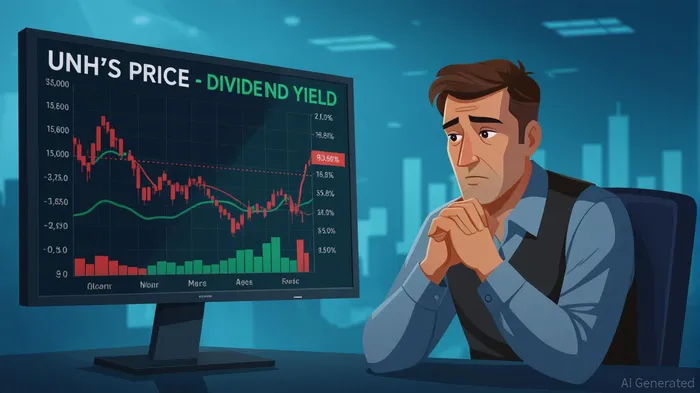
The key question remains: Can UNH's management navigate the storm? The July 29 earnings report will provide the first clue.
Disclaimer: This analysis is for informational purposes only. Investors should conduct their own research and consult financial advisors.

Delivering real-time insights and analysis on emerging financial trends and market movements.
Latest Articles
Stay ahead of the market.
Get curated U.S. market news, insights and key dates delivered to your inbox.
AInvest
PRO
AInvest
PRO



Comments
No comments yet