
UnitedHealth Group's 0.81% Decline Amid 23rd-Ranked $2.88B Trading Activity: Earnings Beat, Revenue Surge, and Institutional Investment Surge Highlight Divergent Market Sentiment
 Aime Summary
Market Snapshot
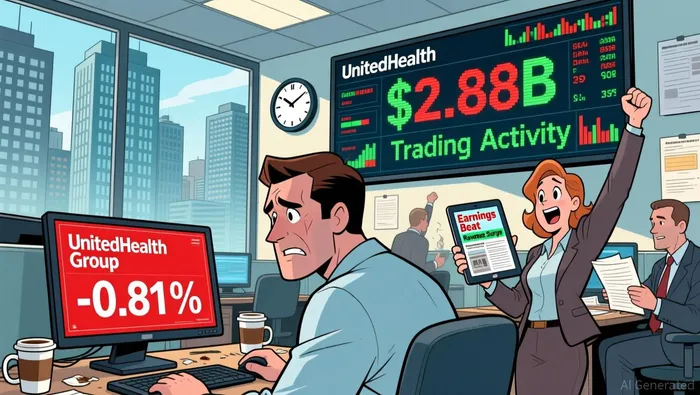
On November 10, 2025, UnitedHealth GroupUNH-- (UNH) closed with a 0.81% decline, marking a negative day for the healthcare conglomerate. The stock traded with a volume of $2.88 billion, ranking it 23rd in terms of trading activity on the day. Despite the dip, UNH’s recent quarterly earnings report showed resilience, with earnings per share (EPS) of $2.92—exceeding estimates by $0.05—and revenue rising 12.2% year-over-year to $113.16 billion. The company also announced a quarterly dividend of $2.21 per share, translating to an annualized yield of 2.7%.
Key Drivers
Institutional Investment Surge
A significant portion of the news highlighted a surge in institutional investment in UNHUNH--. Compass Rose Asset Management acquired 83,000 shares in Q2, adding $25.9 million to its portfolio, while Vanguard Group increased its stake by 6.6%, now holding $47.52 billion worth of shares. Nuveen initiated a $3.85 billion position, and Wellington, Charles Schwab, and National Bank of Canada also added substantial stakes. These moves, with institutional ownership now at 87.86%, signal strong confidence in the stock’s long-term prospects, particularly given the company’s diversified healthcare segments and consistent revenue growth.
Analyst Sentiment and Rating Divergence
Analyst sentiment remains mixed but cautiously optimistic. The consensus rating of “Moderate Buy” reflects 18 “Buy” ratings, nine “Hold” ratings, and three “Sell” ratings. Notable upgrades include JPMorgan Chase & Co. raising its price target from $310 to $425, and Truist Financial increasing its target to $365. Conversely, Baird R W downgraded UNH to “Strong Sell,” and Oppenheimer cut its target price to $325. This divergence underscores uncertainty around regulatory risks and valuation concerns, despite the company’s strong earnings and revenue performance.
Financial Performance and Dividend Appeal
UnitedHealth’s recent financial results bolstered its case for institutional and retail investors. The company’s 12.2% year-over-year revenue growth and 19.23% return on equity highlight operational strength, particularly in its UnitedHealthcare and Optum segments. The dividend announcement, with a payout ratio of 46.14%, positions UNH as a stable income generator, appealing to long-term investors. However, the stock’s price-to-earnings ratio of 16.93 and beta of 0.47 suggest it is undervalued relative to broader market volatility, which may attract value-focused investors.
Mixed Institutional Activity and Market Position
While most institutional investors added to their UNH positions, a few, like Rathbones Group PLC, reduced stakes by 77.5%. This contrast reflects differing strategies—some investors may be capitalizing on short-term gains, while others prioritize long-term exposure to the healthcare sector. UnitedHealth’s market cap of $293.75 billion and dominant presence in the S&P 500 further reinforce its appeal as a defensive play, particularly in a low-growth macroeconomic environment.
Earnings Momentum and Forward Guidance
The stock’s recent earnings beat and guidance for $29.54 EPS in the current fiscal year have positioned UNH as a high-performing healthcare stock. However, the mixed analyst ratings and institutional selling activity by firms like Rathbones indicate caution. The company’s ability to maintain its 12.2% revenue growth and navigate potential regulatory headwinds will be critical in determining whether the current price correction presents a buying opportunity or a cautionary signal.
Valuation Metrics and Strategic Positioning
UnitedHealth’s valuation metrics, including a P/E/G ratio of 2.28 and a debt-to-equity ratio of 0.71, suggest a balance between growth and financial prudence. Its strategic positioning in the healthcare sector—spanning insurance, pharmacy benefits, and data analytics—provides a moat against competition. However, the stock’s recent pullback, coupled with a 52-week low of $234.60 and a high of $630.73, indicates that market participants are recalibrating expectations. The combination of strong fundamentals and sector-specific risks will likely dictate its near-term trajectory.

Stay ahead of the market.
Get curated U.S. market news, insights and key dates delivered to your inbox.
AInvest
PRO
AInvest
PRO



Comments
No comments yet