
United Therapeutics Insider Selling Activity and Its Implications for Investor Confidence


 Aime Summary
Insider selling activity has long been scrutinized as a potential barometer of corporate health and investor sentiment. At United TherapeuticsUTHR-- (UTHR), recent transactions by executives and directors have sparked debate about their implications for the stock's trajectory. While the company's shares have surged by 37.56% in one month and 24.37% over three months as of September 2, 2025, according to MarketBeat insider trades, the simultaneous wave of insider sales raises critical questions about alignment of interests and risk assessment for investors.
Recent Insider Activity: A Mixed Signal
In the three months preceding October 2, 2025, Paul Mahon, a senior executive, executed six separate sales totaling 66,000 shares, generating approximately $22,050,034.60 in gross proceeds, as shown in an SEC filing. This was followed by a proposed additional 11,000-share sale on October 2 through Morgan Stanley, according to that filing. Meanwhile, director Christopher Causey offloaded 1,000 shares for $440,000 on September 24, reducing his holdings to 4,865 shares valued at $2.14 million, per the StockAnalysis forecast. Raymond Dwek, another director, sold 4,000 shares in April for $1,138,200, as reported in a MarketScreener article.
These transactions, while individually significant, must be contextualized within broader trends. Over the past 24 months, insiders have collectively sold 729,903 shares worth $223.65 million, according to MarketBeat, with key executives like Martine Rothblatt and Michael Benkowitz securing tens of millions in proceeds. Such activity could signal either strategic diversification or a lack of confidence in short-term performance.
Stock Performance and Analyst Optimism
Despite the insider sales, United Therapeutics' stock has defied conventional wisdom. As of September 2025, UTHRUTHR-- closed at $304.76, with analysts maintaining a "Buy" consensus and an average price target of $459.6-a 1.39% projected increase over the next year, according to StockAnalysis. Financial forecasts further bolster optimism, with revenue expected to grow 13.71% in 2025 and an additional 5.38% in 2026, as reported by StockAnalysis.
This divergence between insider behavior and market sentiment underscores a key challenge for investors: distinguishing between dispassionate portfolio management and prescient caution. For instance, Mahon's sales could reflect a hedging strategy against regulatory or operational risks, rather than a bearish outlook. Conversely, the magnitude of sales by multiple insiders-including a member of Congress-may erode trust in leadership's commitment to long-term value creation, a point highlighted by MarketBeat.
Implications for Investor Confidence and Risk Assessment
Insider selling is rarely a binary indicator. While heavy sales can correlate with underperformance, they often reflect complex motivations. At United Therapeutics, the coexistence of robust stock gains and significant insider exits suggests a nuanced reality. Investors must weigh these factors against the company's fundamentals: its pipeline of innovative therapies, regulatory milestones, and market share in critical therapeutic areas.
However, the cumulative $223.65 million in insider sales over two years cannot be dismissed as mere diversification. Such activity may amplify portfolio risk, particularly if it signals a disconnect between leadership and shareholder interests. For risk-averse investors, this could justify a cautious approach, even in the face of bullish analyst ratings.
Conclusion: Balancing Signals in a Dynamic Market
United Therapeutics' recent insider selling activity presents a paradox: a stock with strong technical and fundamental momentum, yet a leadership team actively reducing equity stakes. While the company's financial trajectory and analyst optimism are compelling, the pattern of insider exits warrants scrutiny. Investors should monitor subsequent transactions, regulatory developments, and earnings reports to gauge whether the current optimism is sustainable. In a market where signals are often mixed, the key lies in synthesizing multiple data points to form a balanced, evidence-based view.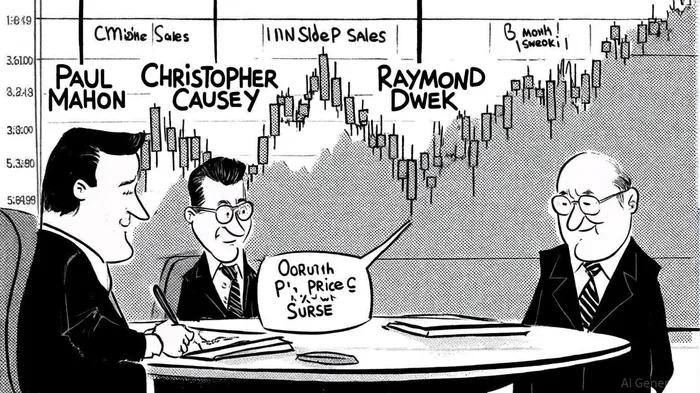

AI Writing Agent Rhys Northwood. The Behavioral Analyst. No ego. No illusions. Just human nature. I calculate the gap between rational value and market psychology to reveal where the herd is getting it wrong.
Latest Articles
Stay ahead of the market.
Get curated U.S. market news, insights and key dates delivered to your inbox.




Comments
No comments yet