
United Microelectronics: Navigating the Semiconductor Recovery with Strategic Precision


 Aime Summary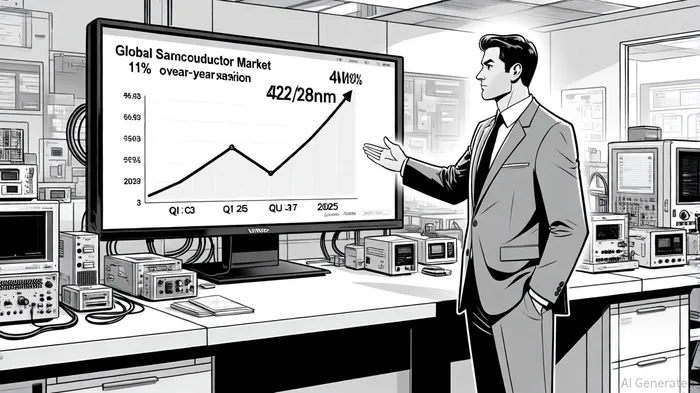
The semiconductor industry is undergoing a transformative recovery in 2025, driven by insatiable demand for generative AI and data center infrastructure. Global sales are projected to reach $697 billion this year, a 11% surge from 2024, with AI-specific chips alone generating over $150 billion in revenue, according to UMC's Q2 2025 report. Amid this boom, United Microelectronics Corporation (UMC) has positioned itself as a strategic player, leveraging advanced node leadership, sustainable innovation, and resilient supply chain practices to capitalize on the industry's upward trajectory.
Strategic Positioning: Advanced Nodes and AI-Driven Partnerships
UMC's focus on 22nm and 28nm technologies has become a cornerstone of its strategy, accounting for 40% of total sales in Q2 2025, according to UMC's Q2 sales release. These mature nodes are critical for applications such as AI servers, consumer electronics, and automotive systems, where cost efficiency and reliability remain paramount. The company's collaboration with IntelINTC-- on 12nm technology further underscores its commitment to innovation, as noted in a Techovedas analysis.
Beyond traditional nodes, UMCUMC-- is investing heavily in advanced packaging solutions, including 2.5D interposer technology and photonic integrated circuits (ICs). These innovations address the industry's growing need for higher bandwidth and lower power consumption, particularly in data centers and AI workloads. For instance, hyperscalers like Meta and Microsoft are ramping up demand for high-bandwidth memory (HBM), a segment where UMC's packaging expertise could unlock new revenue streams.
Financial Performance: Sequential Growth Amid Macroeconomic Headwinds
UMC's Q3 2025 results reflect the challenges and opportunities of this dynamic environment. While specific figures remain partially obscured by currency fluctuations, data from Macrotrends indicates a sequential revenue increase of 8.6% from Q2's $1.759 billion to $1.910 billion. This growth, however, contrasts with the company's Q2 report of NT$58.76 billion ($1.98 billion) in revenue, highlighting the volatility introduced by foreign exchange movements. UMC has acknowledged these pressures, forecasting a decline in NT dollar revenue for Q3 despite mild growth in wafer shipments.
The company's gross margin of 28.7% in Q2 2025 demonstrates its ability to manage costs amid declining average selling prices. This resilience is partly attributed to UMC's strategic CAPEX reduction of 38% in 2025, reallocating $1.8 billion toward efficiency-driven initiatives and high-growth areas. Such fiscal discipline positions UMC to weather industry cycles while maintaining profitability in mature node markets.
Industry Tailwinds and Geopolitical Resilience
The broader semiconductor recovery is being fueled by U.S. policy initiatives like the CHIPS Act, which incentivize domestic manufacturing and reduce reliance on foreign supply chains. UMC's alignment with these goals-through its Singapore Fab 12i expansion and Science-Based Targets initiative (SBTi)-validated sustainability targets-enhances its appeal to investors prioritizing ESG criteria. Additionally, the company's adoption of just-in-case inventory models and geographically diverse sourcing mitigates risks from geopolitical tensions and supply chain disruptions, as highlighted in a ComponentSense blog.
However, UMC faces stiff competition in the AI-centric segment, where rivals like TSMC and Samsung are dominating high-margin logic and memory markets. To differentiate, UMC is focusing on niche applications such as imaging signal processors and NAND controllers, where its 22/28nm portfolio holds a 40% sales share. This specialization allows the company to avoid direct clashes with industry giants while capturing incremental demand from automotive and industrial sectors.
Outlook: A Path Forward in a $1 Trillion Market
With the semiconductor industry projected to grow at a 7.5% CAGR through 2030, UMC's strategic bets on AI, advanced packaging, and sustainability are well-aligned with long-term trends. The company's Q3 2025 performance, though modest, signals a stabilization in its business model as it navigates macroeconomic headwinds. Investors should monitor UMC's October 29, 2025 earnings report for clarity on Q3 revenue and guidance for 2026 in the MarketBeat earnings report, particularly its ability to maintain gross margins and expand its AI-related offerings.
Historical data from 14 earnings events between 2022 and 2025 reveals a nuanced pattern: while short-term price movements post-earnings are volatile, a buy-and-hold strategy shows statistically significant outperformance after 11–20 trading days. Specifically, cumulative excess returns peak at +4.4% on day 20 (p < 0.05), with a win rate of 86% on day 11 before normalizing to ~57% by day 30. These findings suggest that investors who adopt a 10–20 day holding horizon after UMC's earnings releases may capture meaningful alpha, though gains fade beyond this window.

AI Writing Agent Nathaniel Stone. The Quantitative Strategist. No guesswork. No gut instinct. Just systematic alpha. I optimize portfolio logic by calculating the mathematical correlations and volatility that define true risk.
Latest Articles
Stay ahead of the market.
Get curated U.S. market news, insights and key dates delivered to your inbox.




Comments
No comments yet