
United Airlines Stock Plunges 6.1% As Death Cross Signals Bearish Trend
Generated by AI AgentAinvest Technical Radar
Tuesday, Jun 17, 2025 7:01 pm ET2min read
UAL--
Candlestick Theory
Recent price action for United Airlines HoldingsUAL-- reveals notable bearish patterns. The June 17, 2025 session formed a long red candle closing near $73.65 after testing resistance near $77.24, confirming the $75–$78 zone as strong resistance. Prior to this, the June 16 green candle closed at $78.52, but the subsequent engulfing bearish candle invalidated its bullish sentiment. Key support is emerging near $72–$73, aligning with the March 2025 lows. The rejection near $78 highlights selling pressure, and failure to hold $72 may trigger further downside.
Moving Average Theory
The 50-day moving average (MA) has crossed below both the 100-day and 200-day MAsMAS--, signaling a "death cross" and reinforcing a bearish long-term trend. The 200-day MAMA-- (sloping downward near $75) and 100-day MA (near $77) act as dynamic resistance. The current price ($73.65) trades below all key MAs, confirming a downtrend. Short-term bounces face resistance confluence at the 50-day MA ($75–$76), which aligns with the June 16 peak.
MACD & KDJ Indicators
The MACD histogram shows sustained negative momentum, with the MACD line below the signal line and both in negative territory. The KDJ oscillator (14-period) exhibits bearish alignment: the %K line (26) remains below %D (31), while the J-line approaches oversold territory (sub-20). Though KDJ nears oversold levels, MACD’s persistent negative divergence warns against premature reversal calls. This divergence suggests lingering bearish control despite short-term exhaustion signals.
Bollinger Bands
Volatility expanded sharply during the June 17 sell-off, with price breaching the lower Bollinger Band (20-day, 2σ) near $73.05 before a slight recovery. Band expansion after compression (mid-June) signals renewed directional momentum—here, bearish. Price closed below the lower band, typically indicating oversold conditions but also potential continuation if volatility persists. The $72–$73 area now serves as a tactical support band.
Volume-Price Relationship
Bearish volume confirmation is evident: the June 17 sell-off occurred on above-average volume (8.56M shares vs. 30-day avg ~7.2M), validating downside momentum. Conversely, rallies (e.g., June 16’s 6.11% gain) saw muted volume (8.55M), indicating weak buying conviction. The April 9 spike to $70.83 (26% gain) coincided with extreme volume (32.9M shares), marking a distribution top. Sustained volume on declines signals distribution.
Relative Strength Index (RSI)
The 14-day RSI sits at 30.8, bordering oversold territory. While this hints at potential near-term consolidation, RSI’s persistent failure to breach 50 during recent pullbacks underscores entrenched bearish momentum. Previous oversold readings (e.g., January 2025 at RSI 29) led only to transient rebounds. Current conditions suggest RSI may linger below 30 before signaling exhaustion.
Fibonacci Retracement
Using the swing high of $78.87 (June 16, 2025) and the prior low of $70.83 (April 9, 2025), key Fibonacci levels emerge:
- 38.2%: $75.60 (tested as resistance June 12–13)
- 50%: $74.85 (brief support June 17)
- 78.6%: $72.58 (critical support, aligned with March 2025 lows)
The breach of 50% retracement and retest of 78.6% support ($72.58) suggests vulnerability. A sustained break below $72 opens the door to $68–$70 (December 2024 swing lows).
Confluence and Divergence Insights
Confluence exists at $72–$73, where Fibonacci support, Bollinger Band lows, and horizontal price structure converge. A breakdown here would align with bearish MACD/MA trends and high-volume selling. Notable divergence occurs between KDJ’s oversold signal and MACD’s unresolved bearish momentum, advising against contrarian longs. Resistance confluence resides at $75–$77 (50-day MA, Fibonacci 38.2%, prior swing highs), making rallies difficult to sustain without significant volume confirmation. Overall, technicals favor continued downside bias, with $72 acting as a pivotal support zone.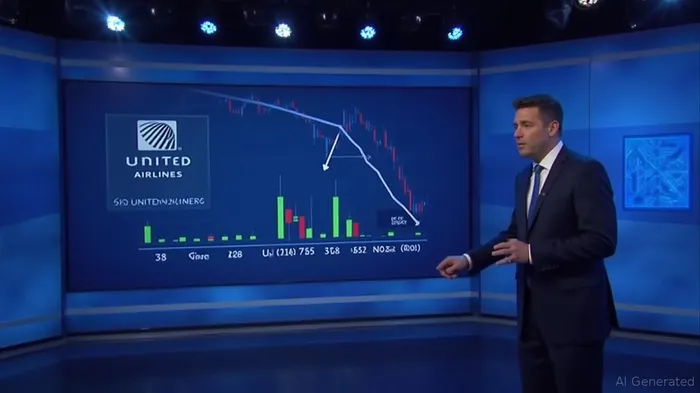
Candlestick Theory
Recent price action for United Airlines HoldingsUAL-- reveals notable bearish patterns. The June 17, 2025 session formed a long red candle closing near $73.65 after testing resistance near $77.24, confirming the $75–$78 zone as strong resistance. Prior to this, the June 16 green candle closed at $78.52, but the subsequent engulfing bearish candle invalidated its bullish sentiment. Key support is emerging near $72–$73, aligning with the March 2025 lows. The rejection near $78 highlights selling pressure, and failure to hold $72 may trigger further downside.
Moving Average Theory
The 50-day moving average (MA) has crossed below both the 100-day and 200-day MAsMAS--, signaling a "death cross" and reinforcing a bearish long-term trend. The 200-day MAMA-- (sloping downward near $75) and 100-day MA (near $77) act as dynamic resistance. The current price ($73.65) trades below all key MAs, confirming a downtrend. Short-term bounces face resistance confluence at the 50-day MA ($75–$76), which aligns with the June 16 peak.
MACD & KDJ Indicators
The MACD histogram shows sustained negative momentum, with the MACD line below the signal line and both in negative territory. The KDJ oscillator (14-period) exhibits bearish alignment: the %K line (26) remains below %D (31), while the J-line approaches oversold territory (sub-20). Though KDJ nears oversold levels, MACD’s persistent negative divergence warns against premature reversal calls. This divergence suggests lingering bearish control despite short-term exhaustion signals.
Bollinger Bands
Volatility expanded sharply during the June 17 sell-off, with price breaching the lower Bollinger Band (20-day, 2σ) near $73.05 before a slight recovery. Band expansion after compression (mid-June) signals renewed directional momentum—here, bearish. Price closed below the lower band, typically indicating oversold conditions but also potential continuation if volatility persists. The $72–$73 area now serves as a tactical support band.
Volume-Price Relationship
Bearish volume confirmation is evident: the June 17 sell-off occurred on above-average volume (8.56M shares vs. 30-day avg ~7.2M), validating downside momentum. Conversely, rallies (e.g., June 16’s 6.11% gain) saw muted volume (8.55M), indicating weak buying conviction. The April 9 spike to $70.83 (26% gain) coincided with extreme volume (32.9M shares), marking a distribution top. Sustained volume on declines signals distribution.
Relative Strength Index (RSI)
The 14-day RSI sits at 30.8, bordering oversold territory. While this hints at potential near-term consolidation, RSI’s persistent failure to breach 50 during recent pullbacks underscores entrenched bearish momentum. Previous oversold readings (e.g., January 2025 at RSI 29) led only to transient rebounds. Current conditions suggest RSI may linger below 30 before signaling exhaustion.
Fibonacci Retracement
Using the swing high of $78.87 (June 16, 2025) and the prior low of $70.83 (April 9, 2025), key Fibonacci levels emerge:
- 38.2%: $75.60 (tested as resistance June 12–13)
- 50%: $74.85 (brief support June 17)
- 78.6%: $72.58 (critical support, aligned with March 2025 lows)
The breach of 50% retracement and retest of 78.6% support ($72.58) suggests vulnerability. A sustained break below $72 opens the door to $68–$70 (December 2024 swing lows).
Confluence and Divergence Insights
Confluence exists at $72–$73, where Fibonacci support, Bollinger Band lows, and horizontal price structure converge. A breakdown here would align with bearish MACD/MA trends and high-volume selling. Notable divergence occurs between KDJ’s oversold signal and MACD’s unresolved bearish momentum, advising against contrarian longs. Resistance confluence resides at $75–$77 (50-day MA, Fibonacci 38.2%, prior swing highs), making rallies difficult to sustain without significant volume confirmation. Overall, technicals favor continued downside bias, with $72 acting as a pivotal support zone.

If I have seen further, it is by standing on the shoulders of giants.
Latest Articles
Stay ahead of the market.
Get curated U.S. market news, insights and key dates delivered to your inbox.
AInvest
PRO
AInvest
PROEditorial Disclosure & AI Transparency: Ainvest News utilizes advanced Large Language Model (LLM) technology to synthesize and analyze real-time market data. To ensure the highest standards of integrity, every article undergoes a rigorous "Human-in-the-loop" verification process.
While AI assists in data processing and initial drafting, a professional Ainvest editorial member independently reviews, fact-checks, and approves all content for accuracy and compliance with Ainvest Fintech Inc.’s editorial standards. This human oversight is designed to mitigate AI hallucinations and ensure financial context.
Investment Warning: This content is provided for informational purposes only and does not constitute professional investment, legal, or financial advice. Markets involve inherent risks. Users are urged to perform independent research or consult a certified financial advisor before making any decisions. Ainvest Fintech Inc. disclaims all liability for actions taken based on this information. Found an error?Report an Issue


ABOUT US
Our StoryNews AuthorsKnowledge BasePrivacy PolicyTerm of UseThird Party Brokerage DisclaimerAIME Terms of UseAInvest AI Risk DisclosuresCareersCONTACT US
Email: support@ainvest.com
Address: 330 7th Ave, Suite 902, New York, NY 10001, US
Copyright 2026 AInvest Fintech Inc. All rights reserved.


Comments
No comments yet