
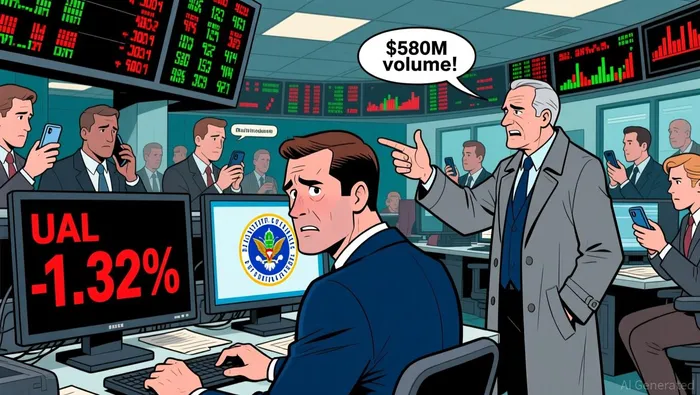
United Airlines Shares Fall 1.32% on FAA-Ordered Cuts Rank 202nd in $580M Volume
 Aime Summary
Market Snapshot
United Airlines Holdings (UAL) fell 1.32% on November 10, 2025, as part of broader market turbulence driven by operational disruptions linked to the U.S. government shutdown. The stock’s trading volume totaled $580 million, ranking it 202nd in activity among U.S. equities for the day. The decline follows a week of significant flight cancellations and capacity reductions mandated by the Federal Aviation Administration (FAA) to address staffing shortages at air traffic control centers.
Key Drivers
The immediate catalyst for UAL’s price movement was the FAA’s directive to scale back operations, which forced United to cancel 730 domestic flights between November 10 and 12, including 190 on Monday alone. The airline attributed these cuts to reduced staffing levels at the FAA, which led to a 10% reduction in flights at 40 major airports. Regional routes and smaller aircraft were disproportionately affected, while international and long-haul flights remained largely unaffected. Analysts highlighted the potential strain on airline revenue, with United’s hub-and-spoke system—centered on cities like Chicago, Denver, and Los Angeles—facing operational bottlenecks.
Compounding concerns, the news articles underscored United’s financial vulnerability amid the crisis. The company’s Altman Z-Score of 1.33 placed it in the “distress zone,” signaling a heightened risk of insolvency within two years. This metric, combined with a debt-to-equity ratio of 2.19 and liquidity ratios (current and quick) below 1, painted a picture of a leveraged business with limited financial flexibility. Insider selling activity—two transactions totaling 61,119 shares over three months—further fueled investor caution, as it suggested internal skepticism about the stock’s near-term prospects.
The operational disruptions also amplified uncertainties around the airline’s revenue resilience. While United reported robust three-year revenue growth of 30.8% and operating margins of 8.85%, the ongoing flight reductions threatened to erode these gains. The FAA’s phased approach to capacity cuts, starting at 4% in early November and escalating to 10%, created a rolling risk of further cancellations if the government shutdown extended beyond the projected timeline. Analysts noted that the airline’s reliance on hub airports made it particularly susceptible to cascading delays, which could degrade customer satisfaction and strain ancillary revenue streams like ancillary services and cargo.
Valuation metrics offered a mixed outlook. United’s P/E ratio of 9.59 and P/S ratio of 0.55 were positioned within historical ranges, suggesting the stock was neither overvalued nor undervalued on a purely earnings or sales basis. However, the gap between its current price ($97.43) and analyst price targets ($123.20) highlighted diverging views on its long-term potential. Proponents pointed to management’s strategies to boost margins through product de-commoditization and technology-driven merchandising, while skeptics questioned whether these initiatives could offset the immediate operational and financial headwinds.
The broader market context also played a role. With the U.S. aviation sector serving as a flashpoint in the political standoff over federal funding, United’s performance reflected macroeconomic anxieties. The airline’s waiver of change and cancellation fees for affected passengers, while customer-friendly, further pressured short-term margins. Meanwhile, the industry’s anticipation of a record 31 million travelers during the Thanksgiving period added a layer of uncertainty, as carriers balanced the need to maintain service with the risk of overcapacity amid shifting demand patterns.
In sum, United Airlines’ 1.32% drop on November 10 was driven by a confluence of operational, financial, and macroeconomic factors. The FAA-mandated flight cuts, combined with weak liquidity metrics and political uncertainty, created a volatile environment for the stock. While long-term growth narratives persisted, the immediate challenges underscored the fragility of the airline’s business model in the face of external shocks. Investors will likely remain watchful as the government shutdown’s resolution—and its implications for air traffic control staffing—remains unresolved.

Stay ahead of the market.
Get curated U.S. market news, insights and key dates delivered to your inbox.
AInvest
PRO
AInvest
PRO



Comments
No comments yet