
United Airlines Shares Climb Near 52-Week High as $660M Trading Volume Ranks 170th
 Aime Summary
Market Snapshot
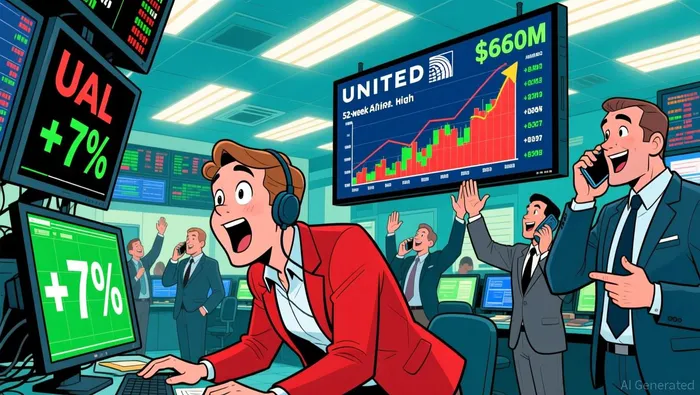
United Airlines Holdings (UAL) closed December 5, 2025, with a 0.21% gain, adding to a year-to-date rise of 9.4%. The stock’s trading volume on the day reached $0.66 billion, ranking it 170th among all listed equities. While the modest intraday increase lagged behind broader market rebounds—such as the Nasdaq’s 2.6% surge driven by Alphabet’s AI advancements—the stock’s performance aligns with its volatile profile, having recorded 26 price swings exceeding 5% over the past year. The current price of $107.28 sits near its 52-week high of $110.52, reflecting sustained investor optimism despite projected annual revenue declines of 3.56% for the company.
Key Drivers
The recent analyst activity surrounding UALUAL-- has been a primary catalyst for its price movement. Citigroup’s initiation of coverage on December 4, 2025, marked a pivotal moment, with analyst John Godyn setting a $132 price target and a “Buy” rating. This followed a series of positive revisions from other major institutions, including TD Cowen’s $125 target (raising its 2026 “Best Idea” designation) and JPMorgan’s $156 price target increase. Collectively, 19 analysts now project an average one-year target of $122.06, implying a 13.78% upside from current levels. These upgrades underscore confidence in United’s operational turnaround, particularly its fleet modernization efforts tied to improved Boeing production rates and cost reductions in non-fuel expenses.
Strategic partnerships and technological advancements further bolstered investor sentiment. A new collaboration to modernize United’s sales technology was highlighted in Yahoo Finance’s report, positioning the airline to enhance premium seating revenue and streamline operations. Analysts have linked these initiatives to broader industry tailwinds, including a shift toward generative AI adoption in enterprise software—a trend likened to the platform dominance of Microsoft and Apple in the 1990s. While United’s core business remains rooted in traditional aviation, its alignment with tech-driven efficiency gains has attracted institutional attention.
Institutional ownership trends also reflect growing confidence. Capital International Investors increased its stake by 0.09% to 6.8% ownership, while Sanders Capital and Primecap Management added to their positions. Notably, Vanguard’s Total Stock Market Index Fund raised its UAL allocation by 4.12%, signaling inclusion in broader market benchmarks. However, the put/call ratio of 1.18 indicates a bearish options market outlook, suggesting some caution among short-term traders. This contrast between institutional accumulation and derivative sentiment highlights the stock’s dual narrative: long-term structural optimism versus near-term volatility.
The broader market environment has amplified UAL’s performance. The Nasdaq’s AI-driven rebound on December 5, fueled by Alphabet’s Gemini 3 announcement, created a favorable backdrop for cyclical sectors like aviation. United’s 3.1% closing gain, though modest compared to the index’s 2.6% jump, aligns with its recent 52-week high proximity. Additionally, Federal Reserve signals of a potential December rate cut have reduced borrowing costs for airlines, which are net beneficiaries of lower interest rates due to their high debt loads. While United’s non-GAAP EPS is projected at $18.02 for the year, the sector-wide easing of financial conditions has become a critical undercurrent for its valuation.
Despite these positives, the stock’s volatility remains a cautionary factor. With 26 price swings exceeding 5% in the past year, UAL’s trajectory is heavily influenced by macroeconomic shifts and operational milestones. The recent analyst upgrades and institutional inflows suggest a consensus view that the airline’s fleet renewal and cost discipline are on track to deliver value. Yet, the bearish options market and revenue projections below 2024 levels indicate that the market is not fully priced for a sustained recovery. For investors, the key question remains whether United’s strategic pivots—spanning technology, fleet modernization, and cost management—can translate into durable earnings growth in a competitive industry landscape.

Encuentren esas acciones que tengan un volumen de transacciones muy alto.
Latest Articles
Stay ahead of the market.
Get curated U.S. market news, insights and key dates delivered to your inbox.
AInvest
PRO
AInvest
PRO



Comments
No comments yet