
United Airlines' 2025 Recovery Momentum: Navigating Industry Tailwinds and Strategic Pricing Power
 Aime Summary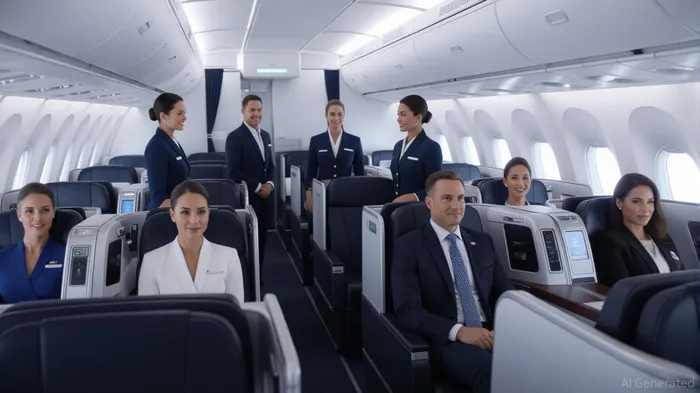
The aviation industry's post-pandemic resurgence has been anything but linear. While global air travel demand has stabilized, airlines have faced headwinds ranging from geopolitical tensions to fuel price volatility. Yet, United AirlinesUAL-- (UAL) has emerged as a standout performer in 2025, leveraging disciplined capacity management, premium product innovation, and CEO Scott Kirby's agile leadership to outpace peers. For investors, the question is no longer whether United can recover—but whether it can sustain its momentum in a sector where margins remain fragile.
A Strategic Shift: From Cost-Cutting to Pricing Power
United's Q2 2025 results underscore a pivotal shift in its strategy. The airline reported adjusted earnings per share (EPS) of $3.87, exceeding expectations, with total revenue of $15.24 billion. While net income dipped 26% year-over-year, this was driven by a 4% decline in unit revenue, not operational missteps. United's proactive decision to reduce domestic capacity by 4% in Q3 2025—a move that prioritized pricing over volume—has already yielded results. By tightening supply, the airline accelerated demand by 6 points in early July 2025, with business travel surging double-digits.
This strategic pivot mirrors industry trends. In 2024, airlines across the globe grappled with overcapacity and eroding fares. United's early recognition of this risk positioned it to capitalize on the subsequent supply contraction. As KirbyKEX-- noted in a recent call, “We're not chasing volume—we're pricing for resilience.”
Historically, UAL's stock has responded positively to earnings beats. From 2022 to the present, the stock has delivered a 60% win rate within three days of an earnings beat, a 50% win rate over 10 days, and a 30% win rate in 30-day windows. This suggests that while short-term momentum is strong after outperforming expectations, long-term gains require a broader strategic lens. For investors, this underscores the importance of aligning with United's structural advantages—such as its premium pricing power and disciplined capacity management—rather than relying solely on transient earnings-driven volatility.
Premium Innovation and Loyalty-Driven Growth
United's focus on premium cabins has been a game-changer. The United Polaris Studio suite, introduced on BoeingBA-- 787-9 aircraft, has redefined long-haul travel, driving a 5.6% year-over-year increase in premium cabin revenue. Pacific and AtlanticATLN-- RASM (revenue per available seat mile) rose 8.5% and 4.7%, respectively, in Q2 2025, outpacing industry averages. These gains are not just a product of higher prices but of product differentiation.
The airline's MileagePlus loyalty program further amplifies its pricing power. Loyalty revenue grew 8.7% year-over-year, buoyed by a 45% surge in co-branded credit card sign-ups. The Blue Sky partnership with JetBlue, which allows cross-booking and loyalty miles interchangeability, has expanded United's reach without sacrificing margins. For investors, this loyalty-driven ecosystem represents a durable competitive advantage—a critical asset in an industry where customer retention is paramount.
Kirby's Calculated Risks: Balancing Short-Term Pain for Long-Term Gain
CEO Scott Kirby's leadership has been central to United's turnaround. His decision to reduce capacity in Q3 2025, despite short-term revenue pressures, reflects a long-term mindset. This approach mirrors his 2024 playbook, when United achieved a record profit in Q4 2024 by preemptively adjusting to demand shifts. Kirby's recent optimism—citing reduced geopolitical uncertainty and a “positive inflection in supply and demand”—is backed by data. United's on-time departure rate hit a five-year high in Q2 2025, with hubs in Newark, Los Angeles, and San Francisco leading the charge.
Operational efficiency has also been a focus. United's $18.6 billion liquidity position and net leverage ratio of 2.0x provide financial flexibility, allowing the airline to invest in growth without overleveraging. The repayment of $6.8 billion in high-cost debt secured against MileagePlus assets in 2020 has unlocked further strategic options, from enhanced loyalty rewards to new partnerships.
Industry Tailwinds and the Path to Sustained Earnings
United's success is not an isolated phenomenon. The broader aviation industry is poised for margin expansion as global uncertainty recedes. However, United's disciplined approach to capacity and premium product innovation has allowed it to outperform peers. While rivals like Delta and American AirlinesAAL-- struggle with cost inflation and labor disputes, United's updated 2025 adjusted EPS guidance of $9–$11 per share (down from $11.50–$13.50 earlier this year) still reflects confidence in its trajectory.
The key to sustained growth lies in managing risks. United's tentative agreement with the Association of Flight Attendants (AFA) and its fleet modernization efforts—135 new aircraft, including fuel-efficient Boeing 787s and Airbus A321neos—mitigate exposure to fuel costs and labor tensions. Analysts project these aircraft could reduce fuel expenses by 20% compared to older models, further bolstering margins.
Investment Case: Positioning for Long-Term Gains
For investors, United's 2025 performance highlights a compelling opportunity. The airline's updated EPS guidance, coupled with its strong balance sheet and strategic agility, positions it to capitalize on industry tailwinds. While short-term volatility—such as the 4% domestic capacity reduction—may test patience, the long-term fundamentals are robust.
Key catalysts to watch include:
1. New Route Launches: United's expansion into Bangkok, Ho Chi Minh City, and Adelaide (pending regulatory approval) could unlock premium demand in high-growth markets.
2. Operational Efficiency: Continued on-time performance and fleet modernization will drive cost savings and customer satisfaction.
3. Loyalty Program Value: Enhanced MileagePlus benefits and the Blue Sky partnership could deepen customer retention and revenue per passenger.
However, risks remain. A resurgence in macroeconomic uncertainty or a spike in fuel prices could pressure margins. Investors should monitor United's July 17 earnings call for updates on these fronts.
Conclusion: A Post-Pandemic Success Story
United Airlines' 2025 recovery is not just about bouncing back—it's about redefining its value proposition. By balancing pricing power with operational discipline, Kirby has positioned the airline to thrive in a post-pandemic world where agility and customer-centric innovation are paramount. For long-term investors, United represents a rare combination of strategic foresight and financial resilience—a compelling case to consider as global air travel demand stabilizes and airline margins expand.
The aviation industry's next chapter is being written by those who adapt. United Airlines, with its disciplined approach and premium-first strategy, is flying ahead.

Delivering real-time insights and analysis on emerging financial trends and market movements.
Latest Articles
Stay ahead of the market.
Get curated U.S. market news, insights and key dates delivered to your inbox.
AInvest
PRO
AInvest
PRO



Comments
No comments yet