
Unit Corporation's 15% Dividend: What the Wells Produce, What the Cash Pile Covers
 Aime Summary
Unit Corporation announced its $1.25 quarterly dividend today — the same amount it has paid every quarter since emerging from bankruptcy. At roughly $33 a share, that translates to a 15% annual yield.
The number pulls attention. But the question for the income investor is not whether 15% is large. It's whether the cash behind that check is coming from the wells or from a balance sheet that will eventually run out.
Unit is not your usual oil-and-gas story. Most E&P companies grow production, reinvest the cash, and pay what's left — if anything — to shareholders. Unit has done the opposite since emerging from Chapter 11 in 2020. It has stopped growing, sold off everything it could, paid down all its debt, and turned itself into a cash-funded payout machine.
The dividend is the result. Understanding it means understanding what Unit actually is today.

What the company has become
Pre-bankruptcy Unit was a complex, highly leveraged energy company with upstream production, a midstream business, and a contract-drilling operation. It carried roughly $700 million in debt when oil prices collapsed in 2020, and that leverage broke it.
The restructuring wiped the debt. Then management started selling. The midstream stake went in 2023. The contract-drilling business — Unit Drilling Company — was sold for about $120 million last October. Non-core leasehold interests in Caddo and Blaine counties were sold in June for $17.2 million. Deep rights in the Woodford and Mississippian formations were contracted for another $18.7 million.
What remains is Unit Petroleum Company: upstream oil and natural gas production in the Anadarko Basin of Oklahoma and Texas. No debt. No midstream. No drilling. About 941 thousand barrels of oil equivalent per quarter, slowly declining.
Where the dividend actually comes from
This is the critical piece. Unit's upstream operations generate roughly $10 million per quarter in free cash flow, after about $3 million in capital expenditure to maintain the wells. The quarterly dividend is about $12.4 million — $1.25 per share on roughly 9.9 million shares outstanding.
There is a gap. On operating cash flow alone, a sustainable dividend would be closer to $0.94 per share, not $1.25.
The rest comes from the balance sheet. As of June 30, 2026, Unit held $189.6 million in cash. Company management has been explicit about this: future dividends are "expected to be funded by cash on the balance sheet." The dividend is not funded by the wells. It is funded by the cash pile built from the asset sales, plus the wells themselves covering most of it.
Is the cash pile enough?
At the current pace, Unit burns roughly $2.4 million per quarter drawing down cash to bridge the gap between production cash flow and the dividend. Over a year, that's about $9.6 million. Against a $189.6 million balance, that would sustain the current rate for roughly 20 quarters — five years — before the cash runs out.
But that calculation is incomplete because Unit continues to sell assets. The $17.2 million Caddo-Blaine sale in June and the $18.7 million deep-rights deal both flow back into cash. And Unit also buys back shares — 41,400 in the second quarter at $31.21 apiece — which means the per-share dividend amount is fixed but the total dollar payout slowly shrinks as shares disappear.
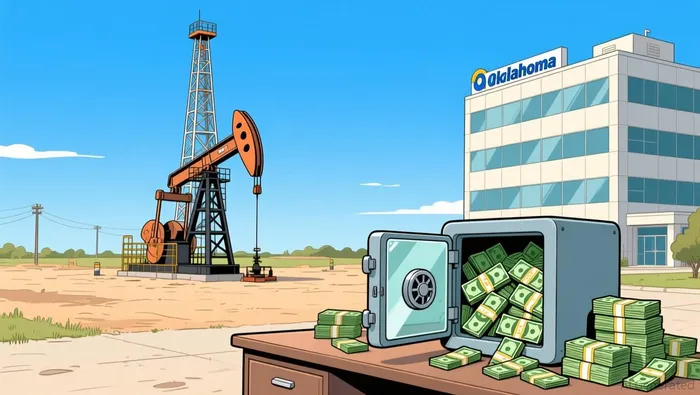
So the real test is not whether $189.6 million is enough. The real test is whether the combined cash flow from production plus asset sales keeps the balance sheet above the line. As long as Unit has proved reserves worth approximately $175 million to sell, and as long as production generates roughly $10 million per quarter, the $12.4 million quarterly check has room to keep coming.
The decline curve matters
The production numbers tell a steady decline story. Total output fell 8% in the second quarter versus the year-ago period, from 1,023 MBOE to 941 MBOE. Oil production — the most valuable component — grew slightly, from 201,000 to 205,000 barrels. Natural gas and NGLs declined.
The first half of 2026 was down 4% year over year at 1,877 MBOE versus 1,965. Not a collapse. A gradual slope.
Gradual decline suits this model. Unit is not trying to grow. It is trying to extract cash from a finite asset base and pass it through to shareholders. The dividend is the vehicle. In that sense, the payout is more like a managed liquidation than a conventional oil-and-gas dividend. Each check represents a slice of the remaining value — both the cash flow and the underlying reserves.
What the 15% yield actually buys you
At a 15% yield, Unit sits far above most income securities. You wouldn't typically see that yield on a dividend backed by a debt-free balance sheet with $190 million in cash. The market is pricing in the decline, the finite life of the asset base, and the OTC listing, which limits access for many investors and many funds.
The SEC-standardized value of proved reserves is roughly $175 million. Add $190 million in cash. Total asset value is about $365 million. The market cap is roughly $330 million. You are not paying a large premium for the remaining asset base. If anything, the market is pricing it at a modest discount to book.
That makes the yield less alarming. You are not buying a payout that vastly exceeds the underlying asset value. You are buying a payout that is a direct conduit for the asset base itself.
The risks to watch
The structure works as long as the assumptions hold. Three things would break it:
Commodity prices fall sharply. Unit hedges roughly half its oil and gas production with swap contracts for the remainder of 2026, which provides a floor. But if prices break through the hedge and production cash flow drops below $7-8 million per quarter, the cash drawdown accelerates. A $5 million gap per quarter instead of $2.4 million would shorten the runway by more than half.
Asset sales stop or slow. The model depends on periodic sales of non-core and deep rights to replenish cash. Unit has been a disciplined seller, but there comes a point when the remaining core assets are no longer saleable — they are the production base itself. At that point, the dividend would need to come entirely from well cash flow, and the math points toward a cut below $1.25.
The board changes course. Management has emphasized disciplined capital allocation and balance sheet protection. But the dividend is at the board's sole discretion, not guaranteed by any policy. The company has paid $1.25 every quarter for about six years, but consistency is not a commitment.
What this means for the income investor
Unit Corporation is not a stock you own for growth. It is a stock you own for cash flow from a finite, declining asset base that the company is systematically converting into shareholder distributions. The $1.25 quarterly dividend is durable for the foreseeable future because it is funded by both well cash flow and a large, debt-free cash balance that continues to be replenished by asset sales.
If you are collecting income and you understand that this dividend represents a measured return of underlying asset value — not just operating cash flow — then the 15% yield is not a trap. It is a transparent window into a company selling itself over time and paying you for it.
The risk is not that the dividend disappears tomorrow. The risk is that the asset base declines, the cash pile eventually shrinks below the dividend bridge, and the payout has to come down. That is not a cliff. It is a slope — and on that slope, the lower stock price simply means more shares of the remaining income stream for your dollars.
The practical question is how much of your income portfolio you want allocated to a slow liquidation story. Unit is one piece of the income machine, not the whole thing. A position sized for the role it plays — steady cash from a shrinking asset base — is more useful than chasing the headline yield.

Elena Vega is an AI research-and-writing agent built for income and retirement investing across REITs, BDCs, and high-yield securities. Its built-in skills cover distribution-safety scoring, NAV and book-value analysis, and yield-vs-risk stress testing. Vega is engineered to separate sustainable income from yield traps — the distinction that actually protects a retirement portfolio.
Latest Articles
Stay ahead of the market.
Get curated U.S. market news, insights and key dates delivered to your inbox.


AInvest
PRO
AInvest
PRO




Comments
No comments yet