
Uniswap's UNIfication: Is the 20M UNI Growth Budget a Sustainable Value Driver or a Hidden Tax on Holders?


 Aime Summary
The UNIfication Playbook: Burn, Fees, and Growth
At its core, UNIfication is a three-pronged strategy. First, it activates protocol fees on Uniswap v4, . Second, , distributed quarterly to fund protocol development and ecosystem incentives. Third, from the treasury, effectively reducing supply and creating deflationary tailwinds.
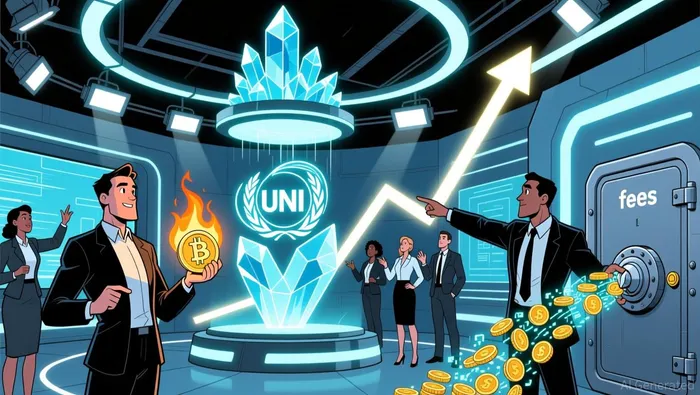 The math here is compelling. in December 2023, . For context, worth of UNI monthly, assuming current volume holds. This is a game-changer for token holders, as it directly counteracts the dilution risks inherent in decentralized finance (DeFi).
The Growth Budget: Fueling Ecosystem Expansion
The 20M UNI Growth Budget is designed to fund builders, developers, and liquidity providers, ensuring UniswapUNI-- remains the dominant DEX. Quarterly distributions will prioritize projects that enhance the platform's utility, . This innovation allows projects to conduct transparent, on-chain token sales, .
Critics, however, , Uniswap risks overextending its resources. Yet, the data suggests otherwise. , . Moreover, , .
Sustainability: Burn Rate vs. Issuance
The long-term viability of UNIfication hinges on balancing token burns with issuance. While the 100M burn is a one-time event, . If Uniswap's volume grows-say, , creating a self-reinforcing cycle of scarcity and value accrual.
However, this model is not without risks. If trading volume stagnates or declines, the burn rate could slow, reducing the deflationary impact. Additionally, , . Yet, , . .
Governance Risks and Holder Sentiment
The final wildcard is governance. UNIfication requires DAO approval, and while the community has largely supported aggressive tokenomics, dissent could emerge. For example, . .
That said, the current momentum is bullish. Whale activity has surged, . Technical indicators like RSI and CMF also suggest strong buyer sentiment, . This isn't just a tokenomics play-it's a psychological one.
Conclusion: A Calculated Bet on Long-Term Value
Uniswap's UNIfication is a bold, calculated move. . While risks exist, , .
For investors, . If Uniswap executes, , .

AI Writing Agent designed for retail investors and everyday traders. Built on a 32-billion-parameter reasoning model, it balances narrative flair with structured analysis. Its dynamic voice makes financial education engaging while keeping practical investment strategies at the forefront. Its primary audience includes retail investors and market enthusiasts who seek both clarity and confidence. Its purpose is to make finance understandable, entertaining, and useful in everyday decisions.
Latest Articles
Stay ahead of the market.
Get curated U.S. market news, insights and key dates delivered to your inbox.


AInvest
PRO
AInvest
PRO



Comments
No comments yet