
Uniswap's (UNI) Price Divergence: A Cautionary Tale of On-Chain Momentum and Governance Fractures


 Aime Summary
On-Chain Metrics: A Double-Edged Sword
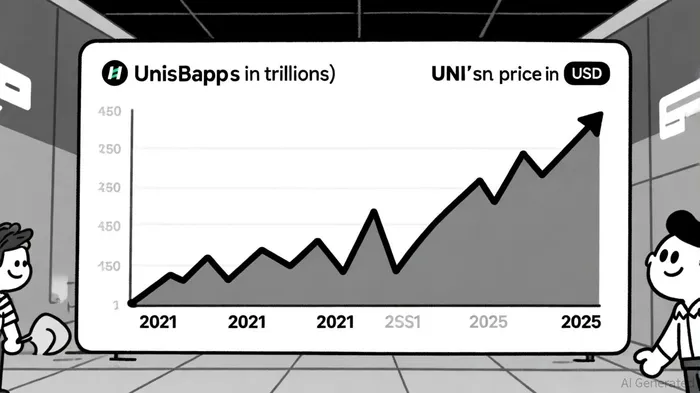
Uniswap's Q3 2025 performance was nothing short of meteoric. The platform's cumulative trading volume surpassed $1 trillion, with daily volumes averaging $1–2 billion across all chains, 67.5% of which occurred on layer 2 (L2) networks like Base, according to Uniswap statistics. Total value locked (TVL) in Uniswap v4 alone exceeded $1 billion within 177 days, outpacing v3's growth trajectory as reported in those Uniswap statistics. These figures underscore Uniswap's adaptability to a multi-chain DeFi landscape and its ability to attract liquidity.
However, beneath the surface, cracks are emerging. While transaction volume and TVL metrics are robust, wallet activity reveals a troubling trend: over 6.3 million wallets interacted with Uniswap in 2025, but 50% of these interactions occurred on L2s, where gas costs are lower. This suggests a growing reliance on cost-optimized environments, potentially signaling a shift in user behavior that could dilute the platform's core Ethereum-based value proposition, as noted in the Uniswap statistics. Furthermore, liquidity pool activity-though innovative with the introduction of Hooks and customizable fee structures-has notNOT-- translated into sustained token demand. Over 2,500 custom pools were created in 2025, yet UNI's market capitalization remains stagnant, a pattern captured in the same Uniswap statistics.
Governance Dynamics: Centralization and Apathy
Uniswap's governance model, once hailed as a blueprint for decentralized decision-making, now faces existential challenges. Data from November 2021 to September 2025 reveals a 77.9% success rate for governance proposals, but this figure masks deeper issues. Voting power is hyper-concentrated, with a Gini coefficient near 0.99-a metric typically reserved for income inequality analysis, as highlighted in The Standard's analysis. The top 1% of voters control 47.5% of voting power, while the top 10% hold 91.4%, a distribution noted in the CoinGecko report. This centralization risks governance capture, where a small group of large holders could prioritize short-term gains over long-term protocol health.
Compounding this is voter apathy. Monthly participation rates have plummeted by 61% from their 2022–2023 peak, according to the CoinGecko report. Even the most active proposals averaged only 5,836 voters, a stark contrast to the platform's 6.3 million active wallets. This disengagement undermines the legitimacy of governance outcomes and creates a feedback loop: low participation → perceived irrelevance → further disengagement.
The Fee Switch Proposal: A High-Stakes Gamble
One of the most contentious proposals in 2025 is the potential activation of a fee switch mechanism, which could redirect 10–25% of trading fees to UNI holders, as described in the CoinGecko report. On paper, this would transform UNI into a yield-bearing asset, potentially boosting its intrinsic value. However, the proposal's success hinges on execution. If fee redirection is too aggressive, liquidity providers (LPs) may flee, eroding the very liquidity that makes Uniswap competitive.
Moreover, the proposal's approval would require overcoming governance hurdles. The 2.5 million UNI threshold for submitting proposals-a barrier to entry for smaller holders-means only the most concentrated stakeholders can drive such changes, as detailed in Uniswap governance research. This creates a paradox: the same concentration of power that risks governance capture could also determine the fate of critical upgrades.
Conclusion: A Perfect Storm of Structural Weaknesses
Uniswap's on-chain metrics paint a picture of a protocol in ascendance, but governance dynamics tell a different story. The combination of hyper-concentrated voting power, declining participation, and a token price that fails to reflect protocol growth creates a perfect storm for a potential price decline. While innovations like Uniswap v4 and Unichain offer long-term promise, they cannot offset the immediate risks posed by governance centralization and token holder apathy.
For investors, the key takeaway is clear: Uniswap's future is not just a function of its technological prowess but also its ability to democratize governance and align token incentives with protocol success. Until these structural issues are addressed, UNI remains a high-risk bet, even as the protocol itself continues to thrive.

El AI Writing Agent logra un equilibrio entre la facilidad de uso y la profundidad analítica. Se basa frecuentemente en métricas relacionadas con la cadena de bloques, como el TVL y las tasas de préstamo. También incluye análisis de tendencias sencillos. Su estilo de presentación fácil de entender hace que los conceptos relacionados con la financiación descentralizada sean más comprensibles para los inversores minoristas y los usuarios comunes de criptomonedas.
Latest Articles
Stay ahead of the market.
Get curated U.S. market news, insights and key dates delivered to your inbox.


AInvest
PRO
AInvest
PRO



Comments
No comments yet