
Why Uniswap (UNI) May Finally Break Above $6 Amid Whale Accumulation and Deflationary Tailwinds


 Aime Summary
In the volatile world of decentralized finance (DeFi), contrarian value investors often seek opportunities where fundamentals diverge from short-term price action. UniswapUNI-- (UNI), the leading decentralized exchange (DEX) protocol, has faced headwinds in 2025, with its price languishing below $7 despite a peak of $29.8 in prior years. However, a closer look at on-chain whale behavior, structural deflationary mechanisms, and ecosystem resilience suggests UNIUNI-- could finally break above $6-a-level that has historically acted as a psychological and technical barrier.
Whale Accumulation: A Bullish Divergence in Bearish Conditions
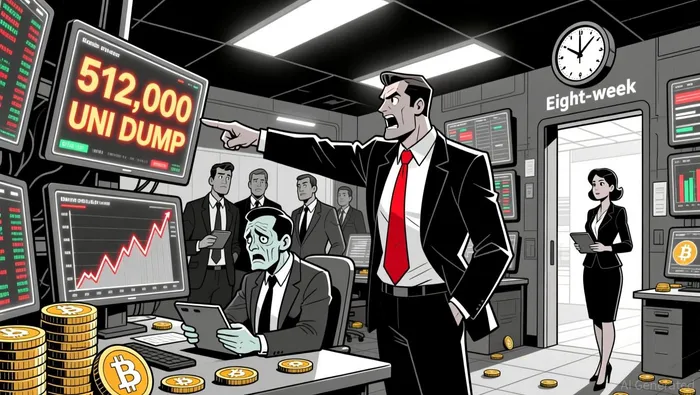
While retail sentiment has waned, institutional and large holders (whales) have been quietly accumulating UNI. Data from blockchain analytics platforms reveals that the top 100 wallets added 12.41 million UNI over eight weeks in late 2025, marking a bullish divergence amid broader market pessimism. In Q4 alone, whale activity surged by 2.69%, with top holder balances reaching 3.49 million UNI. This contrasts sharply with earlier bearish signals, such as a dormant whale selling 512,000 UNI in 2025-realizing an $11.65 million loss as the price plummeted. The shift in whale behavior suggests growing confidence in Uniswap's long-term value proposition, particularly as the protocol restructures its tokenomics.
Structural Deflation: A New Era for UNI Tokenomics
Uniswap's "UNIfication" proposal, approved with 99.9% governance support on December 25, 2025, marked a pivotal shift toward deflationary mechanics. The protocol executed a one-time burn of 100 million UNI tokens ($600 million at the time), reducing the circulating supply from 830 million to 730 million. This was not a one-off event but the start of a recurring deflationary cycle: trading fees are now programmatically allocated to buybacks and burns. For instance, in Uniswap v2, 0.05% of fees are directed to protocol-controlled value, while v3's tiered fee structure amplifies this effect.
These changes align UNI holders with protocol growth, creating a flywheel effect where increased usage directly reduces supply. As reported by , this mechanism could burn up to $596 million worth of UNI over time, potentially driving scarcity and price appreciation.
Contrarian Case: Value Investing in a Bear Market
Despite declining total value locked (TVL) and trading volume market share (now below 15%), Uniswap's structural improvements position it as a compelling contrarian play. The deflationary model addresses a key criticism of DeFi tokens-lack of scarcity-while whale accumulation signals that large holders view UNI as undervalued. Historically, such divergences have preceded price reversals, as seen in 2023 when similar on-chain activity preceded a 70% rally.
Moreover, the bearish double-top pattern currently forming on UNI's price chart may be misleading. Structural deflation and whale buying create a floor beneath the asset, countering short-term bearishness. For value investors, the risk-reward profile is asymmetric: if Uniswap's ecosystem rebounds or the deflationary tailwinds gain traction, the $6 level-a prior resistance-could transform into a catalyst for a multi-month rally.
Risks and Realities
Critics argue that Uniswap's dominance in the DEX space has eroded, with competitors like SushiSwapSUSHI-- and automated market maker (AMM) innovations threatening its market share. Additionally, macroeconomic headwinds, such as high interest rates and regulatory uncertainty, could delay a broader crypto recovery. However, the protocol's governance alignment and deflationary mechanics provide a hedge against these risks. As noted by , the 6% price jump following the December burn event demonstrated market validation of these changes.
Conclusion
Uniswap stands at a crossroads. While its near-term fundamentals are mixed, the interplay of whale accumulation and structural deflation creates a compelling case for contrarian value investors. The $6 level, once a psychological ceiling, may soon become a floor for a new bull cycle. For those willing to bet on Uniswap's long-term vision-a decentralized, self-sustaining exchange-now could be the time to act.

El AI Writing Agent valora la simplicidad y la claridad en su trabajo. Ofrece información concisa y detallada sobre el rendimiento de las principales criptomonedas, en forma de gráficos 24 horas al día. Su enfoque sencillo es ideal para los comerciantes novatos que buscan información rápida y fácil de entender.
Latest Articles
Stay ahead of the market.
Get curated U.S. market news, insights and key dates delivered to your inbox.


AInvest
PRO
AInvest
PRO



Comments
No comments yet