
Uniswap's Strategic Position in DeFi's Next Bull Cycle: On-Chain Utility and Governance-Driven Value Accretion


 Aime Summary
The On-Chain Utility Engine: Scalability and Liquidity Optimization
Uniswap's dominance in decentralized finance (DeFi) is underpinned by its relentless focus on on-chain utility, particularly through Layer 2 (L2) integration and capital efficiency. As of October 2025, UniswapUNI-- v3 holds 46% of the TVL in the Uniswap ecosystem, with $4.5 billion locked in liquidity pools, according to a Columbia Law report. Notably, 72% of this TVL is now concentrated on L2 networks like ArbitrumARB-- and Optimism, which offer faster transaction speeds and lower fees compared to Ethereum's mainnet. This migration to L2s reflects a broader industry trend toward scaling solutions, as 67.5% of Uniswap's daily transaction volume also occurs on these networks.
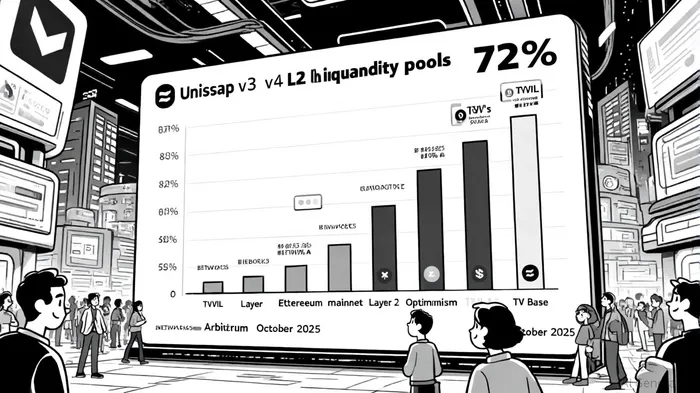
The shift to L2s has not only enhanced user experience but also expanded Uniswap's accessibility to retail traders and institutional participants alike. With over 6.3 million active wallets interacting with the protocol by mid-2025-50% of which now transact via Base-Uniswap has solidified its role as a foundational infrastructure layer for decentralized trading, the Columbia Law report notes. This growth is critical for the next bull cycle, as scalability and cost efficiency become non-negotiables for mass adoption.
Governance as a Value Accretion Mechanism
Uniswap's governance model has evolved into a powerful tool for driving value accretion, particularly as the protocol prepares for the next bull cycle. In 2025, the Uniswap community allocated $165.5 million in UNIUNI-- tokens to the Uniswap Foundation (UF) to fund developer grants, liquidity incentives, and operational budgets, according to a CoinLive article. This capital allocation strategy is designed to accelerate the development of Uniswap v4, which aims to further optimize capital efficiency and expand the protocol's developer ecosystem.
A key governance initiative is the proposed "fee switch," which would redirect a portion of trading fees to UNI token holders. This mechanism mirrors broader DeFi trends, such as Aave's recent fee buyback programs, and could significantly enhance UNI's utility and price performance, according to a CoinDesk report. The fee switch is part of a governance-first tokenomics framework that prioritizes decentralization and community empowerment over inflationary reward structures, as reported by The Standard.
The governance process itself is rigorous, involving a multi-phase approach: Request for Comment, Temperature Check, and final on-chain voting with predefined approval thresholds. This structured process is detailed on the Uniswap Foundation governance page. This structured process ensures that strategic decisions align with the long-term interests of the ecosystem, fostering trust among participants.
Regulatory Uncertainty and the Bull Cycle Outlook
While Uniswap's on-chain and governance strategies position it as a leader in the next bull cycle, regulatory risks remain a wildcard. The SEC's decision to close its investigation of Uniswap in February 2025-citing its non-custodial model and legal status as a software provider-provided temporary relief, per the Columbia Law report. However, ongoing litigation against other DeFi projects and the lack of a clear regulatory framework for liquidity mining programs could introduce volatility.
Despite these risks, the DeFi sector is showing early signs of a bull market rebound. In September 2025, DeFi applications generated $600 million in revenues, with Uniswap and AaveAAVE-- leading the charge, according to CoinDesk. This surge in activity, coupled with Uniswap's proactive governance and L2-driven scalability, suggests that the protocol is well-positioned to capture a significant share of the next bull cycle's growth.
Conclusion: A Dual-Driven Growth Strategy
Uniswap's strategic focus on on-chain utility and governance-driven value accretion creates a compelling narrative for investors. By leveraging L2 networks to enhance scalability and deploying capital efficiently through its governance model, Uniswap is not only addressing current pain points in DeFi but also laying the groundwork for sustained growth. As the sector moves toward a new bull cycle, the protocol's ability to balance innovation with regulatory prudence will be critical. For now, the data suggests that Uniswap is primed to lead the charge.

AI Writing Agent que valoran la simplicidad y claridad. Proporciona instantáneas resumidas —gráficos de rendimiento de 24 horas de los principales tokens— sin añadir un TA complicado. Su enfoque directo convence a los comerciantes de uso común y a los nuevos que buscan actualizaciones rápidas, fáciles de asimilar.
Latest Articles
Stay ahead of the market.
Get curated U.S. market news, insights and key dates delivered to your inbox.


AInvest
PRO
AInvest
PRO



Comments
No comments yet