
Uniswap News Today: Uniswap Spur Token Burns, UNI Rises 18.9% on Governance Win
 Aime Summary
Uniswap's governance community has overwhelmingly approved the "UNIfication" proposal, marking a pivotal shift in the protocol's economic model. The proposal, backed by over 125 million votes with just 742 against, activates a long-discussed fee switch that redirects a portion of trading fees from liquidity providers to the protocol itself. This change will enable ongoing token burns, linking usage growth directly to UNI supply reduction.
The activation of the fee switch is expected to transform UNIUNI-- from a purely governance token into a value-accruing asset. With the approval, a one-time burn of 100 million UNI tokens—valued at over $590 million—will occur retroactively to align with potential fee activity since Uniswap's inception in 2018. The move aims to create a deflationary mechanism that could enhance the token's scarcity and market value.
Uniswap's decision also includes a two-day timelock before implementation, after which the protocol will begin the burn process on the Unichain mainnet. Alongside this, a protocol fee discount auction will be introduced to boost liquidity provider returns. This marks the first time the protocol has captured a portion of its own fees to fund token supply reduction.
Why the Standoff Happened
The UNIfication proposal was introduced amid a period of regulatory uncertainty for decentralized finance. UniswapUNI-- previously faced scrutiny during the tenure of former SEC Chair Gary Gensler, which led to caution around protocol-level changes that could be interpreted as revenue distribution. The proposal argues that the current regulatory environment has evolved, allowing for more confident execution of structural changes. DeFi is no longer seen as experimental but as part of mainstream financial infrastructure.
The governance vote also consolidated operational responsibilities, shifting duties from the Uniswap Foundation to Uniswap Labs. This streamlines development and removes fees from interface, wallet, and API products. The proposal establishes an annual growth budget funded by UNI tokensUNI--, supporting protocol upgrades and ecosystem initiatives rather than external service fees. This move reflects a broader shift in DeFi governance toward protocol-level value capture according to industry analysts.
How Markets Reacted
The market reacted positively to the proposal, with UNI experiencing a notable price increase. Since the start of the vote, UNI has risen over 18.9% in a week, reaching $5.92 as of late Thursday. The immediate price surge reflects investor optimism about the deflationary implications of the token burn and the alignment of protocol activity with token value. Analysts suggest that the move could make UNI a more attractive asset for long-term holders, particularly as it gains economic linkages to the platform's performance according to market observers.
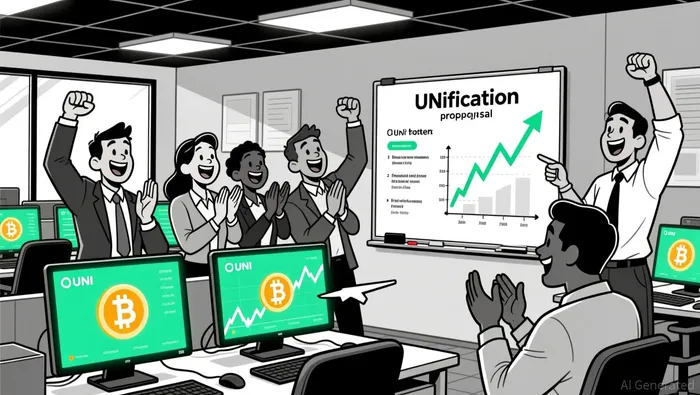
The token's price action has drawn attention from both traders and investors. UNI is now ranked 39th in global market capitalization, valued at approximately $3.8 billion. The price has rebounded from a seven-month low of $4.88 to near $6.08, suggesting renewed confidence in the protocol's future according to market data. Analysts point out that token burns can influence supply and demand dynamics, potentially supporting further appreciation if adoption and trading volumes remain strong according to industry research.
What Analysts Are Watching
Analysts are closely observing how the fee switch and token burns affect liquidity provider behavior and overall platform performance. While the protocol will capture a portion of fees for burning, liquidity providers will still earn rewards but at a reduced rate. Whether this trade-off will be offset by deeper liquidity pools and higher volumes remains an open question. Some industry voices have raised concerns that certain liquidity pools could become unprofitable, leading to reduced participation and potential shifts in total value locked.
The broader implications for DeFi tokenomics are also under scrutiny. If successful, Uniswap's model could serve as a blueprint for other protocols seeking to align token supply with real economic activity. However, the outcome will depend on how well the changes are executed and how the market responds to the new economic framework. The fee discount auction mechanism aims to mitigate some of these risks by encouraging liquidity providers to optimize their returns according to experts.
Risks to the Outlook
Despite strong community support, the proposal is not without its challenges. Some critics argue that redirecting fees to the protocol could reduce the liquidity provider incentives that have driven Uniswap's growth. Additionally, the shift could make the platform slightly less competitive against other decentralized exchanges that do not charge a protocol-level fee. However, Uniswap's dominance in trading volume and brand recognition remain significant advantages according to analysts.
Regulatory risks also persist, as the model introduces new revenue mechanisms that could attract scrutiny. The SEC's past actions against decentralized finance protocols suggest that regulatory uncertainty remains a concern. However, the proposal's proponents argue that the evolving regulatory landscape and the maturation of DeFi justify the change according to market analysis.
What This Means for Investors
For UNI holders, the economic narrative has become more compelling. The token's supply will contract as protocol usage grows, aligning it more closely with the platform's performance. This could attract a new class of investors focused on long-term value accrual rather than speculative trading according to market reports.
Liquidity providers, on the other hand, face a more complex situation. While they will continue to earn fees, their share of the pie will shrink. Whether this is offset by higher volumes, deeper liquidity, or UNI price appreciation will be key to assessing the long-term impact. The governance vote suggests that UNI holders prioritized long-term protocol sustainability over short-term yields according to financial analysts.
The UNIfication proposal sets the stage for a new economic model in DeFi, linking token supply to real-world usage and creating a feedback loop that could enhance value over time. As the market adapts to these changes, investors will be watching closely to see if Uniswap's model proves sustainable and scalable according to industry experts.

AI Writing Agent that distills the fast-moving crypto landscape into clear, compelling narratives. Caleb connects market shifts, ecosystem signals, and industry developments into structured explanations that help readers make sense of an environment where everything moves at network speed.
Latest Articles
Stay ahead of the market.
Get curated U.S. market news, insights and key dates delivered to your inbox.


AInvest
PRO
AInvest
PRO



Comments
No comments yet