
Uniswap News Today: Uniswap's 100M UNI Burn Ignites 38% Surge as Deflationary Overhaul Reshapes DeFi


 Aime Summary
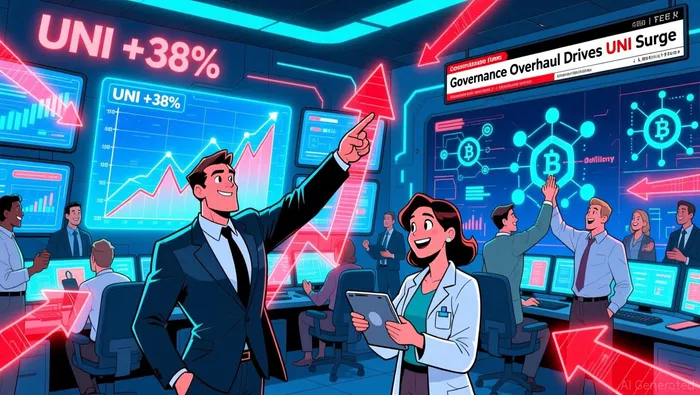
Uniswap's UNIUNI-- token surged nearly 38% following the launch of the "UNIfication" governance overhaul, a sweeping proposal aimed at redefining the decentralized exchange's economic model and governance structure. The initiative, jointly introduced by the UniswapUNI-- Foundation and Uniswap Labs on November 10–11, activates protocol fees, introduces a token burn mechanism, and consolidates key teams under a unified growth strategy, signaling a strategic shift to enhance UNI's utility and scarcity while aligning incentives across the ecosystem UNI Token Surges 38% on Proposed Fee Burns and Development Boost.
The proposal redirects trading fees from Uniswap's EthereumETH-- layer-2 network, Unichain, into a UNI burn mechanism, with annualized fees from Unichain already reaching $7.5 million since its launch nine months ago. A retroactive burn of 100 million UNI—roughly 16% of the circulating supply—would also occur, effectively compensating for fees that could have been burned if protocol fees had been active since the token's 2020 launch. This deflationary approach is expected to reduce UNI's supply, potentially boosting its value as demand for the governance token increases Uniswap Proposes Sweeping ‘UNIfication’ With UNI Burn and Protocol Fee Overhaul.
 The proposal includes a 20 million UNI Growth Budget, allocated quarterly starting in 2026, to fund decentralized finance (DeFi) innovation and ecosystem expansion. This budget, governed by a service provider agreement between Uniswap Labs and DUNA, ensures future initiatives align with token holder interests. The plan also locks in the original Uniswap v1 liquidity position for governance-owned "Unisocks," migrating it to Uniswap v4 on Unichain and burning the LP position to permanently fix the supply curve UNIfication.
Central to the proposal is the activation of Protocol Fee Discount Auctions (PFDA), a mechanism allowing traders to bid for fee discounts while internalizing maximal extractable value (MEV) into the burn process. Early analysis suggests this could enhance liquidity provider returns by $0.06–$0.26 for every $10,000 traded, a significant uplift in an ecosystem where returns typically range between -$1.00 and $1.00 for similar volumes UNIfication. Additionally, Uniswap v4 will evolve into an on-chain aggregator, collecting fees from external liquidity pools via "hooks," further diversifying revenue streams for the protocol.
The UNIfication proposal also marks a structural reorganization. Uniswap Labs will absorb the Uniswap Foundation's ecosystem teams, focusing exclusively on protocol growth while eliminating fees on its interface, wallet, and API. This shift aims to drive organic volume for the protocol, with future monetization directly tied to UNI holder interests. A five-member board, including co-founders Hayden Adams and Devin Walsh, will oversee the new structure, ensuring alignment with the decentralized Unincorporated Nonprofit Association (DUNA) Uniswap Proposes Sweeping ‘UNIfication’ With UNI Burn and Protocol Fee Overhaul.
Market reaction has been robust, with UNI surging to $9.70—a 38.5% increase—immediately after the proposal's announcement. The token's market capitalization surpassed $6 billion, propelling it to the 34th-largest cryptocurrency by market cap. Analysts attribute the rally to the proposal's deflationary mechanics and Uniswap's dominant position as the largest decentralized exchange, having processed $4 trillion in cumulative volume since its 2018 launch. The move also addresses long-standing concerns about token dilution, with the burn of 100 million UNI directly targeting supply-side dynamics Uniswap token jumps 38% after fee switch, burn proposal hits the table.
Uniswap's leadership emphasized that the overhaul positions the protocol as the "default decentralized exchange for tokenized value," leveraging its established infrastructure and governance framework to drive broader adoption. The proposal's success hinges on community approval via a decentralized autonomous organization (DAO) vote, with proponents highlighting its potential to solidify Uniswap's role in tokenized asset trading amid a maturing DeFi landscape UNI token soars 30% as Uniswap Labs and Foundation propose fee switch activation.

Stay ahead of the market.
Get curated U.S. market news, insights and key dates delivered to your inbox.


AInvest
PRO
AInvest
PRO



Comments
No comments yet