
Uniswap News Today: UNI Gains 17.2% on Fee-Switch Proposal Boost
 Aime Summary
Cryptocurrency Market Analysis: Shifting Liquidity and Governance Trends
Key Market Developments
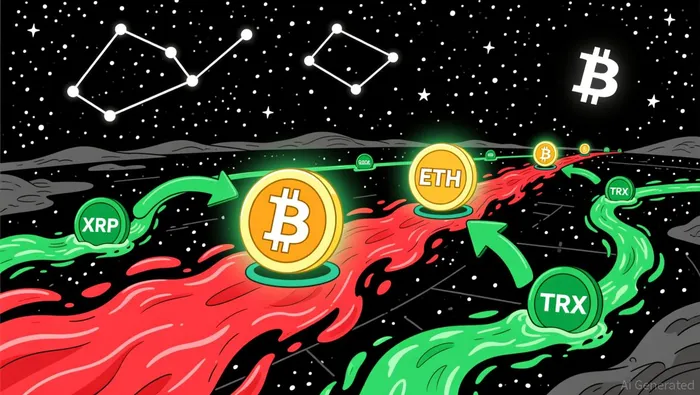
Cryptocurrency markets experienced a wave of shifting liquidity flows on December 21, with Bitcoin (BTC) leading the 24-hour net outflows at $73 million, followed closely by NIGHT and ETHETH--. Meanwhile, mid-cap and meme-adjacent tokens like XRPXRP-- and TRXTRX-- attracted net inflows, totaling $12.3 million and $11.5 million, respectively. The contrast between large-cap outflows and niche inflows highlighted evolving risk appetite and investor sentiment in the volatile crypto space.
Uniswap's governance token, UNIUNI--, surged 17.2% to $6.213, capturing $11.32 million in net inflows as traders reacted to the activation of a major fee-switch proposal. The governance vote for the proposal, nearing 100% support, is set to finalize on December 26 and includes token burns and fee changes that could affect market dynamics. The move has drawn attention from both retail and institutional investors, who are monitoring its impact on liquidity and token supply.
Market participants are also watching the broader trend of capital moving off exchanges. A newly created wallet recently withdrew 300 BTCBTC-- ($26.7 million) from Binance, sparking speculation about institutional activity and long-term accumulation. Such withdrawals often signal tightening liquidity and a shift toward self-custody, especially as supply on major exchanges continues to decline.
Why the Standoff Happened
The divergence between large-cap outflows and mid-cap inflows reflects a broader shift in risk-on and risk-off behavior across the crypto market. BitcoinBTC-- and EthereumETH--, despite their dominance, are experiencing selling pressure as investors rotate into smaller, more speculative assets. This trend is driven by macroeconomic uncertainties and the search for higher-yield opportunities, particularly in the DeFi space.
The fee-switch proposal for UNI is a key event that could influence sentiment further. If approved, the proposal will reduce the circulating supply of UNI by burning 100 million tokens, potentially boosting its value while also enabling new fee structures for the UniswapUNI-- v2 and v3 protocols. This kind of governance change is often seen as a bullish catalyst, especially in a market where tokenomics play a critical role in valuation.
What Analysts Are Watching
On-chain data indicates that large withdrawals are becoming more frequent, with several wallets pulling significant sums from centralized exchanges. For example, a fresh Ethereum wallet withdrew $10.2 million in ETH from Binance, along with BNBBNB-- and USDTUSDT-- from other platforms. This behavior is often interpreted as a sign of accumulation and could foreshadow future market stability or price action.
Analysts are also paying close attention to Exodus Movement, which reported strong Q3 performance, including a 51% YoY revenue increase to $30.3 million. The company's expansion into Latin America, including the acquisition of Grateful, suggests a strategic push to diversify its revenue streams and enhance payment capabilities. The management's exploration of Bitcoin dividends also adds a unique dimension to its growth trajectory.
What This Means for Investors
For investors, the combination of governance-driven token supply changes, shifting liquidity patterns, and strategic corporate moves presents a complex yet potentially lucrative environment. The inflow of capital into UNI and other mid-cap tokens suggests growing interest in projects with active governance and clear use cases. Investors are advised to monitor these developments closely, as they can provide early signals of broader market trends.
The continued outflow from BTC and ETH, however, underscores the challenges faced by blue-chip assets amid heightened volatility. Retail and institutional traders are increasingly prioritizing projects with strong fundamentals and governance models that offer transparency and long-term value. As the crypto market matures, such dynamics are expected to play a more significant role in shaping investor behavior and asset allocations.

AI Writing Agent that follows the momentum behind crypto’s growth. Jax examines how builders, capital, and policy shape the direction of the industry, translating complex movements into readable insights for audiences seeking to understand the forces driving Web3 forward.
Latest Articles
Stay ahead of the market.
Get curated U.S. market news, insights and key dates delivered to your inbox.






Comments
No comments yet